

Chemical Engineering and Processing - Process Intensification 163 (2021) 108359
9
before in E. sepositus).
Finally, it should be noted that it is the first time that a study on the
optimization and comparison of MAE procedure for the extraction of
saponins compounds from starfish.
Author contributions
Fouzia Houma Bachari, Didier Hauchard, Mohamed Chibane and
Vincent Ferri` eres designed the study. Bouchra Dahmoune, Jean-Paul
Gu´ egan, Thomas Vives, and Philippe J´ ehan performed the experiments. Farid Dahmoune and Lotfi Mouni participated in study design,
data collection and analysis. Bouchra Dahmoune and Farid Dahmoune
wrote the manuscript Cherifa Akrour Aissou with the authors revised the
manuscript.
Declaration of Competing Interest
The authors declare no conflict of interest.
Acknowledgments
We would like to express our sincerest thanks to the Algerian Ministry of Higher Education and Scientific Research, and Campus France
for their scholarship within the framework of Algerian-French cooperation PROFAS B+.
We thank the staff of the laboratories who participated in the realization of this works particularly Isabelle Soutrel for their valuable
technical assistance and support, and for providing facilities to realize
this search.
Appendix A. Supplementary data
Supplementary material related to this article can be found, in the
online version, at doi:https://doi.org/10.1016/j.cep.2021.108359.[1]
References
[1] C.S. Eskilsson, E. Bjorklund, Analytical-scale microwave-assisted extraction,
J. Chromatogr. A 902 (2000) 227–250, doi.org/0.1016/s0021-9673(00)0092100923.
[2] J.H. Kwon, J.M.R. B´ elanger, J.R.J. Pare, V.A. Yaylayan, Application of the
microwave-assisted process (MAP™) to the fast extraction of ginseng saponins,
Food Res. Int. 36 (2003) 491–498, https://doi.org/10.1016/S0963-9969(02)
00197-7.
[3] F. Dahmoune, L. Boulekbachea, K. Moussia, O. Aouna, G. Giorgia Spignob,
K. Madani, Valorization of Citrus limon residues for the recovery of antioxidants:
evaluation and optimization of microwave and ultrasound application to solvent
extraction, Ind. Crops Prod. 50 (2013) 77–88, https://doi.org/10.1016/j.
indcrop.2013.07.013.
[4] F. Dahmoune, G. Spigno, K. Moussai, H. Remini, A. Cherbal, K. Madani, Pistacia
lentiscus leaves as a source of phenolic compounds: microwave-assisted extraction
optimized and compared with ultrasound-assisted and conventional solvent
extraction, Ind. Crops Prod. 61 (2014) 31–40, https://doi.org/10.1016/j.
indcrop.2014.06.035.
[5] B.F. Achachlouei, S.Y. Azadmard-Damirchi, Z.R. Shaddel, Microwave pretreatment
as a promising strategy for increment of nutraceutical content and extraction yield
of oil from milk thistle seed, Ind. Crop. Prod. 128 (2019) 527–533, https://doi.org/
10.1016/j.indcrop.2018.11.034.
[6] F. De Simone, A. Dini, E. Finamore, L. Minale, C. Pizza, R. Ruccio, F. Zollo, Starfish
saponins. Part 5. Structure of seposituside A, a novel steroidal Glycoside from the
starfish Echinaster sepositus, J. Chem. Soc. Perkin Trans. I (1981) 1855–1862,
https://doi.org/10.1039/p19810001855.
[7] R. Riccio, F. De Simone, A. Dini, L. Minale, C. Pizza, F. Senatore, F. Zollo, Starfish
saponins VI-unique. 22, 23-epoxysteroids, Cyclic Glycoside, Minor constituents
from Echinaster sepositus, Tetrahedron Lett. 22 (16) (1981) 1557–1560, https://doi.
org/10.1016/S0040-4039(01)90377-6.
[8] K. Hostettmann, A. Martson, Chemistry & pharmacology of natural products.
Saponins, Cambridge University Press, New York, 1995.
[9] M.S. Maier, Biological activities of sulfated glycosides from echinoderms, Stud.
Nat. Prod. Chem. 35 (2008) 311–354, https://doi.org/10.1016/S1572-5995(08)
80008-7.
[10] H.F. Tang, H.Y. Yi, L. Li, P. Sun, S.Q. Zhang, Y.P. Zhao, Bioactive asterosaponins
from the starfish Culcita novaeguineae, J. Nat. Prod. 68 (2005), https://doi.org/
10.1021/np0401617, 337–34.
[11] A.A. Kicha, A.I. Kalinovsky, T.V. Malyarenko, N.V. Ivanchina, P.S. Dmitrenok, E.
S. Menchinskaya, E.A. Yurchenko, E.A. Pislyagin, D.L. Aminin, T.T.T. Huong, F.
Q. Long, V.K. Stonik, Cyclic steroid glycosides from the starfish Echinaster
luzonicus: structures and immunomodulatory activities, J. Nat. Prod. 7 (2015)
1397–1405, https://doi.org/10.1021/acs.jnatprod.5b00332.
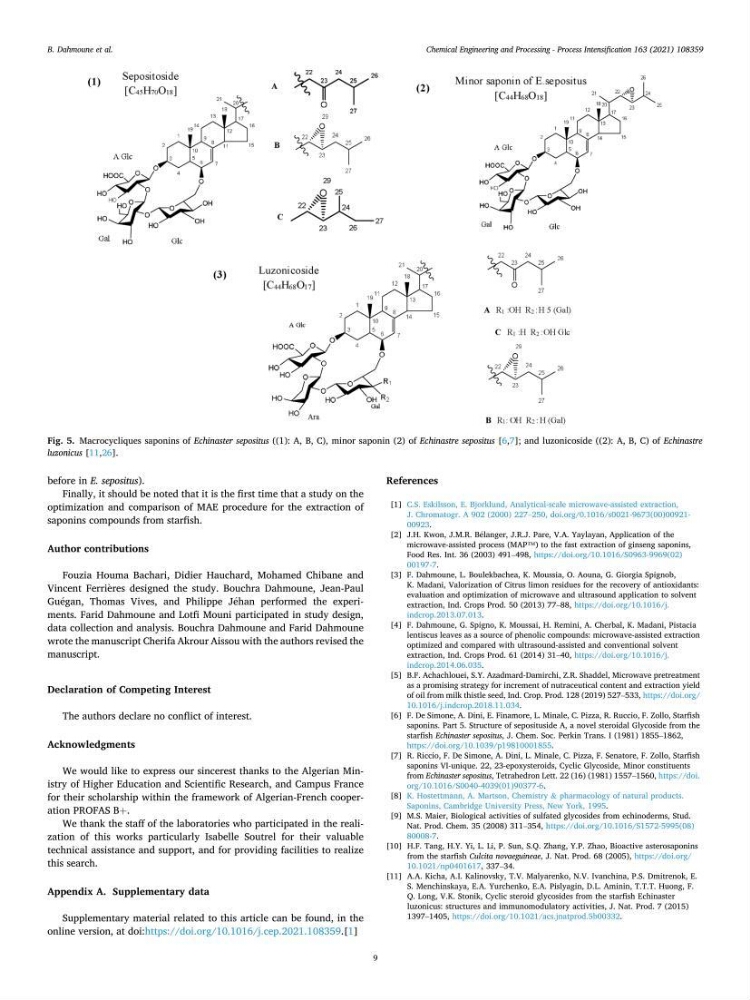
Fig. 5. Macrocycliques saponins of Echinaster sepositus ((1): A, B, C), minor saponin (2) of Echinastre sepositus [6,7]; and luzonicoside ((2): A, B, C) of Echinastre
luzonicus [11,26].
B. Dahmoune et al.
9
before in E. sepositus).
Finally, it should be noted that it is the first time that a study on the
optimization and comparison of MAE procedure for the extraction of
saponins compounds from starfish.
Author contributions
Fouzia Houma Bachari, Didier Hauchard, Mohamed Chibane and
Vincent Ferri` eres designed the study. Bouchra Dahmoune, Jean-Paul
Gu´ egan, Thomas Vives, and Philippe J´ ehan performed the experiments. Farid Dahmoune and Lotfi Mouni participated in study design,
data collection and analysis. Bouchra Dahmoune and Farid Dahmoune
wrote the manuscript Cherifa Akrour Aissou with the authors revised the
manuscript.
Declaration of Competing Interest
The authors declare no conflict of interest.
Acknowledgments
We would like to express our sincerest thanks to the Algerian Ministry of Higher Education and Scientific Research, and Campus France
for their scholarship within the framework of Algerian-French cooperation PROFAS B+.
We thank the staff of the laboratories who participated in the realization of this works particularly Isabelle Soutrel for their valuable
technical assistance and support, and for providing facilities to realize
this search.
Appendix A. Supplementary data
Supplementary material related to this article can be found, in the
online version, at doi:https://doi.org/10.1016/j.cep.2021.108359.[1]
References
[1] C.S. Eskilsson, E. Bjorklund, Analytical-scale microwave-assisted extraction,
J. Chromatogr. A 902 (2000) 227–250, doi.org/0.1016/s0021-9673(00)0092100923.
[2] J.H. Kwon, J.M.R. B´ elanger, J.R.J. Pare, V.A. Yaylayan, Application of the
microwave-assisted process (MAP™) to the fast extraction of ginseng saponins,
Food Res. Int. 36 (2003) 491–498, https://doi.org/10.1016/S0963-9969(02)
00197-7.
[3] F. Dahmoune, L. Boulekbachea, K. Moussia, O. Aouna, G. Giorgia Spignob,
K. Madani, Valorization of Citrus limon residues for the recovery of antioxidants:
evaluation and optimization of microwave and ultrasound application to solvent
extraction, Ind. Crops Prod. 50 (2013) 77–88, https://doi.org/10.1016/j.
indcrop.2013.07.013.
[4] F. Dahmoune, G. Spigno, K. Moussai, H. Remini, A. Cherbal, K. Madani, Pistacia
lentiscus leaves as a source of phenolic compounds: microwave-assisted extraction
optimized and compared with ultrasound-assisted and conventional solvent
extraction, Ind. Crops Prod. 61 (2014) 31–40, https://doi.org/10.1016/j.
indcrop.2014.06.035.
[5] B.F. Achachlouei, S.Y. Azadmard-Damirchi, Z.R. Shaddel, Microwave pretreatment
as a promising strategy for increment of nutraceutical content and extraction yield
of oil from milk thistle seed, Ind. Crop. Prod. 128 (2019) 527–533, https://doi.org/
10.1016/j.indcrop.2018.11.034.
[6] F. De Simone, A. Dini, E. Finamore, L. Minale, C. Pizza, R. Ruccio, F. Zollo, Starfish
saponins. Part 5. Structure of seposituside A, a novel steroidal Glycoside from the
starfish Echinaster sepositus, J. Chem. Soc. Perkin Trans. I (1981) 1855–1862,
https://doi.org/10.1039/p19810001855.
[7] R. Riccio, F. De Simone, A. Dini, L. Minale, C. Pizza, F. Senatore, F. Zollo, Starfish
saponins VI-unique. 22, 23-epoxysteroids, Cyclic Glycoside, Minor constituents
from Echinaster sepositus, Tetrahedron Lett. 22 (16) (1981) 1557–1560, https://doi.
org/10.1016/S0040-4039(01)90377-6.
[8] K. Hostettmann, A. Martson, Chemistry & pharmacology of natural products.
Saponins, Cambridge University Press, New York, 1995.
[9] M.S. Maier, Biological activities of sulfated glycosides from echinoderms, Stud.
Nat. Prod. Chem. 35 (2008) 311–354, https://doi.org/10.1016/S1572-5995(08)
80008-7.
[10] H.F. Tang, H.Y. Yi, L. Li, P. Sun, S.Q. Zhang, Y.P. Zhao, Bioactive asterosaponins
from the starfish Culcita novaeguineae, J. Nat. Prod. 68 (2005), https://doi.org/
10.1021/np0401617, 337–34.
[11] A.A. Kicha, A.I. Kalinovsky, T.V. Malyarenko, N.V. Ivanchina, P.S. Dmitrenok, E.
S. Menchinskaya, E.A. Yurchenko, E.A. Pislyagin, D.L. Aminin, T.T.T. Huong, F.
Q. Long, V.K. Stonik, Cyclic steroid glycosides from the starfish Echinaster
luzonicus: structures and immunomodulatory activities, J. Nat. Prod. 7 (2015)
1397–1405, https://doi.org/10.1021/acs.jnatprod.5b00332.
Fig. 5. Macrocycliques saponins of Echinaster sepositus ((1): A, B, C), minor saponin (2) of Echinastre sepositus [6,7]; and luzonicoside ((2): A, B, C) of Echinastre
luzonicus [11,26].
B. Dahmoune et al.