

Chemical Engineering and Processing - Process Intensification 163 (2021) 108359
7
g
− 1
. The results suggested that methanol in this condition could offer the
suitable vapor pressure, viscosity and surface tension of extraction solvent for the saponin-enriched extract.
In conclusion, carrying out the optimized MAE produced a saponins
yield of 60.3 ± 0.6 mg g
− 1
, that is very close to the value predicted
which confirms the validity of the model (Eq. (4).
3.2. Comparison between MAE, UAE and CSE
The efficiency of extraction using MAE was compared to other
emerging extraction techniques (UAE and CSE).
Considering the optimal conditions, the results show that MAE was
able to give a higher yield of saponins (60.3 ± 0.6 mg g
− 1
), followed by
the UAE with (18.5 ± 0.2 mg g
− 1
), and the CSE (7.7 ± 0.2 mg g
− 1
)
(<0.005). In addition, the extraction duration of MAE (3 min) was
shorter than that of UAE (25 min) or CSE (24 h). From the results we can
deduce that extraction efficiency by microwave was 3.3 times more than
UAE extraction and was 7.8 times more than CSE extraction.
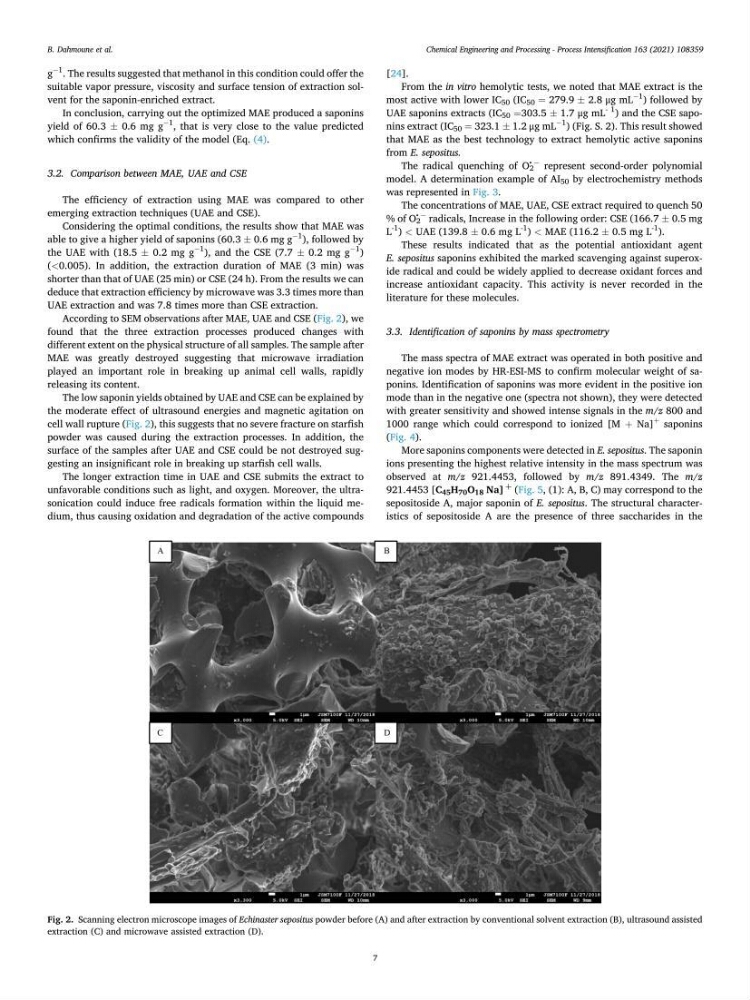
According to SEM observations after MAE, UAE and CSE (Fig. 2), we
found that the three extraction processes produced changes with
different extent on the physical structure of all samples. The sample after
MAE was greatly destroyed suggesting that microwave irradiation
played an important role in breaking up animal cell walls, rapidly
releasing its content.
The low saponin yields obtained by UAE and CSE can be explained by
the moderate effect of ultrasound energies and magnetic agitation on
cell wall rupture (Fig. 2), this suggests that no severe fracture on starfish
powder was caused during the extraction processes. In addition, the
surface of the samples after UAE and CSE could be not destroyed suggesting an insignificant role in breaking up starfish cell walls.
The longer extraction time in UAE and CSE submits the extract to
unfavorable conditions such as light, and oxygen. Moreover, the ultrasonication could induce free radicals formation within the liquid medium, thus causing oxidation and degradation of the active compounds
[24].
From the in vitro hemolytic tests, we noted that MAE extract is the
most active with lower IC 50 (IC 50 = 279.9 ± 2.8 μg mL
− 1
) followed by
UAE saponins extracts (IC 50 =303.5 ± 1.7 μg mL
- 1
) and the CSE saponins extract (IC 50 = 323.1 ± 1.2 μg mL
− 1
) (Fig. S. 2). This result showed
that MAE as the best technology to extract hemolytic active saponins
from E. sepositus.
The radical quenching of O 2
• −
represent second-order polynomial
model. A determination example of AI 50 by electrochemistry methods
was represented in Fig. 3.
The concentrations of MAE, UAE, CSE extract required to quench 50
% of O 2
• −
radicals, Increase in the following order: CSE (166.7 ± 0.5 mg
L
-1
) < UAE (139.8 ± 0.6 mg L
-1
) < MAE (116.2 ± 0.5 mg L
-1
).
These results indicated that as the potential antioxidant agent
E. sepositus saponins exhibited the marked scavenging against superoxide radical and could be widely applied to decrease oxidant forces and
increase antioxidant capacity. This activity is never recorded in the
literature for these molecules.
3.3. Identification of saponins by mass spectrometry
The mass spectra of MAE extract was operated in both positive and
negative ion modes by HR-ESI-MS to confirm molecular weight of saponins. Identification of saponins was more evident in the positive ion
mode than in the negative one (spectra not shown), they were detected
with greater sensitivity and showed intense signals in the m/z 800 and
1000 range which could correspond to ionized [M + Na]
+
saponins
(Fig. 4).
More saponins components were detected in E. sepositus. The saponin
ions presenting the highest relative intensity in the mass spectrum was
observed at m/z 921.4453, followed by m/z 891.4349. The m/z
921.4453 [C 45 H 70 O 18 Na]
þ
(Fig. 5, (1): A, B, C) may correspond to the
sepositoside A, major saponin of E. sepositus. The structural characteristics of sepositoside A are the presence of three saccharides in the
Fig. 2. Scanning electron microscope images of Echinaster sepositus powder before (A) and after extraction by conventional solvent extraction (B), ultrasound assisted
extraction (C) and microwave assisted extraction (D).
B. Dahmoune et al.
7
g
− 1
. The results suggested that methanol in this condition could offer the
suitable vapor pressure, viscosity and surface tension of extraction solvent for the saponin-enriched extract.
In conclusion, carrying out the optimized MAE produced a saponins
yield of 60.3 ± 0.6 mg g
− 1
, that is very close to the value predicted
which confirms the validity of the model (Eq. (4).
3.2. Comparison between MAE, UAE and CSE
The efficiency of extraction using MAE was compared to other
emerging extraction techniques (UAE and CSE).
Considering the optimal conditions, the results show that MAE was
able to give a higher yield of saponins (60.3 ± 0.6 mg g
− 1
), followed by
the UAE with (18.5 ± 0.2 mg g
− 1
), and the CSE (7.7 ± 0.2 mg g
− 1
)
(<0.005). In addition, the extraction duration of MAE (3 min) was
shorter than that of UAE (25 min) or CSE (24 h). From the results we can
deduce that extraction efficiency by microwave was 3.3 times more than
UAE extraction and was 7.8 times more than CSE extraction.
According to SEM observations after MAE, UAE and CSE (Fig. 2), we
found that the three extraction processes produced changes with
different extent on the physical structure of all samples. The sample after
MAE was greatly destroyed suggesting that microwave irradiation
played an important role in breaking up animal cell walls, rapidly
releasing its content.
The low saponin yields obtained by UAE and CSE can be explained by
the moderate effect of ultrasound energies and magnetic agitation on
cell wall rupture (Fig. 2), this suggests that no severe fracture on starfish
powder was caused during the extraction processes. In addition, the
surface of the samples after UAE and CSE could be not destroyed suggesting an insignificant role in breaking up starfish cell walls.
The longer extraction time in UAE and CSE submits the extract to
unfavorable conditions such as light, and oxygen. Moreover, the ultrasonication could induce free radicals formation within the liquid medium, thus causing oxidation and degradation of the active compounds
[24].
From the in vitro hemolytic tests, we noted that MAE extract is the
most active with lower IC 50 (IC 50 = 279.9 ± 2.8 μg mL
− 1
) followed by
UAE saponins extracts (IC 50 =303.5 ± 1.7 μg mL
- 1
) and the CSE saponins extract (IC 50 = 323.1 ± 1.2 μg mL
− 1
) (Fig. S. 2). This result showed
that MAE as the best technology to extract hemolytic active saponins
from E. sepositus.
The radical quenching of O 2
• −
represent second-order polynomial
model. A determination example of AI 50 by electrochemistry methods
was represented in Fig. 3.
The concentrations of MAE, UAE, CSE extract required to quench 50
% of O 2
• −
radicals, Increase in the following order: CSE (166.7 ± 0.5 mg
L
-1
) < UAE (139.8 ± 0.6 mg L
-1
) < MAE (116.2 ± 0.5 mg L
-1
).
These results indicated that as the potential antioxidant agent
E. sepositus saponins exhibited the marked scavenging against superoxide radical and could be widely applied to decrease oxidant forces and
increase antioxidant capacity. This activity is never recorded in the
literature for these molecules.
3.3. Identification of saponins by mass spectrometry
The mass spectra of MAE extract was operated in both positive and
negative ion modes by HR-ESI-MS to confirm molecular weight of saponins. Identification of saponins was more evident in the positive ion
mode than in the negative one (spectra not shown), they were detected
with greater sensitivity and showed intense signals in the m/z 800 and
1000 range which could correspond to ionized [M + Na]
+
saponins
(Fig. 4).
More saponins components were detected in E. sepositus. The saponin
ions presenting the highest relative intensity in the mass spectrum was
observed at m/z 921.4453, followed by m/z 891.4349. The m/z
921.4453 [C 45 H 70 O 18 Na]
þ
(Fig. 5, (1): A, B, C) may correspond to the
sepositoside A, major saponin of E. sepositus. The structural characteristics of sepositoside A are the presence of three saccharides in the
Fig. 2. Scanning electron microscope images of Echinaster sepositus powder before (A) and after extraction by conventional solvent extraction (B), ultrasound assisted
extraction (C) and microwave assisted extraction (D).
B. Dahmoune et al.