

Chemical Engineering and Processing - Process Intensification 163 (2021) 108359
6
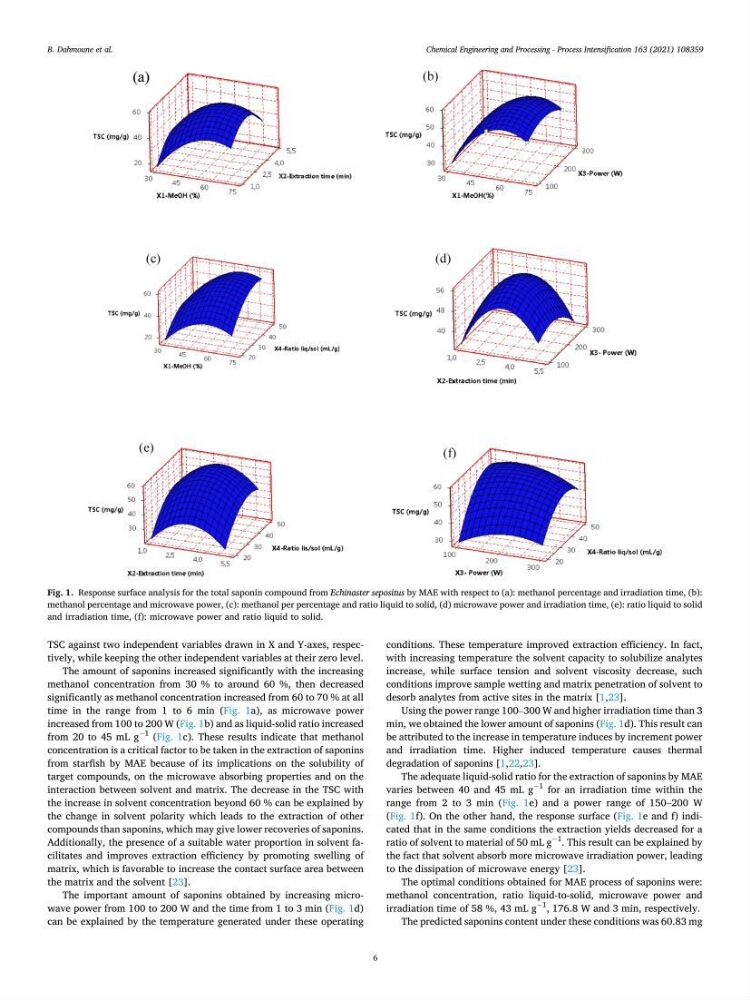
TSC against two independent variables drawn in X and Y-axes, respectively, while keeping the other independent variables at their zero level.
The amount of saponins increased significantly with the increasing
methanol concentration from 30 % to around 60 %, then decreased
significantly as methanol concentration increased from 60 to 70 % at all
time in the range from 1 to 6 min (Fig. 1a), as microwave power
increased from 100 to 200 W (Fig. 1b) and as liquid-solid ratio increased
from 20 to 45 mL g
− 1
(Fig. 1c). These results indicate that methanol
concentration is a critical factor to be taken in the extraction of saponins
from starfish by MAE because of its implications on the solubility of
target compounds, on the microwave absorbing properties and on the
interaction between solvent and matrix. The decrease in the TSC with
the increase in solvent concentration beyond 60 % can be explained by
the change in solvent polarity which leads to the extraction of other
compounds than saponins, which may give lower recoveries of saponins.
Additionally, the presence of a suitable water proportion in solvent facilitates and improves extraction efficiency by promoting swelling of
matrix, which is favorable to increase the contact surface area between
the matrix and the solvent [23].
The important amount of saponins obtained by increasing microwave power from 100 to 200 W and the time from 1 to 3 min (Fig. 1d)
can be explained by the temperature generated under these operating
conditions. These temperature improved extraction efficiency. In fact,
with increasing temperature the solvent capacity to solubilize analytes
increase, while surface tension and solvent viscosity decrease, such
conditions improve sample wetting and matrix penetration of solvent to
desorb analytes from active sites in the matrix [1,23].
Using the power range 100–300 W and higher irradiation time than 3
min, we obtained the lower amount of saponins (Fig. 1d). This result can
be attributed to the increase in temperature induces by increment power
and irradiation time. Higher induced temperature causes thermal
degradation of saponins [1,22,23].
The adequate liquid-solid ratio for the extraction of saponins by MAE
varies between 40 and 45 mL g
− 1
for an irradiation time within the
range from 2 to 3 min (Fig. 1e) and a power range of 150–200 W
(Fig. 1f). On the other hand, the response surface (Fig. 1e and f) indicated that in the same conditions the extraction yields decreased for a
ratio of solvent to material of 50 mL g
− 1
. This result can be explained by
the fact that solvent absorb more microwave irradiation power, leading
to the dissipation of microwave energy [23].
The optimal conditions obtained for MAE process of saponins were:
methanol concentration, ratio liquid-to-solid, microwave power and
irradiation time of 58 %, 43 mL g
− 1
, 176.8 W and 3 min, respectively.
The predicted saponins content under these conditions was 60.83 mg
Fig. 1. Response surface analysis for the total saponin compound from Echinaster sepositus by MAE with respect to (a): methanol percentage and irradiation time, (b):
methanol percentage and microwave power, (c): methanol per percentage and ratio liquid to solid, (d) microwave power and irradiation time, (e): ratio liquid to solid
and irradiation time, (f): microwave power and ratio liquid to solid.
B. Dahmoune et al.
6
TSC against two independent variables drawn in X and Y-axes, respectively, while keeping the other independent variables at their zero level.
The amount of saponins increased significantly with the increasing
methanol concentration from 30 % to around 60 %, then decreased
significantly as methanol concentration increased from 60 to 70 % at all
time in the range from 1 to 6 min (Fig. 1a), as microwave power
increased from 100 to 200 W (Fig. 1b) and as liquid-solid ratio increased
from 20 to 45 mL g
− 1
(Fig. 1c). These results indicate that methanol
concentration is a critical factor to be taken in the extraction of saponins
from starfish by MAE because of its implications on the solubility of
target compounds, on the microwave absorbing properties and on the
interaction between solvent and matrix. The decrease in the TSC with
the increase in solvent concentration beyond 60 % can be explained by
the change in solvent polarity which leads to the extraction of other
compounds than saponins, which may give lower recoveries of saponins.
Additionally, the presence of a suitable water proportion in solvent facilitates and improves extraction efficiency by promoting swelling of
matrix, which is favorable to increase the contact surface area between
the matrix and the solvent [23].
The important amount of saponins obtained by increasing microwave power from 100 to 200 W and the time from 1 to 3 min (Fig. 1d)
can be explained by the temperature generated under these operating
conditions. These temperature improved extraction efficiency. In fact,
with increasing temperature the solvent capacity to solubilize analytes
increase, while surface tension and solvent viscosity decrease, such
conditions improve sample wetting and matrix penetration of solvent to
desorb analytes from active sites in the matrix [1,23].
Using the power range 100–300 W and higher irradiation time than 3
min, we obtained the lower amount of saponins (Fig. 1d). This result can
be attributed to the increase in temperature induces by increment power
and irradiation time. Higher induced temperature causes thermal
degradation of saponins [1,22,23].
The adequate liquid-solid ratio for the extraction of saponins by MAE
varies between 40 and 45 mL g
− 1
for an irradiation time within the
range from 2 to 3 min (Fig. 1e) and a power range of 150–200 W
(Fig. 1f). On the other hand, the response surface (Fig. 1e and f) indicated that in the same conditions the extraction yields decreased for a
ratio of solvent to material of 50 mL g
− 1
. This result can be explained by
the fact that solvent absorb more microwave irradiation power, leading
to the dissipation of microwave energy [23].
The optimal conditions obtained for MAE process of saponins were:
methanol concentration, ratio liquid-to-solid, microwave power and
irradiation time of 58 %, 43 mL g
− 1
, 176.8 W and 3 min, respectively.
The predicted saponins content under these conditions was 60.83 mg
Fig. 1. Response surface analysis for the total saponin compound from Echinaster sepositus by MAE with respect to (a): methanol percentage and irradiation time, (b):
methanol percentage and microwave power, (c): methanol per percentage and ratio liquid to solid, (d) microwave power and irradiation time, (e): ratio liquid to solid
and irradiation time, (f): microwave power and ratio liquid to solid.
B. Dahmoune et al.