

Conmy, Del Castillo, Downing, and Chen
196
16 emission wavelengths (WetLabs Inc SAFIre – Spectral Absorption and Fluorescence
Instrument) thereby producing coincident measurements of CDOM, protein, and chlorophyll fluorescence (Del Castillo et al., 2001; Conmy et al., 2004). These types of flash
lamp, interference filter-based instruments were more affordable and less cumbersome
than fiber optic designs. In addition, another unique design was developed by Physical
Sciences, Inc (Mazel, 1997). It was a submersible, handheld and negatively buoyant design
for diver operation. It utilized a spectrometer, measuring fluorescence between 250 and
750 nm using a halogen bulb, filters for selecting excitation wavelength, interference filters
for emission wavelength selection, and a grating/charge-coupled device (CCD) detector
combo. This sensor was optimized for fine-scale spatial resolution in ocean environments.
Laser-induced fluorescence (LIF) systems became popular in the late 1990s (Hoge et al.,
1998). Systems like the LIF used by Chen (1999) utilized a UV N 2 laser at excitation =
337 nm, 30 m of fiber optic cable and a sensitive detector to measure bulk-integrated fluorescence between 350 and 550 nm with a 0 ns time delay. A probe could be placed directly
in the ocean or in a flowing seawater system (water pumped from ~3 m deep in the ship’s
bow). This system had the advantage of carrying out time-resolved fluorescence measurements and detecting pyrene, a polycyclic aromatic hydrocarbon, with a detection limit
of 5 parts per trillion in seawater (Rudnick et al., 1998). Later designs include a system
25
20
10 15
FLU
5
3 0
0
0
(B)
500
Depth (m)
1000
1500
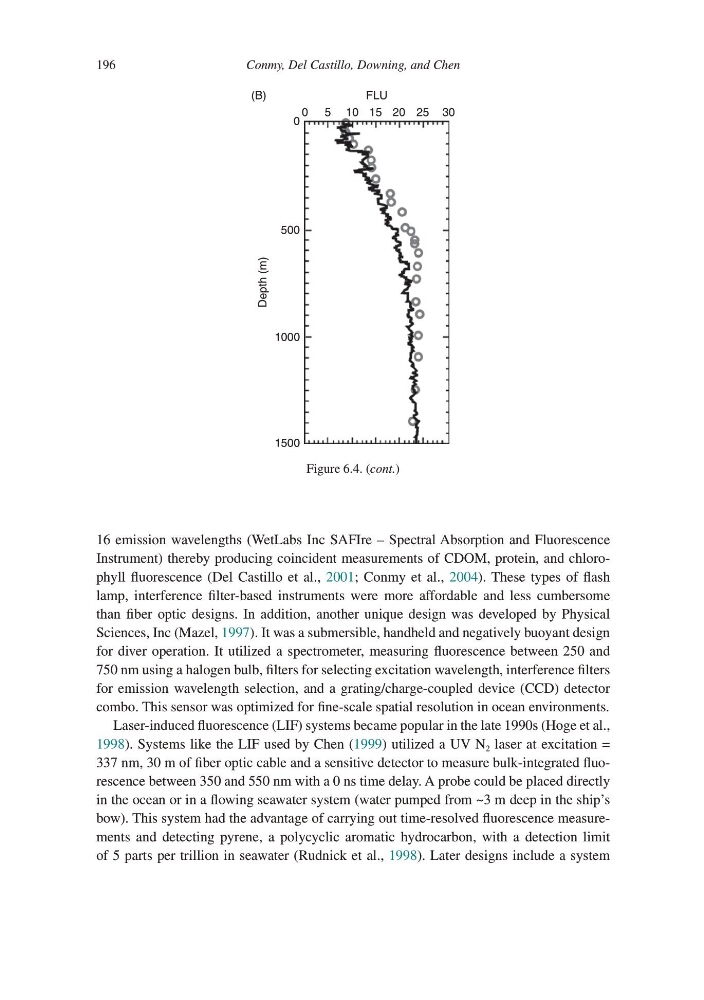
Figure 6.4. (cont.)
196
16 emission wavelengths (WetLabs Inc SAFIre – Spectral Absorption and Fluorescence
Instrument) thereby producing coincident measurements of CDOM, protein, and chlorophyll fluorescence (Del Castillo et al., 2001; Conmy et al., 2004). These types of flash
lamp, interference filter-based instruments were more affordable and less cumbersome
than fiber optic designs. In addition, another unique design was developed by Physical
Sciences, Inc (Mazel, 1997). It was a submersible, handheld and negatively buoyant design
for diver operation. It utilized a spectrometer, measuring fluorescence between 250 and
750 nm using a halogen bulb, filters for selecting excitation wavelength, interference filters
for emission wavelength selection, and a grating/charge-coupled device (CCD) detector
combo. This sensor was optimized for fine-scale spatial resolution in ocean environments.
Laser-induced fluorescence (LIF) systems became popular in the late 1990s (Hoge et al.,
1998). Systems like the LIF used by Chen (1999) utilized a UV N 2 laser at excitation =
337 nm, 30 m of fiber optic cable and a sensitive detector to measure bulk-integrated fluorescence between 350 and 550 nm with a 0 ns time delay. A probe could be placed directly
in the ocean or in a flowing seawater system (water pumped from ~3 m deep in the ship’s
bow). This system had the advantage of carrying out time-resolved fluorescence measurements and detecting pyrene, a polycyclic aromatic hydrocarbon, with a detection limit
of 5 parts per trillion in seawater (Rudnick et al., 1998). Later designs include a system
25
20
10 15
FLU
5
3 0
0
0
(B)
500
Depth (m)
1000
1500
Figure 6.4. (cont.)