

Optical Spectroscopy Instrumentation Design
175
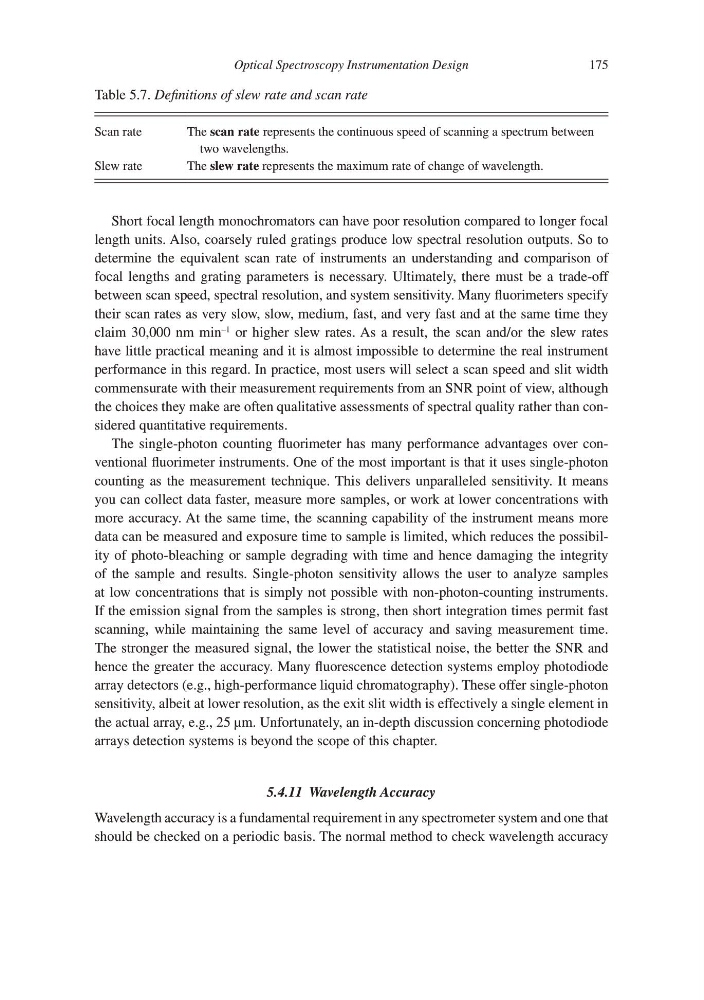
Table 5.7. Definitions of slew rate and scan rate
Scan rate
The scan rate represents the continuous speed of scanning a spectrum between
two wavelengths.
Slew rate
The slew rate represents the maximum rate of change of wavelength.
Short focal length monochromators can have poor resolution compared to longer focal
length units. Also, coarsely ruled gratings produce low spectral resolution outputs. So to
determine the equivalent scan rate of instruments an understanding and comparison of
focal lengths and grating parameters is necessary. Ultimately, there must be a trade-off
between scan speed, spectral resolution, and system sensitivity. Many fluorimeters specify
their scan rates as very slow, slow, medium, fast, and very fast and at the same time they
claim 30,000 nm min
–1
or higher slew rates. As a result, the scan and/or the slew rates
have little practical meaning and it is almost impossible to determine the real instrument
performance in this regard. In practice, most users will select a scan speed and slit width
commensurate with their measurement requirements from an SNR point of view, although
the choices they make are often qualitative assessments of spectral quality rather than considered quantitative requirements.
The single-photon counting fluorimeter has many performance advantages over conventional fluorimeter instruments. One of the most important is that it uses single-photon
counting as the measurement technique. This delivers unparalleled sensitivity. It means
you can collect data faster, measure more samples, or work at lower concentrations with
more accuracy. At the same time, the scanning capability of the instrument means more
data can be measured and exposure time to sample is limited, which reduces the possibility of photo-bleaching or sample degrading with time and hence damaging the integrity
of the sample and results. Single-photon sensitivity allows the user to analyze samples
at low concentrations that is simply not possible with non-photon-counting instruments.
If the emission signal from the samples is strong, then short integration times permit fast
scanning, while maintaining the same level of accuracy and saving measurement time.
The stronger the measured signal, the lower the statistical noise, the better the SNR and
hence the greater the accuracy. Many fluorescence detection systems employ photodiode
array detectors (e.g., high-performance liquid chromatography). These offer single-photon
sensitivity, albeit at lower resolution, as the exit slit width is effectively a single element in
the actual array, e.g., 25 μm. Unfortunately, an in-depth discussion concerning photodiode
arrays detection systems is beyond the scope of this chapter.
5.4.11 Wavelength Accuracy
Wavelength accuracy is a fundamental requirement in any spectrometer system and one that
should be checked on a periodic basis. The normal method to check wavelength accuracy
175
Table 5.7. Definitions of slew rate and scan rate
Scan rate
The scan rate represents the continuous speed of scanning a spectrum between
two wavelengths.
Slew rate
The slew rate represents the maximum rate of change of wavelength.
Short focal length monochromators can have poor resolution compared to longer focal
length units. Also, coarsely ruled gratings produce low spectral resolution outputs. So to
determine the equivalent scan rate of instruments an understanding and comparison of
focal lengths and grating parameters is necessary. Ultimately, there must be a trade-off
between scan speed, spectral resolution, and system sensitivity. Many fluorimeters specify
their scan rates as very slow, slow, medium, fast, and very fast and at the same time they
claim 30,000 nm min
–1
or higher slew rates. As a result, the scan and/or the slew rates
have little practical meaning and it is almost impossible to determine the real instrument
performance in this regard. In practice, most users will select a scan speed and slit width
commensurate with their measurement requirements from an SNR point of view, although
the choices they make are often qualitative assessments of spectral quality rather than considered quantitative requirements.
The single-photon counting fluorimeter has many performance advantages over conventional fluorimeter instruments. One of the most important is that it uses single-photon
counting as the measurement technique. This delivers unparalleled sensitivity. It means
you can collect data faster, measure more samples, or work at lower concentrations with
more accuracy. At the same time, the scanning capability of the instrument means more
data can be measured and exposure time to sample is limited, which reduces the possibility of photo-bleaching or sample degrading with time and hence damaging the integrity
of the sample and results. Single-photon sensitivity allows the user to analyze samples
at low concentrations that is simply not possible with non-photon-counting instruments.
If the emission signal from the samples is strong, then short integration times permit fast
scanning, while maintaining the same level of accuracy and saving measurement time.
The stronger the measured signal, the lower the statistical noise, the better the SNR and
hence the greater the accuracy. Many fluorescence detection systems employ photodiode
array detectors (e.g., high-performance liquid chromatography). These offer single-photon
sensitivity, albeit at lower resolution, as the exit slit width is effectively a single element in
the actual array, e.g., 25 μm. Unfortunately, an in-depth discussion concerning photodiode
arrays detection systems is beyond the scope of this chapter.
5.4.11 Wavelength Accuracy
Wavelength accuracy is a fundamental requirement in any spectrometer system and one that
should be checked on a periodic basis. The normal method to check wavelength accuracy