

Gilchrist and Reynolds
174
Therefore if the maximum count rate is 100 Mcps, and the dead time is about 26–27 ns,
this would give a maximum practical signal count rate of approximately 22 Mcps.
For photon counting, the photomultiplier dark noise level defines the noise level of
the instrument, and this is determined by the operating conditions of the detector itself:
type of detector photocathode, applied high voltage, voltage divider arrangement, and discriminator threshold value. Typically, for blue-sensitive photomultipliers the noise level
is under 100 counts per second (cps), and for red-sensitive detectors it may be 10 times
higher at room temperature owing to the lower work function photocathode and higher
intrinsic dark noise level from such a detector. However, routine cooling can reduce dark
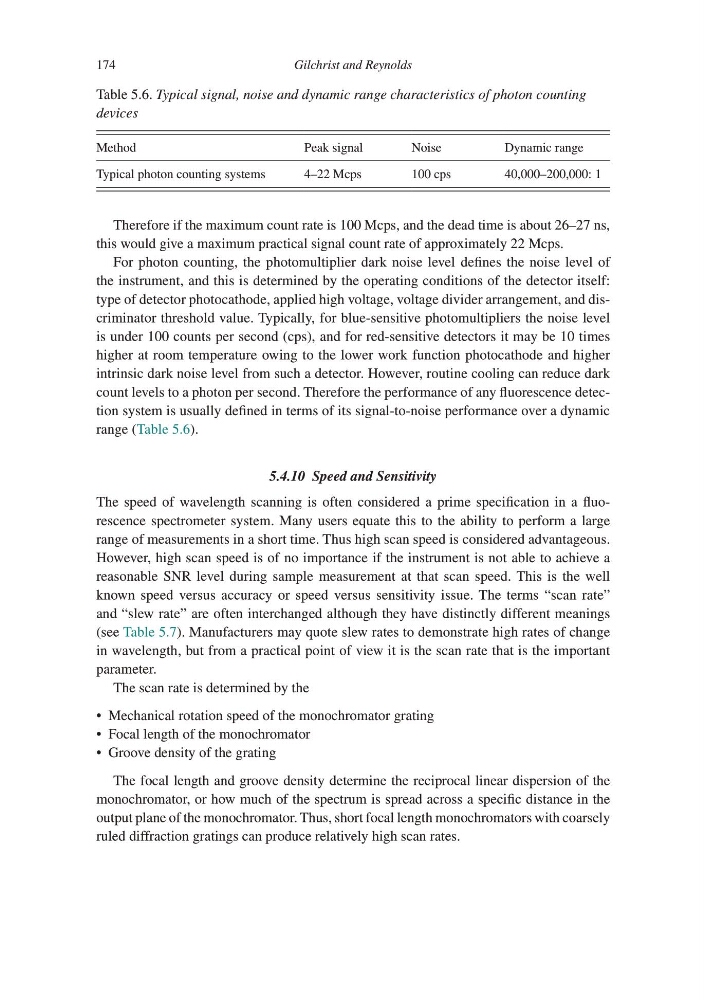
count levels to a photon per second. Therefore the performance of any fluorescence detection system is usually defined in terms of its signal-to-noise performance over a dynamic
range (Table 5.6).
5.4.10 Speed and Sensitivity
The speed of wavelength scanning is often considered a prime specification in a fluorescence spectrometer system. Many users equate this to the ability to perform a large
range of measurements in a short time. Thus high scan speed is considered advantageous.
However, high scan speed is of no importance if the instrument is not able to achieve a
reasonable SNR level during sample measurement at that scan speed. This is the well
known speed versus accuracy or speed versus sensitivity issue. The terms “scan rate”
and “slew rate” are often interchanged although they have distinctly different meanings
(see Table 5.7). Manufacturers may quote slew rates to demonstrate high rates of change
in wavelength, but from a practical point of view it is the scan rate that is the important
parameter.
The scan rate is determined by the
Mechanical rotation speed of the monochromator grating
•
Focal length of the monochromator
•
Groove density of the grating
•
The focal length and groove density determine the reciprocal linear dispersion of the
monochromator, or how much of the spectrum is spread across a specific distance in the
output plane of the monochromator. Thus, short focal length monochromators with coarsely
ruled diffraction gratings can produce relatively high scan rates.
Table 5.6. Typical signal, noise and dynamic range characteristics of photon counting
devices
Method
Peak signal
Noise
Dynamic range
Typical photon counting systems
4–22 Mcps
100 cps
40,000–200,000: 1
174
Therefore if the maximum count rate is 100 Mcps, and the dead time is about 26–27 ns,
this would give a maximum practical signal count rate of approximately 22 Mcps.
For photon counting, the photomultiplier dark noise level defines the noise level of
the instrument, and this is determined by the operating conditions of the detector itself:
type of detector photocathode, applied high voltage, voltage divider arrangement, and discriminator threshold value. Typically, for blue-sensitive photomultipliers the noise level
is under 100 counts per second (cps), and for red-sensitive detectors it may be 10 times
higher at room temperature owing to the lower work function photocathode and higher
intrinsic dark noise level from such a detector. However, routine cooling can reduce dark
count levels to a photon per second. Therefore the performance of any fluorescence detection system is usually defined in terms of its signal-to-noise performance over a dynamic
range (Table 5.6).
5.4.10 Speed and Sensitivity
The speed of wavelength scanning is often considered a prime specification in a fluorescence spectrometer system. Many users equate this to the ability to perform a large
range of measurements in a short time. Thus high scan speed is considered advantageous.
However, high scan speed is of no importance if the instrument is not able to achieve a
reasonable SNR level during sample measurement at that scan speed. This is the well
known speed versus accuracy or speed versus sensitivity issue. The terms “scan rate”
and “slew rate” are often interchanged although they have distinctly different meanings
(see Table 5.7). Manufacturers may quote slew rates to demonstrate high rates of change
in wavelength, but from a practical point of view it is the scan rate that is the important
parameter.
The scan rate is determined by the
Mechanical rotation speed of the monochromator grating
•
Focal length of the monochromator
•
Groove density of the grating
•
The focal length and groove density determine the reciprocal linear dispersion of the
monochromator, or how much of the spectrum is spread across a specific distance in the
output plane of the monochromator. Thus, short focal length monochromators with coarsely
ruled diffraction gratings can produce relatively high scan rates.
Table 5.6. Typical signal, noise and dynamic range characteristics of photon counting
devices
Method
Peak signal
Noise
Dynamic range
Typical photon counting systems
4–22 Mcps
100 cps
40,000–200,000: 1