

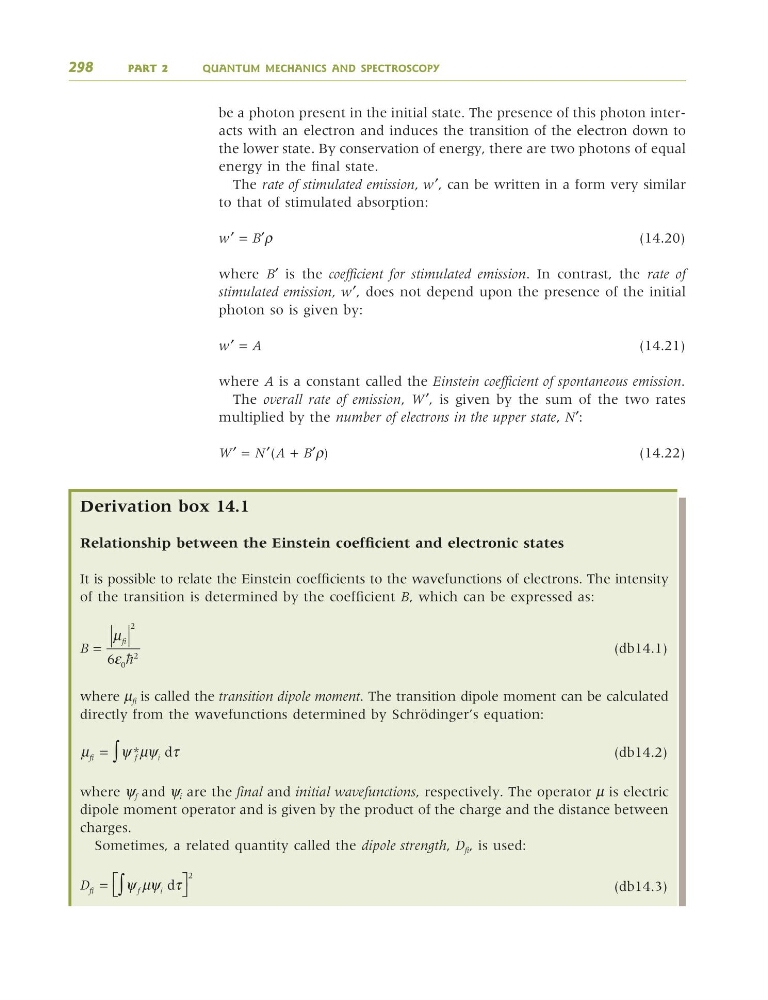
be a photon present in the initial state. The presence of this photon interacts with an electron and induces the transition of the electron down to
the lower state. By conservation of energy, there are two photons of equal
energy in the final state.
The rate of stimulated emission, w′, can be written in a form very similar
to that of stimulated absorption:
w′ = B′ρ
(14.20)
where B′ is the coefficient for stimulated emission. In contrast, the rate of
stimulated emission, w′, does not depend upon the presence of the initial
photon so is given by:
w ′ = A
(14.21)
where A is a constant called the Einstein coefficient of spontaneous emission.
The o9erall rate of emission, W′, is given by the sum of the two rates
multiplied by the number of electrons in the upper state, N′:
W ′ = N′(A + B′ρ)
(14.22)
298
PART 2
QUANTUM MECHANICS AND SPECTROSCOPY
Derivation box 14.1
Relationship between the Einstein coefficient and electronic states
It is possible to relate the Einstein coefficients to the wavefunctions of electrons. The intensity
of the transition is determined by the coefficient B, which can be expressed as:
(db14.1)
where μ fi is called the transition dipole moment. The transition dipole moment can be calculated
directly from the wavefunctions determined by Schrödinger’s equation:
(db14.2)
where ψ f and ψ i are the final and initial wa9efunctions, respectively. The operator μ is electric
dipole moment operator and is given by the product of the charge and the distance between
charges.
Sometimes, a related quantity called the dipole strength, D fi , is used:
(db14.3)
D
f
i
3 = ⎡
⎣
⎤
⎦
∫ ψ μψ τ
d
2
μ
ψ μψ τ
3
*
= ∫ f i d
B =
μ
ε
3
Z
2
0
2
6
9781405124362_4_014.qxd 4/30/08 20:26 Page 298
the lower state. By conservation of energy, there are two photons of equal
energy in the final state.
The rate of stimulated emission, w′, can be written in a form very similar
to that of stimulated absorption:
w′ = B′ρ
(14.20)
where B′ is the coefficient for stimulated emission. In contrast, the rate of
stimulated emission, w′, does not depend upon the presence of the initial
photon so is given by:
w ′ = A
(14.21)
where A is a constant called the Einstein coefficient of spontaneous emission.
The o9erall rate of emission, W′, is given by the sum of the two rates
multiplied by the number of electrons in the upper state, N′:
W ′ = N′(A + B′ρ)
(14.22)
298
PART 2
QUANTUM MECHANICS AND SPECTROSCOPY
Derivation box 14.1
Relationship between the Einstein coefficient and electronic states
It is possible to relate the Einstein coefficients to the wavefunctions of electrons. The intensity
of the transition is determined by the coefficient B, which can be expressed as:
(db14.1)
where μ fi is called the transition dipole moment. The transition dipole moment can be calculated
directly from the wavefunctions determined by Schrödinger’s equation:
(db14.2)
where ψ f and ψ i are the final and initial wa9efunctions, respectively. The operator μ is electric
dipole moment operator and is given by the product of the charge and the distance between
charges.
Sometimes, a related quantity called the dipole strength, D fi , is used:
(db14.3)
D
f
i
3 = ⎡
⎣
⎤
⎦
∫ ψ μψ τ
d
2
μ
ψ μψ τ
3
*
= ∫ f i d
B =
μ
ε
3
Z
2
0
2
6
9781405124362_4_014.qxd 4/30/08 20:26 Page 298