

CHAPTER 14
OPTICAL SPECTROSCOPY
299
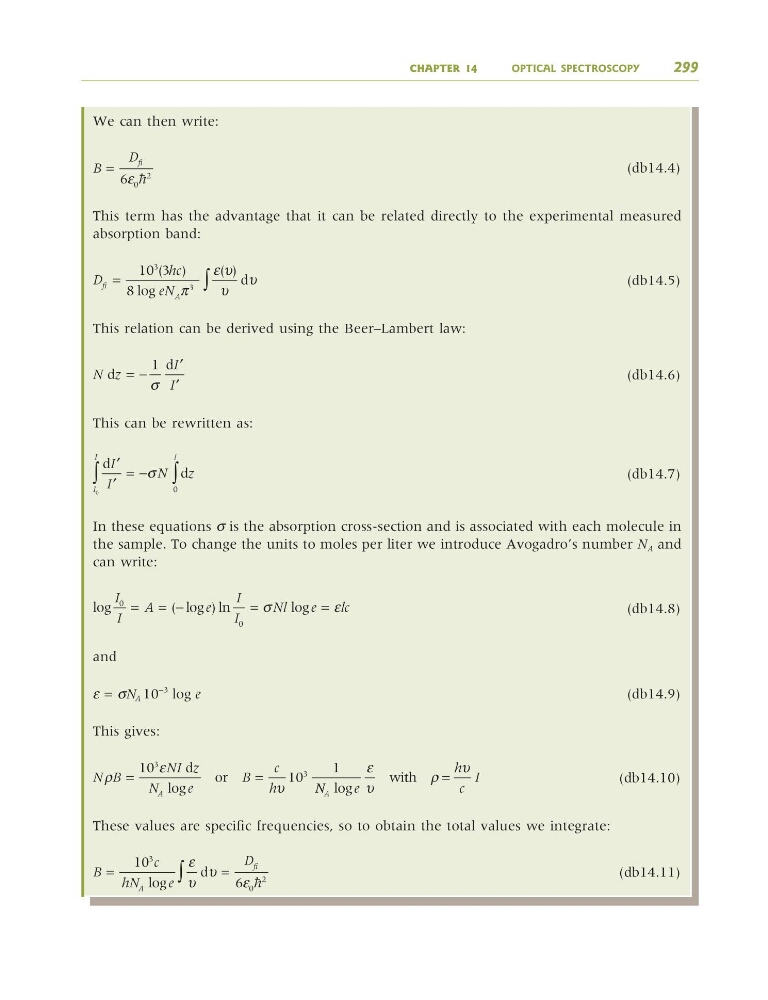
We can then write:
(db14.4)
This term has the advantage that it can be related directly to the experimental measured
absorption band:
(db14.5)
This relation can be derived using the Beer–Lambert law:
(db14.6)
This can be rewritten as:
(db14.7)
In these equations σ is the absorption cross-section and is associated with each molecule in
the sample. To change the units to moles per liter we introduce Avogadro’s number N A and
can write:
(db14.8)
and
ε = σN A 10
−3 log e
(db14.9)
This gives:
(db14.10)
These values are specific frequencies, so to obtain the total values we integrate:
(db14.11)
B
c
hN
e
D
A log
=
=
∫
10
6
3
0
2
ε
υ
υ
ε
d
3
Z
N B
NI z
N
e
B
c
h
N
A
ρ
ε
υ
ε
υ
log
N
e
A log
=
=
10
10
1
3
3
d or
wit th ρ
υ
=
h
c
I
log
( log ) ln
log
I
I
A
e
I
I
Nl
e
lc
0
0
= = −
=
=
σ
ε
d
d
′
′
= −
∫
∫
I
I
N z
I
I
l
0
0
σ
N z
I
I
d
d
= −
′
′
1
σ
D
hc
eN A
3
( )
log
( )
=
∫
10 3
8
3
3
π
ε υ
υ
υ
d
B
D
=
3
Z
6 0
2
ε
9781405124362_4_014.qxd 4/30/08 20:26 Page 299
OPTICAL SPECTROSCOPY
299
We can then write:
(db14.4)
This term has the advantage that it can be related directly to the experimental measured
absorption band:
(db14.5)
This relation can be derived using the Beer–Lambert law:
(db14.6)
This can be rewritten as:
(db14.7)
In these equations σ is the absorption cross-section and is associated with each molecule in
the sample. To change the units to moles per liter we introduce Avogadro’s number N A and
can write:
(db14.8)
and
ε = σN A 10
−3 log e
(db14.9)
This gives:
(db14.10)
These values are specific frequencies, so to obtain the total values we integrate:
(db14.11)
B
c
hN
e
D
A log
=
=
∫
10
6
3
0
2
ε
υ
υ
ε
d
3
Z
N B
NI z
N
e
B
c
h
N
A
ρ
ε
υ
ε
υ
log
N
e
A log
=
=
10
10
1
3
3
d or
wit th ρ
υ
=
h
c
I
log
( log ) ln
log
I
I
A
e
I
I
Nl
e
lc
0
0
= = −
=
=
σ
ε
d
d
′
′
= −
∫
∫
I
I
N z
I
I
l
0
0
σ
N z
I
I
d
d
= −
′
′
1
σ
D
hc
eN A
3
( )
log
( )
=
∫
10 3
8
3
3
π
ε υ
υ
υ
d
B
D
=
3
Z
6 0
2
ε
9781405124362_4_014.qxd 4/30/08 20:26 Page 299