

(14.15)
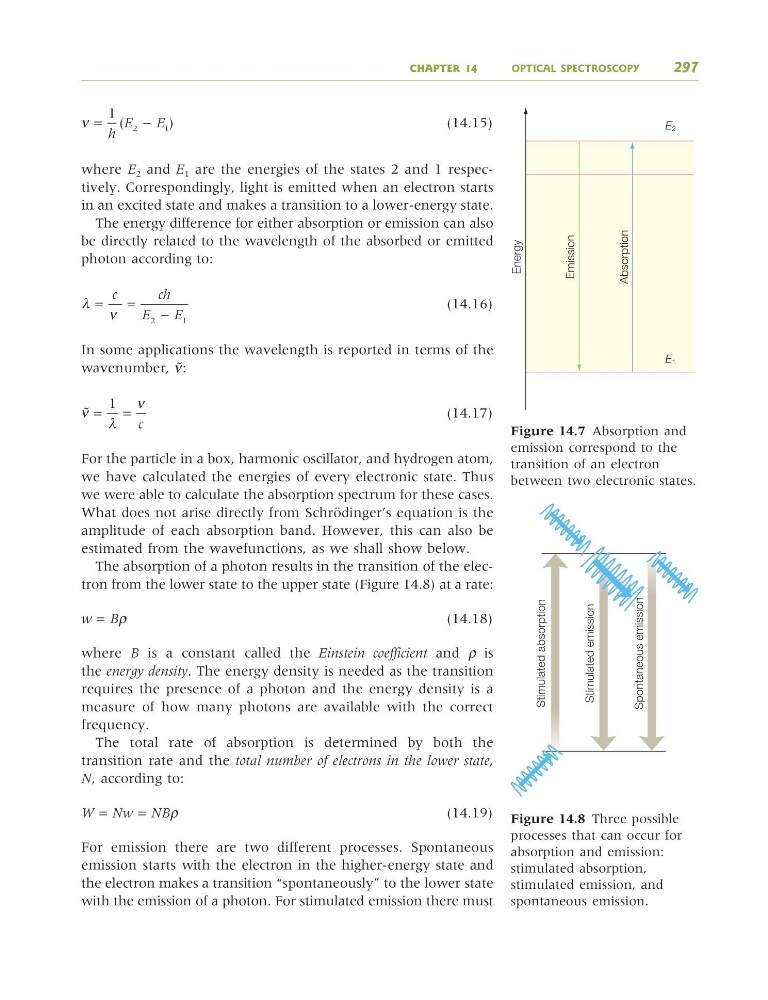
where E 2 and E 1 are the energies of the states 2 and 1 respectively. Correspondingly, light is emitted when an electron starts
in an excited state and makes a transition to a lower-energy state.
The energy difference for either absorption or emission can also
be directly related to the wavelength of the absorbed or emitted
photon according to:
(14.16)
In some applications the wavelength is reported in terms of the
wavenumber, E:
(14.17)
For the particle in a box, harmonic oscillator, and hydrogen atom,
we have calculated the energies of every electronic state. Thus
we were able to calculate the absorption spectrum for these cases.
What does not arise directly from Schrödinger’s equation is the
amplitude of each absorption band. However, this can also be
estimated from the wavefunctions, as we shall show below.
The absorption of a photon results in the transition of the electron from the lower state to the upper state (Figure 14.8) at a rate:
w = Bρ
(14.18)
where B is a constant called the Einstein coefficient and ρ is
the energy density. The energy density is needed as the transition
requires the presence of a photon and the energy density is a
measure of how many photons are available with the correct
frequency.
The total rate of absorption is determined by both the
transition rate and the total number of electrons in the lower state,
N, according to:
W = Nw = NBρ
(14.19)
For emission there are two different processes. Spontaneous
emission starts with the electron in the higher-energy state and
the electron makes a transition “spontaneously” to the lower state
with the emission of a photon. For stimulated emission there must
E = =
1
λ
ν
c
λ ν
=
=
−
c
ch
E
E
2
1
ν
(
)
=
−
1
2
1
h
E
E
CHAPTER 14
OPTICAL SPECTROSCOPY
297
Energy
Emission
Absorption
E2
E1
Figure 14.7 Absorption and
emission correspond to the
transition of an electron
between two electronic states.
Stimulated absorption
Stimulated emission
Spontaneous emission
Figure 14.8 Three possible
processes that can occur for
absorption and emission:
stimulated absorption,
stimulated emission, and
spontaneous emission.
9781405124362_4_014.qxd 4/29/08 13:09 Page 297
where E 2 and E 1 are the energies of the states 2 and 1 respectively. Correspondingly, light is emitted when an electron starts
in an excited state and makes a transition to a lower-energy state.
The energy difference for either absorption or emission can also
be directly related to the wavelength of the absorbed or emitted
photon according to:
(14.16)
In some applications the wavelength is reported in terms of the
wavenumber, E:
(14.17)
For the particle in a box, harmonic oscillator, and hydrogen atom,
we have calculated the energies of every electronic state. Thus
we were able to calculate the absorption spectrum for these cases.
What does not arise directly from Schrödinger’s equation is the
amplitude of each absorption band. However, this can also be
estimated from the wavefunctions, as we shall show below.
The absorption of a photon results in the transition of the electron from the lower state to the upper state (Figure 14.8) at a rate:
w = Bρ
(14.18)
where B is a constant called the Einstein coefficient and ρ is
the energy density. The energy density is needed as the transition
requires the presence of a photon and the energy density is a
measure of how many photons are available with the correct
frequency.
The total rate of absorption is determined by both the
transition rate and the total number of electrons in the lower state,
N, according to:
W = Nw = NBρ
(14.19)
For emission there are two different processes. Spontaneous
emission starts with the electron in the higher-energy state and
the electron makes a transition “spontaneously” to the lower state
with the emission of a photon. For stimulated emission there must
E = =
1
λ
ν
c
λ ν
=
=
−
c
ch
E
E
2
1
ν
(
)
=
−
1
2
1
h
E
E
CHAPTER 14
OPTICAL SPECTROSCOPY
297
Energy
Emission
Absorption
E2
E1
Figure 14.7 Absorption and
emission correspond to the
transition of an electron
between two electronic states.
Stimulated absorption
Stimulated emission
Spontaneous emission
Figure 14.8 Three possible
processes that can occur for
absorption and emission:
stimulated absorption,
stimulated emission, and
spontaneous emission.
9781405124362_4_014.qxd 4/29/08 13:09 Page 297