

Let us determine what energies and wavelengths are relevant for transitions between adjacent energy states. Consider a proton held to a spring
with k = 500 N m
−1
:
(11.33)
E = Zω = (1.05 × 10
−34 Js)(5.5 × 10
14 s
−1
) = 5.8 × 10
−20 J
(11.34)
(11.35)
In general, transitions of vibrational states are always associated with
infrared light and involve energies that are much smaller than the energies
associated with the electronic levels.
VIBRATIONAL SPECTRA
In small molecules, the vibrational modes of the
molecules are well defined and predictable. For
a molecule of N atoms, there are 3N–6 independent modes if the molecule is nonlinear and
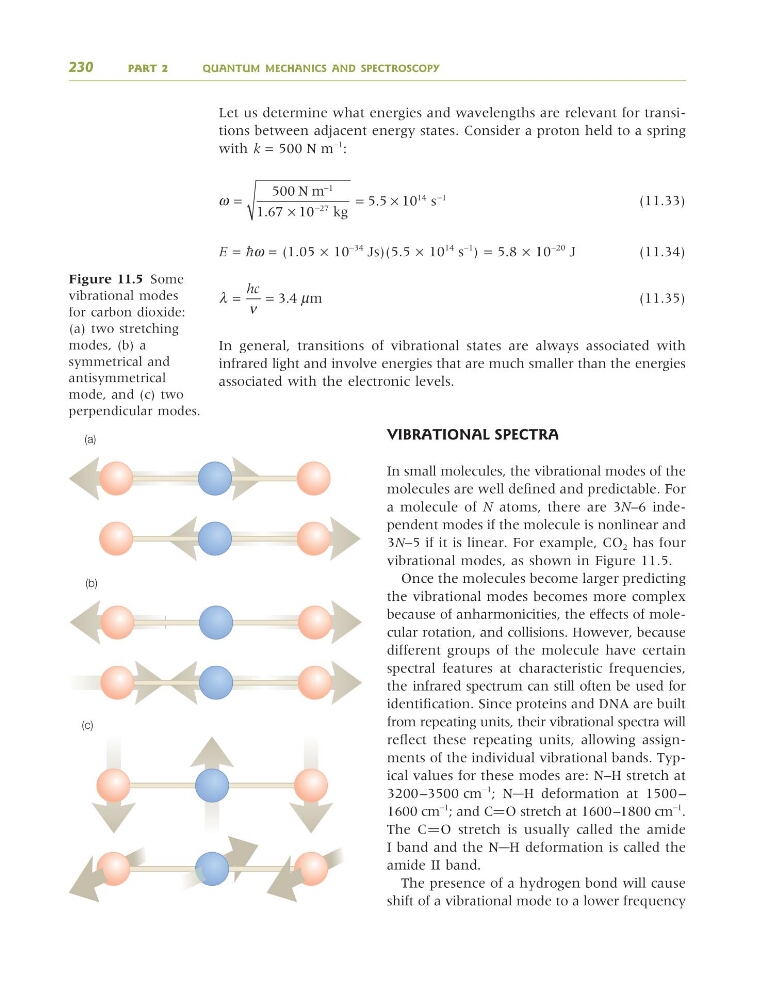
3N–5 if it is linear. For example, CO 2 has four
vibrational modes, as shown in Figure 11.5.
Once the molecules become larger predicting
the vibrational modes becomes more complex
because of anharmonicities, the effects of molecular rotation, and collisions. However, because
different groups of the molecule have certain
spectral features at characteristic frequencies,
the infrared spectrum can still often be used for
identification. Since proteins and DNA are built
from repeating units, their vibrational spectra will
reflect these repeating units, allowing assignments of the individual vibrational bands. Typical values for these modes are: N–H stretch at
3200–3500 cm
−1
; N6H deformation at 1500–
1600 cm
−1
; and C7O stretch at 1600–1800 cm
−1
.
The C7O stretch is usually called the amide
I band and the N6H deformation is called the
amide II band.
The presence of a hydrogen bond will cause
shift of a vibrational mode to a lower frequency
λ ν
μ
.
=
=
hc 3 4 m
ω
.
.
=
×
=
×
−
−
−
500
1 67 10
5 5 10
1
27
14
1
N m
kg
s
230
PART 2
QUANTUM MECHANICS AND SPECTROSCOPY
(c)
Figure 11.5 Some
vibrational modes
for carbon dioxide:
(a) two stretching
modes, (b) a
symmetrical and
antisymmetrical
mode, and (c) two
perpendicular modes.
(a)
(b)
9781405124362_4_011.qxd 4/29/08 9:11 Page 230
with k = 500 N m
−1
:
(11.33)
E = Zω = (1.05 × 10
−34 Js)(5.5 × 10
14 s
−1
) = 5.8 × 10
−20 J
(11.34)
(11.35)
In general, transitions of vibrational states are always associated with
infrared light and involve energies that are much smaller than the energies
associated with the electronic levels.
VIBRATIONAL SPECTRA
In small molecules, the vibrational modes of the
molecules are well defined and predictable. For
a molecule of N atoms, there are 3N–6 independent modes if the molecule is nonlinear and
3N–5 if it is linear. For example, CO 2 has four
vibrational modes, as shown in Figure 11.5.
Once the molecules become larger predicting
the vibrational modes becomes more complex
because of anharmonicities, the effects of molecular rotation, and collisions. However, because
different groups of the molecule have certain
spectral features at characteristic frequencies,
the infrared spectrum can still often be used for
identification. Since proteins and DNA are built
from repeating units, their vibrational spectra will
reflect these repeating units, allowing assignments of the individual vibrational bands. Typical values for these modes are: N–H stretch at
3200–3500 cm
−1
; N6H deformation at 1500–
1600 cm
−1
; and C7O stretch at 1600–1800 cm
−1
.
The C7O stretch is usually called the amide
I band and the N6H deformation is called the
amide II band.
The presence of a hydrogen bond will cause
shift of a vibrational mode to a lower frequency
λ ν
μ
.
=
=
hc 3 4 m
ω
.
.
=
×
=
×
−
−
−
500
1 67 10
5 5 10
1
27
14
1
N m
kg
s
230
PART 2
QUANTUM MECHANICS AND SPECTROSCOPY
(c)
Figure 11.5 Some
vibrational modes
for carbon dioxide:
(a) two stretching
modes, (b) a
symmetrical and
antisymmetrical
mode, and (c) two
perpendicular modes.
(a)
(b)
9781405124362_4_011.qxd 4/29/08 9:11 Page 230