

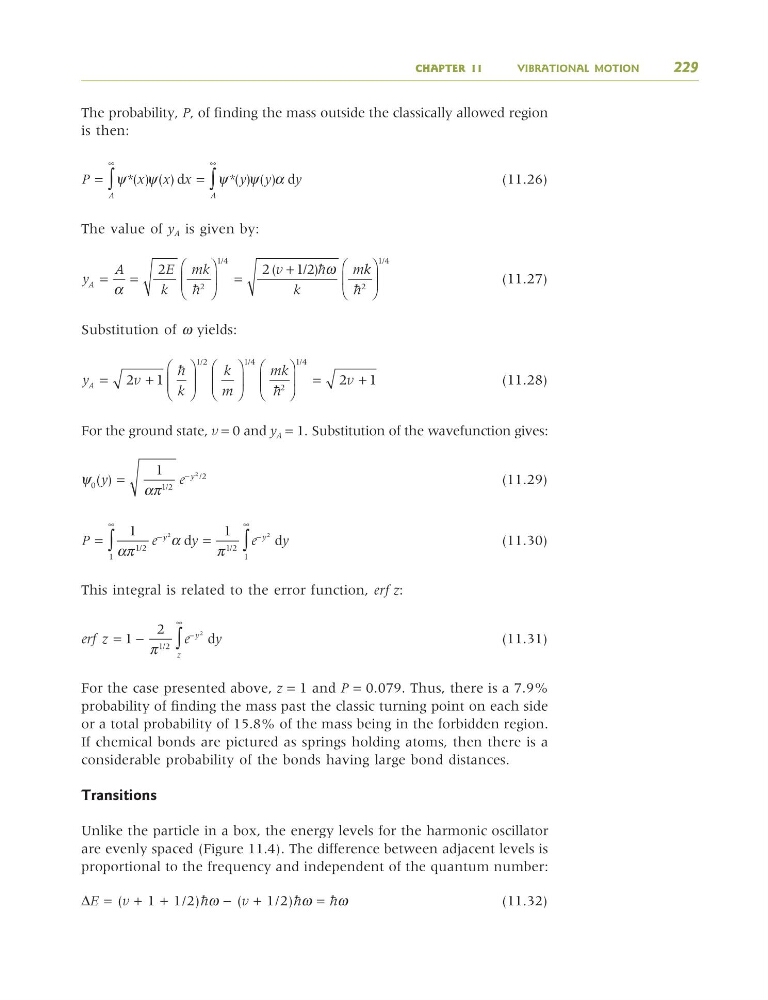
The probability, P, of finding the mass outside the classically allowed region
is then:
(11.26)
The value of y A is given by:
(11.27)
Substitution of ω yields:
(11.28)
For the ground state, 9 = 0 and y A = 1. Substitution of the wavefunction gives:
(11.29)
(11.30)
This integral is related to the error function, erf z:
(11.31)
For the case presented above, z = 1 and P = 0.079. Thus, there is a 7.9%
probability of finding the mass past the classic turning point on each side
or a total probability of 15.8% of the mass being in the forbidden region.
If chemical bonds are pictured as springs holding atoms, then there is a
considerable probability of the bonds having large bond distances.
Transitions
Unlike the particle in a box, the energy levels for the harmonic oscillator
are evenly spaced (Figure 11.4). The difference between adjacent levels is
proportional to the frequency and independent of the quantum number:
ΔE = (9 + 1 + 1/2)Zω − (9 + 1/2)Zω = Zω
(11.32)
erf z
e
y
y
z
/
= −
−
∞
∫
1
2
1 2
2
π
d
P
e
y
e
y
y
y
/
/
=
=
∞
−
−
∞
∫
∫
1
1
1 2
1
1 2
1
2
2
απ
α
π
d
d
ψ
απ
0
1 2
2
1
2
( )
/
/
y
e
y
=
−
y
k
k
m
mk
A
/
/
=
+
⎛
⎝
⎜ ⎜
⎞
⎠
⎟ ⎟
⎛
⎝
⎜ ⎜
⎞
⎠
⎟ ⎟
⎛
⎝
2
1
1 2
1 4
2
9
Z
Z
⎜ ⎜ ⎜
⎞
⎠
⎟ ⎟ =
+
1 4
2
1
/
9
y
A
E
k
mk
k
m
A
(
)
/
=
=
⎛
⎝
⎜ ⎜
⎞
⎠
⎟ ⎟ =
+
α
ω
2
2
1 2
2
1 4
Z
9
Z
/
k k
Z
2
1 4
⎛
⎝
⎜ ⎜
⎞
⎠
⎟ ⎟
/
P
x x x
y y
y
A
A
( ) ( )
( ) ( )
=
=
∞
∞
∫
∫
ψ ψ
ψ ψ α
*
d
*
d
CHAPTER 11
VIBRATIONAL MOTION
229
9781405124362_4_011.qxd 4/29/08 9:11 Page 229
is then:
(11.26)
The value of y A is given by:
(11.27)
Substitution of ω yields:
(11.28)
For the ground state, 9 = 0 and y A = 1. Substitution of the wavefunction gives:
(11.29)
(11.30)
This integral is related to the error function, erf z:
(11.31)
For the case presented above, z = 1 and P = 0.079. Thus, there is a 7.9%
probability of finding the mass past the classic turning point on each side
or a total probability of 15.8% of the mass being in the forbidden region.
If chemical bonds are pictured as springs holding atoms, then there is a
considerable probability of the bonds having large bond distances.
Transitions
Unlike the particle in a box, the energy levels for the harmonic oscillator
are evenly spaced (Figure 11.4). The difference between adjacent levels is
proportional to the frequency and independent of the quantum number:
ΔE = (9 + 1 + 1/2)Zω − (9 + 1/2)Zω = Zω
(11.32)
erf z
e
y
y
z
/
= −
−
∞
∫
1
2
1 2
2
π
d
P
e
y
e
y
y
y
/
/
=
=
∞
−
−
∞
∫
∫
1
1
1 2
1
1 2
1
2
2
απ
α
π
d
d
ψ
απ
0
1 2
2
1
2
( )
/
/
y
e
y
=
−
y
k
k
m
mk
A
/
/
=
+
⎛
⎝
⎜ ⎜
⎞
⎠
⎟ ⎟
⎛
⎝
⎜ ⎜
⎞
⎠
⎟ ⎟
⎛
⎝
2
1
1 2
1 4
2
9
Z
Z
⎜ ⎜ ⎜
⎞
⎠
⎟ ⎟ =
+
1 4
2
1
/
9
y
A
E
k
mk
k
m
A
(
)
/
=
=
⎛
⎝
⎜ ⎜
⎞
⎠
⎟ ⎟ =
+
α
ω
2
2
1 2
2
1 4
Z
9
Z
/
k k
Z
2
1 4
⎛
⎝
⎜ ⎜
⎞
⎠
⎟ ⎟
/
P
x x x
y y
y
A
A
( ) ( )
( ) ( )
=
=
∞
∞
∫
∫
ψ ψ
ψ ψ α
*
d
*
d
CHAPTER 11
VIBRATIONAL MOTION
229
9781405124362_4_011.qxd 4/29/08 9:11 Page 229