

There are a total of four terms in the equation. Two are multiplying x
2 (the
terms in the left-hand parentheses) and can be rewritten by substituting
the value of α from eqn 11.9:
(11.21)
So these two terms cancel and we are left with the terms in the right-hand
parentheses:
(11.22)
The product of the wavefunction and the terms in the parentheses must
always zero for all values of the wavefunction, including all non-zero
values. This can only be true if the term in the parentheses is always zero.
Thus, we can write:
(11.23)
Thus, substitution of the wavefunction ψ 0 (x) yields a specific energy of
. This is the ground-state energy. Substitution of the 9th wavefunction
will yield the energy:
(11.24)
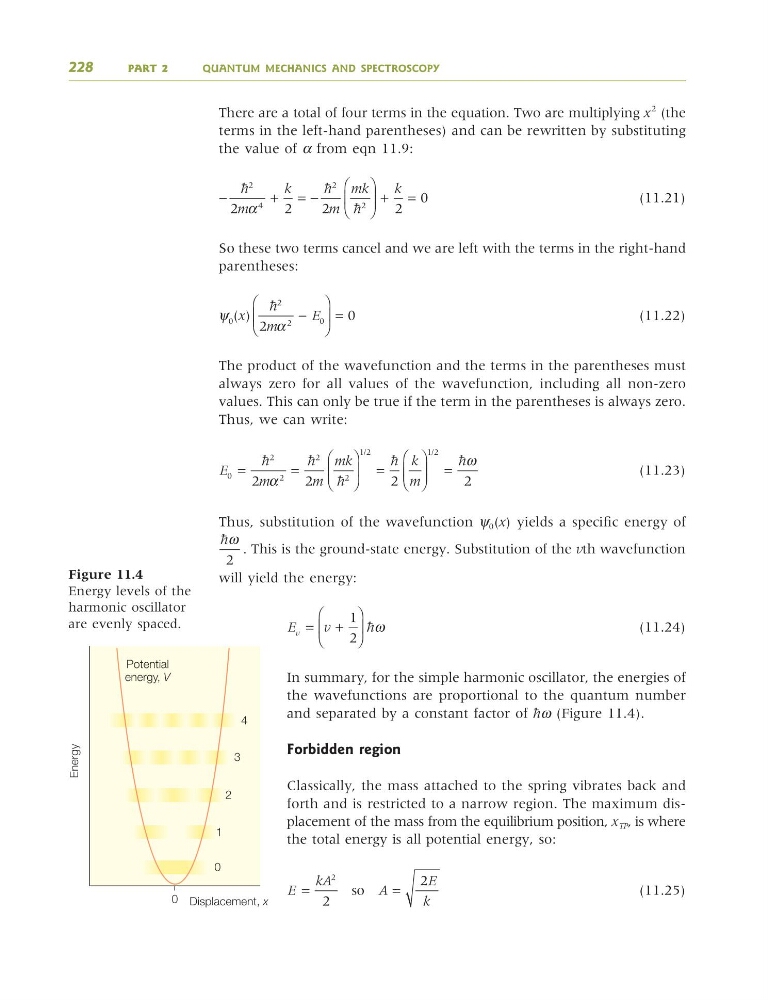
In summary, for the simple harmonic oscillator, the energies of
the wavefunctions are proportional to the quantum number
and separated by a constant factor of Zω (Figure 11.4).
Forbidden region
Classically, the mass attached to the spring vibrates back and
forth and is restricted to a narrow region. The maximum displacement of the mass from the equilibrium position, x TP , is where
the total energy is all potential energy, so:
(11.25)
E
kA
A
E
k
=
=
2
2
2
so
E 9
9
Z
=
+
⎛
⎝
⎜ ⎜
⎞
⎠
⎟ ⎟
1
2
ω
Zω
2
E
m
m
mk
k
m
0
2
2
2
2
1 2
2
2
2
/
=
=
⎛
⎝
⎜ ⎜
⎞
⎠
⎟ ⎟ =
⎛
⎝
⎜
Z
Z
Z
Z
α
⎜ ⎜
⎞
⎠
⎟ ⎟ =
1 2
2
/
Zω
ψ
α
0
2
2
0
2
0
( )
x
m
E
Z
−
⎛
⎝
⎜ ⎜
⎞
⎠
⎟ ⎟ =
−
+ =−
⎛
⎝
⎜ ⎜
⎞
⎠
⎟ ⎟ + =
Z
Z
Z
2
4
2
2
2
2
2
2
0
m
k
m
mk
k
α
228
PART 2
QUANTUM MECHANICS AND SPECTROSCOPY
0
4
3
2
1
0
Displacement, x
Potential
energy, V
Energy
Figure 11.4
Energy levels of the
harmonic oscillator
are evenly spaced.
9781405124362_4_011.qxd 4/29/08 9:11 Page 228
2 (the
terms in the left-hand parentheses) and can be rewritten by substituting
the value of α from eqn 11.9:
(11.21)
So these two terms cancel and we are left with the terms in the right-hand
parentheses:
(11.22)
The product of the wavefunction and the terms in the parentheses must
always zero for all values of the wavefunction, including all non-zero
values. This can only be true if the term in the parentheses is always zero.
Thus, we can write:
(11.23)
Thus, substitution of the wavefunction ψ 0 (x) yields a specific energy of
. This is the ground-state energy. Substitution of the 9th wavefunction
will yield the energy:
(11.24)
In summary, for the simple harmonic oscillator, the energies of
the wavefunctions are proportional to the quantum number
and separated by a constant factor of Zω (Figure 11.4).
Forbidden region
Classically, the mass attached to the spring vibrates back and
forth and is restricted to a narrow region. The maximum displacement of the mass from the equilibrium position, x TP , is where
the total energy is all potential energy, so:
(11.25)
E
kA
A
E
k
=
=
2
2
2
so
E 9
9
Z
=
+
⎛
⎝
⎜ ⎜
⎞
⎠
⎟ ⎟
1
2
ω
Zω
2
E
m
m
mk
k
m
0
2
2
2
2
1 2
2
2
2
/
=
=
⎛
⎝
⎜ ⎜
⎞
⎠
⎟ ⎟ =
⎛
⎝
⎜
Z
Z
Z
Z
α
⎜ ⎜
⎞
⎠
⎟ ⎟ =
1 2
2
/
Zω
ψ
α
0
2
2
0
2
0
( )
x
m
E
Z
−
⎛
⎝
⎜ ⎜
⎞
⎠
⎟ ⎟ =
−
+ =−
⎛
⎝
⎜ ⎜
⎞
⎠
⎟ ⎟ + =
Z
Z
Z
2
4
2
2
2
2
2
2
0
m
k
m
mk
k
α
228
PART 2
QUANTUM MECHANICS AND SPECTROSCOPY
0
4
3
2
1
0
Displacement, x
Potential
energy, V
Energy
Figure 11.4
Energy levels of the
harmonic oscillator
are evenly spaced.
9781405124362_4_011.qxd 4/29/08 9:11 Page 228