

The half-life and rate constant are inversely
related to each other and correspondingly
have inverse units. Whereas the half-life is
commonly used to characterize radioactive
processes, it is not usually used to describe
chemical reactions. Rather, a process is described as having a lifetime that is simply the
inverse of the rate constant, or equivalently
the time at which 1/e of the initial population
has changed.
PARALLEL FIRST-ORDER REACTIONS
In many biological processes, first-order rates
are observed when a reaction involves a highenergy molecule that relaxes spontaneously to a lower-energy state
without the involvement of another molecule. For example, such
high-energy states are created in photosynthesis due to the absorption of light energy (see Chapter 20). However, the decay may be
possible by more than one pathway and the kinetics will reflect the
possible formation of several different products.
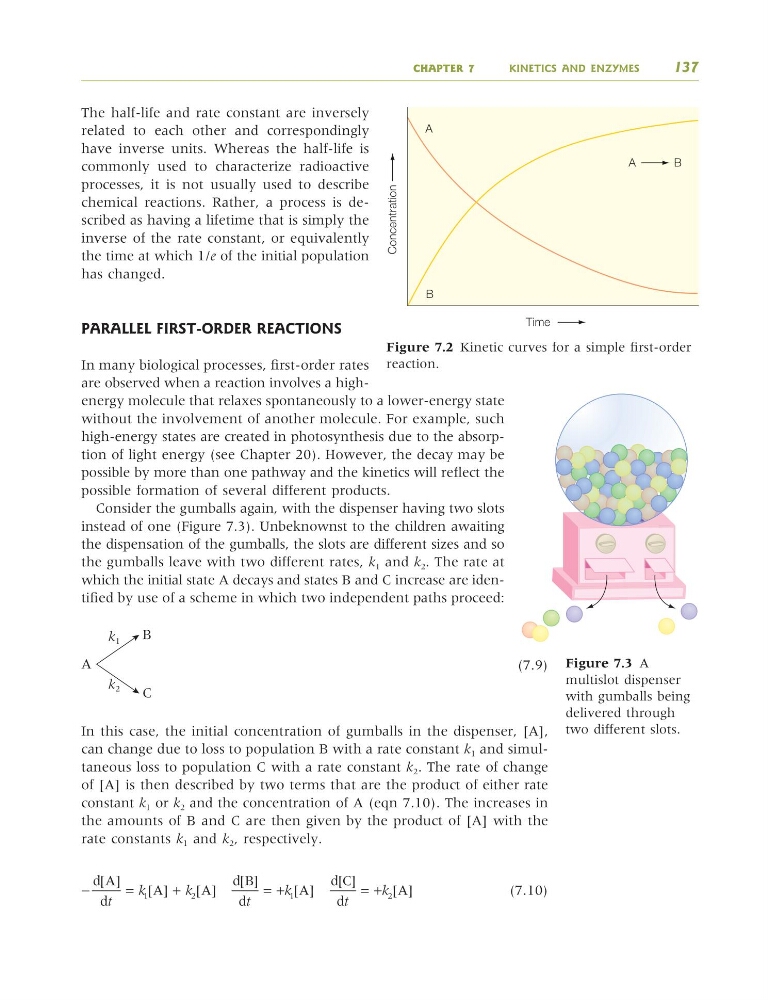
Consider the gumballs again, with the dispenser having two slots
instead of one (Figure 7.3). Unbeknownst to the children awaiting
the dispensation of the gumballs, the slots are different sizes and so
the gumballs leave with two different rates, k 1 and k 2 . The rate at
which the initial state A decays and states B and C increase are identified by use of a scheme in which two independent paths proceed:
(7.9)
In this case, the initial concentration of gumballs in the dispenser, [A],
can change due to loss to population B with a rate constant k 1 and simultaneous loss to population C with a rate constant k 2 . The rate of change
of [A] is then described by two terms that are the product of either rate
constant k 1 or k 2 and the concentration of A (eqn 7.10). The increases in
the amounts of B and C are then given by the product of [A] with the
rate constants k 1 and k 2 , respectively.
(7.10)
d C
d
A
[ ]
[ ]
t
k
= + 2
d B
d
A
[ ]
[ ]
t
k
= + 1
−
=
+
d A
d
A
A
[ ]
[ ]
[ ]
t
k
k
1
2
A
B
k 1
k 2
C
CHAPTER 7
KINETICS AND ENZYMES
137
B
B
A
A
Concentration
Time
Figure 7.2 Kinetic curves for a simple first-order
reaction.
Figure 7.3 A
multislot dispenser
with gumballs being
delivered through
two different slots.
9781405124362_4_007.qxd 4/29/08 10:41 Page 137
related to each other and correspondingly
have inverse units. Whereas the half-life is
commonly used to characterize radioactive
processes, it is not usually used to describe
chemical reactions. Rather, a process is described as having a lifetime that is simply the
inverse of the rate constant, or equivalently
the time at which 1/e of the initial population
has changed.
PARALLEL FIRST-ORDER REACTIONS
In many biological processes, first-order rates
are observed when a reaction involves a highenergy molecule that relaxes spontaneously to a lower-energy state
without the involvement of another molecule. For example, such
high-energy states are created in photosynthesis due to the absorption of light energy (see Chapter 20). However, the decay may be
possible by more than one pathway and the kinetics will reflect the
possible formation of several different products.
Consider the gumballs again, with the dispenser having two slots
instead of one (Figure 7.3). Unbeknownst to the children awaiting
the dispensation of the gumballs, the slots are different sizes and so
the gumballs leave with two different rates, k 1 and k 2 . The rate at
which the initial state A decays and states B and C increase are identified by use of a scheme in which two independent paths proceed:
(7.9)
In this case, the initial concentration of gumballs in the dispenser, [A],
can change due to loss to population B with a rate constant k 1 and simultaneous loss to population C with a rate constant k 2 . The rate of change
of [A] is then described by two terms that are the product of either rate
constant k 1 or k 2 and the concentration of A (eqn 7.10). The increases in
the amounts of B and C are then given by the product of [A] with the
rate constants k 1 and k 2 , respectively.
(7.10)
d C
d
A
[ ]
[ ]
t
k
= + 2
d B
d
A
[ ]
[ ]
t
k
= + 1
−
=
+
d A
d
A
A
[ ]
[ ]
[ ]
t
k
k
1
2
A
B
k 1
k 2
C
CHAPTER 7
KINETICS AND ENZYMES
137
B
B
A
A
Concentration
Time
Figure 7.2 Kinetic curves for a simple first-order
reaction.
Figure 7.3 A
multislot dispenser
with gumballs being
delivered through
two different slots.
9781405124362_4_007.qxd 4/29/08 10:41 Page 137