

Since each of the individual rates is first
order, the observed rate constant, k obs , for the
exponential loss of state A, will be given by
the sum of the individual rates:
(7.11)
A(t) = A(t = 0)e
−k obs t
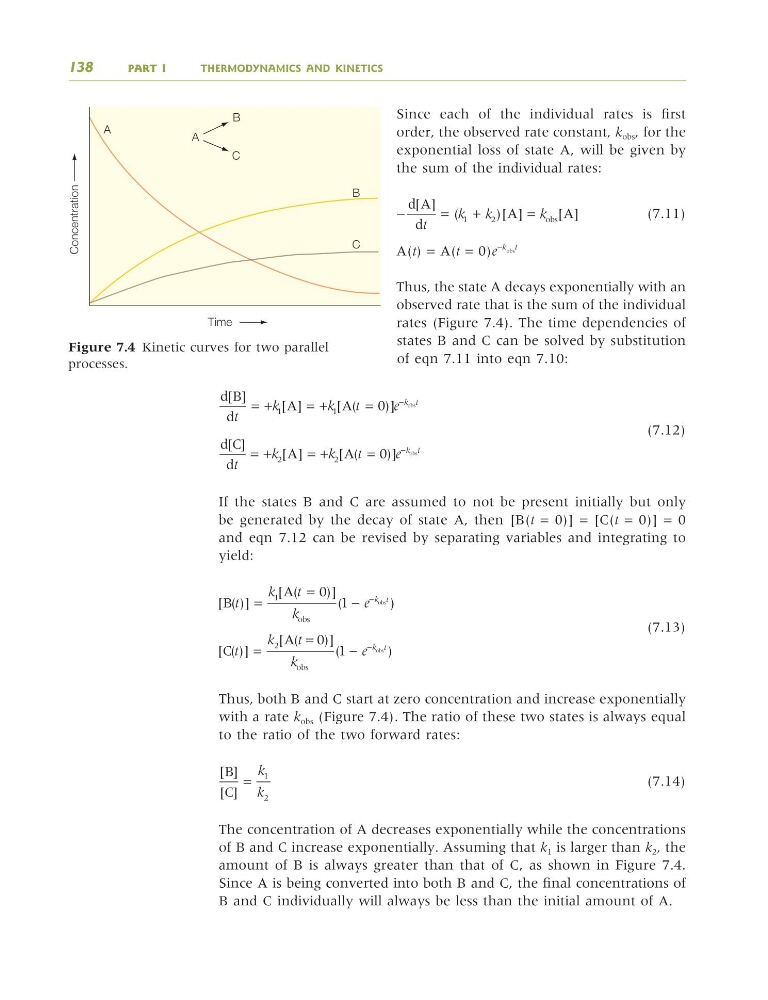
Thus, the state A decays exponentially with an
observed rate that is the sum of the individual
rates (Figure 7.4). The time dependencies of
states B and C can be solved by substitution
of eqn 7.11 into eqn 7.10:
(7.12)
If the states B and C are assumed to not be present initially but only
be generated by the decay of state A, then [B(t = 0)] = [C(t = 0)] = 0
and eqn 7.12 can be revised by separating variables and integrating to
yield:
(7.13)
Thus, both B and C start at zero concentration and increase exponentially
with a rate k obs (Figure 7.4). The ratio of these two states is always equal
to the ratio of the two forward rates:
(7.14)
The concentration of A decreases exponentially while the concentrations
of B and C increase exponentially. Assuming that k 1 is larger than k 2 , the
amount of B is always greater than that of C, as shown in Figure 7.4.
Since A is being converted into both B and C, the final concentrations of
B and C individually will always be less than the initial amount of A.
[ ]
[ ]
B
C
=
k
k
1
2
[ ( )]
[ (
)]
(
)
C
A
obs
obs
t
k
t
k
e
k t
=
=
−
−
2
0
1
[ ( )]
[ (
)]
(
)
B
A
obs
obs
t
k
t
k
e
k t
=
=
−
−
1
0
1
d C
d
A
A
obs
[ ]
[ ]
[ (
)]
t
k
k
t
e
k t
= +
= +
=
−
2
2
0
d B
d
A
A
obs
[ ]
[ ]
[ (
)]
t
k
k t
e
k t
= +
= +
=
−
1
1
0
−
=
+
=
d A
d
A
A
obs
[ ] (
)[ ]
[ ]
t
k k
k
1
2
138
PART I
THERMODYNAMICS AND KINETICS
B
C
B
C
A
A
Concentration
Time
Figure 7.4 Kinetic curves for two parallel
processes.
9781405124362_4_007.qxd 4/29/08 10:41 Page 138
order, the observed rate constant, k obs , for the
exponential loss of state A, will be given by
the sum of the individual rates:
(7.11)
A(t) = A(t = 0)e
−k obs t
Thus, the state A decays exponentially with an
observed rate that is the sum of the individual
rates (Figure 7.4). The time dependencies of
states B and C can be solved by substitution
of eqn 7.11 into eqn 7.10:
(7.12)
If the states B and C are assumed to not be present initially but only
be generated by the decay of state A, then [B(t = 0)] = [C(t = 0)] = 0
and eqn 7.12 can be revised by separating variables and integrating to
yield:
(7.13)
Thus, both B and C start at zero concentration and increase exponentially
with a rate k obs (Figure 7.4). The ratio of these two states is always equal
to the ratio of the two forward rates:
(7.14)
The concentration of A decreases exponentially while the concentrations
of B and C increase exponentially. Assuming that k 1 is larger than k 2 , the
amount of B is always greater than that of C, as shown in Figure 7.4.
Since A is being converted into both B and C, the final concentrations of
B and C individually will always be less than the initial amount of A.
[ ]
[ ]
B
C
=
k
k
1
2
[ ( )]
[ (
)]
(
)
C
A
obs
obs
t
k
t
k
e
k t
=
=
−
−
2
0
1
[ ( )]
[ (
)]
(
)
B
A
obs
obs
t
k
t
k
e
k t
=
=
−
−
1
0
1
d C
d
A
A
obs
[ ]
[ ]
[ (
)]
t
k
k
t
e
k t
= +
= +
=
−
2
2
0
d B
d
A
A
obs
[ ]
[ ]
[ (
)]
t
k
k t
e
k t
= +
= +
=
−
1
1
0
−
=
+
=
d A
d
A
A
obs
[ ] (
)[ ]
[ ]
t
k k
k
1
2
138
PART I
THERMODYNAMICS AND KINETICS
B
C
B
C
A
A
Concentration
Time
Figure 7.4 Kinetic curves for two parallel
processes.
9781405124362_4_007.qxd 4/29/08 10:41 Page 138