

136
PART I
THERMODYNAMICS AND KINETICS
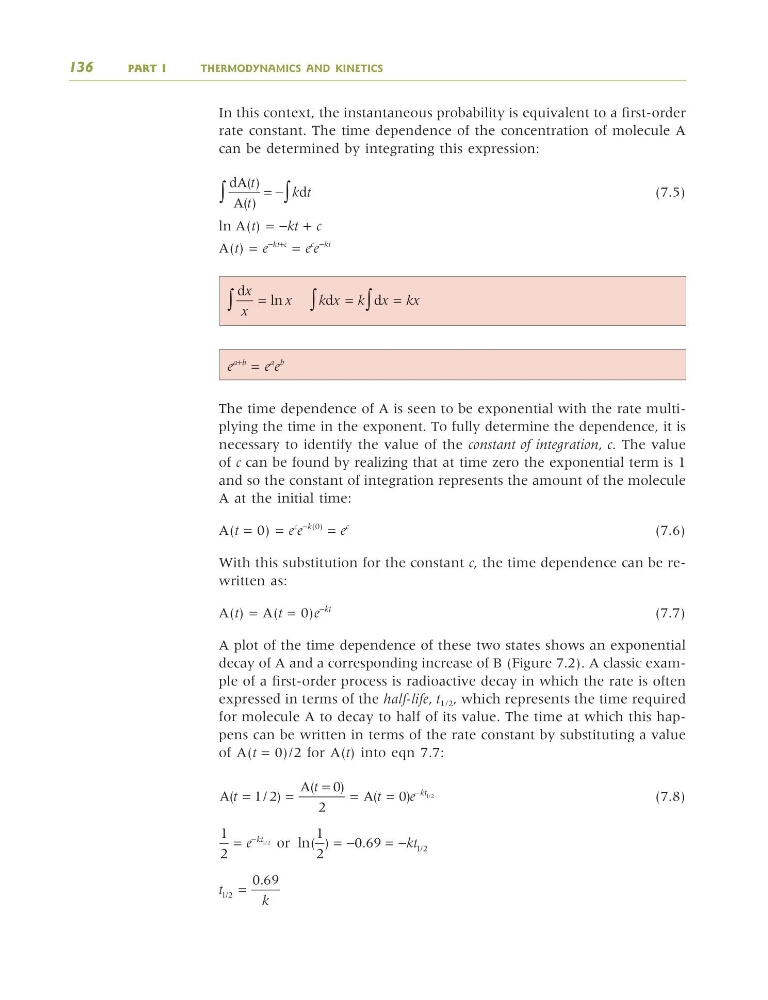
In this context, the instantaneous probability is equivalent to a first-order
rate constant. The time dependence of the concentration of molecule A
can be determined by integrating this expression:
(7.5)
ln A(t) = −kt + c
A(t) = e
−kt+c
= e
c
e
−kt
e
a+b
= e
a e
b
The time dependence of A is seen to be exponential with the rate multiplying the time in the exponent. To fully determine the dependence, it is
necessary to identify the value of the constant of integration, c. The value
of c can be found by realizing that at time zero the exponential term is 1
and so the constant of integration represents the amount of the molecule
A at the initial time:
A(t = 0) = e
c
e
−k(0)
= e
c
(7.6)
With this substitution for the constant c, the time dependence can be rewritten as:
A(t) = A(t = 0)e
−kt
(7.7)
A plot of the time dependence of these two states shows an exponential
decay of A and a corresponding increase of B (Figure 7.2). A classic example of a first-order process is radioactive decay in which the rate is often
expressed in terms of the half-life, t 1/2 , which represents the time required
for molecule A to decay to half of its value. The time at which this happens can be written in terms of the rate constant by substituting a value
of A(t = 0)/2 for A(t) into eqn 7.7:
(7.8)
t
k
1 2
0 69
/
.
=
1
2
1
2
0 69
1 2
1 2
ln( )
.
/
/
=
=−
=−
−
e
k t
kt
or
A
A
A
(
/ )
(
)
(
) /
t
t
t
e
kt
=
=
= =
=
−
1 2
0
2
0 1 2
d
d
d
x
x
x
k x k x kx
∫
∫
∫
=
=
=
ln
dA
A
d
( )
( )
t
t
k t
∫
∫
= −
9781405124362_4_007.qxd 4/30/08 19:07 Page 136
PART I
THERMODYNAMICS AND KINETICS
In this context, the instantaneous probability is equivalent to a first-order
rate constant. The time dependence of the concentration of molecule A
can be determined by integrating this expression:
(7.5)
ln A(t) = −kt + c
A(t) = e
−kt+c
= e
c
e
−kt
e
a+b
= e
a e
b
The time dependence of A is seen to be exponential with the rate multiplying the time in the exponent. To fully determine the dependence, it is
necessary to identify the value of the constant of integration, c. The value
of c can be found by realizing that at time zero the exponential term is 1
and so the constant of integration represents the amount of the molecule
A at the initial time:
A(t = 0) = e
c
e
−k(0)
= e
c
(7.6)
With this substitution for the constant c, the time dependence can be rewritten as:
A(t) = A(t = 0)e
−kt
(7.7)
A plot of the time dependence of these two states shows an exponential
decay of A and a corresponding increase of B (Figure 7.2). A classic example of a first-order process is radioactive decay in which the rate is often
expressed in terms of the half-life, t 1/2 , which represents the time required
for molecule A to decay to half of its value. The time at which this happens can be written in terms of the rate constant by substituting a value
of A(t = 0)/2 for A(t) into eqn 7.7:
(7.8)
t
k
1 2
0 69
/
.
=
1
2
1
2
0 69
1 2
1 2
ln( )
.
/
/
=
=−
=−
−
e
k t
kt
or
A
A
A
(
/ )
(
)
(
) /
t
t
t
e
kt
=
=
= =
=
−
1 2
0
2
0 1 2
d
d
d
x
x
x
k x k x kx
∫
∫
∫
=
=
=
ln
dA
A
d
( )
( )
t
t
k t
∫
∫
= −
9781405124362_4_007.qxd 4/30/08 19:07 Page 136