

80
A n a l y s e e n 3 0 f i c h e s
A p p l i c a t i o n
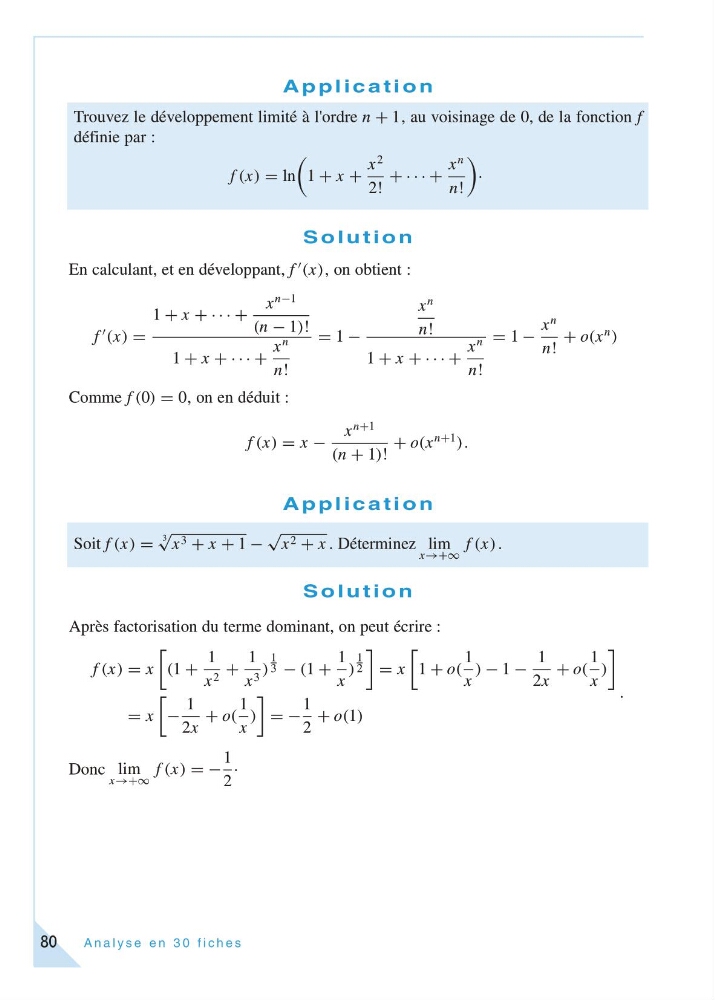
Trouvez le développement limité à l'ordre n + 1, au voisinage de 0, de la fonction f
définie par :
f (x) = ln
1 + x +
x
2
2!
+ · · · +
x
n
n!
·
S o l u t i o n
En calculant, et en développant, f
(x), on obtient :
f
(x) =
1 + x + · · · +
x
n−1
(n − 1)!
1 + x + · · · +
x
n
n!
= 1 −
x
n
n!
1 + x + · · · +
x
n
n!
= 1 −
x
n
n!
+ o(x
n
)
Comme f (0) = 0, on en déduit :
f (x) = x −
x
n+1
(n + 1)!
+ o(x
n+1
).
A p p l i c a t i o n
Soit f (x) =
3
√
x 3 + x + 1 −
√
x 2 + x . Déterminez lim
x→+∞
f (x) .
S o l u t i o n
Après factorisation du terme dominant, on peut écrire :
f (x) = x
(1 +
1
x 2 +
1
x 3 )
1
3 − (1 +
1
x
)
1
2
= x
1 + o(
1
x
) − 1 −
1
2x
+ o(
1
x
)
= x
−
1
2x
+ o(
1
x
)
= −
1
2
+ o(1)
.
Donc lim
x→+∞
f (x) = −
1
2
·
A n a l y s e e n 3 0 f i c h e s
A p p l i c a t i o n
Trouvez le développement limité à l'ordre n + 1, au voisinage de 0, de la fonction f
définie par :
f (x) = ln
1 + x +
x
2
2!
+ · · · +
x
n
n!
·
S o l u t i o n
En calculant, et en développant, f
(x), on obtient :
f
(x) =
1 + x + · · · +
x
n−1
(n − 1)!
1 + x + · · · +
x
n
n!
= 1 −
x
n
n!
1 + x + · · · +
x
n
n!
= 1 −
x
n
n!
+ o(x
n
)
Comme f (0) = 0, on en déduit :
f (x) = x −
x
n+1
(n + 1)!
+ o(x
n+1
).
A p p l i c a t i o n
Soit f (x) =
3
√
x 3 + x + 1 −
√
x 2 + x . Déterminez lim
x→+∞
f (x) .
S o l u t i o n
Après factorisation du terme dominant, on peut écrire :
f (x) = x
(1 +
1
x 2 +
1
x 3 )
1
3 − (1 +
1
x
)
1
2
= x
1 + o(
1
x
) − 1 −
1
2x
+ o(
1
x
)
= x
−
1
2x
+ o(
1
x
)
= −
1
2
+ o(1)
.
Donc lim
x→+∞
f (x) = −
1
2
·