

40
A n a l y s e e n 3 0 f i c h e s
A p p l i c a t i o n
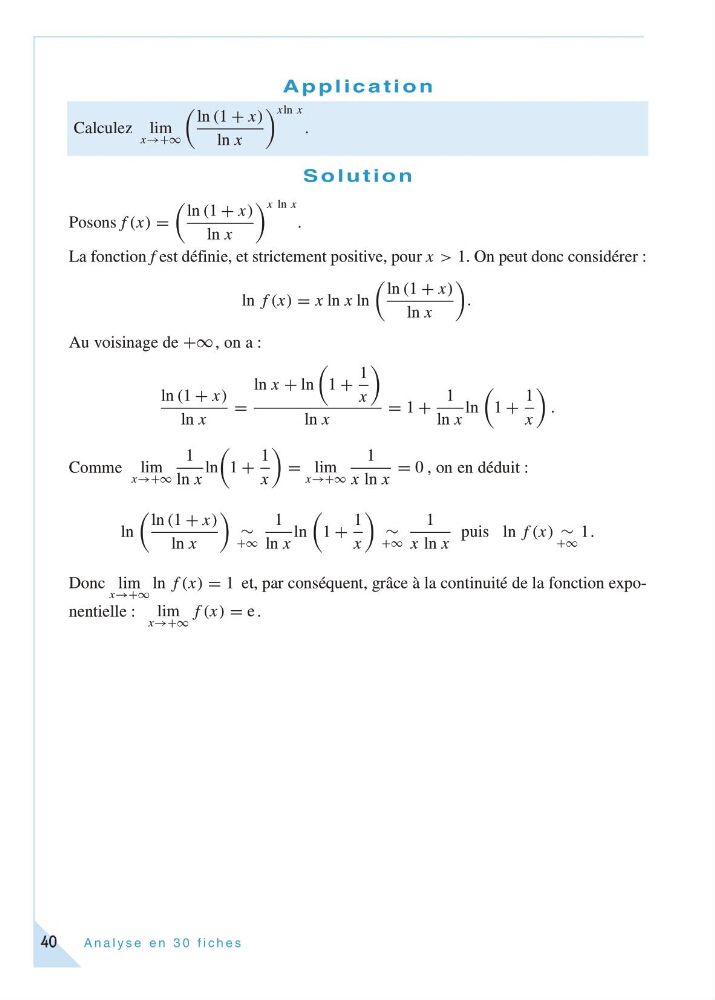
Calculez lim
x→+∞
ln (1 + x)
ln x
xln x
.
S o l u t i o n
Posons f (x) =
ln (1 + x)
ln x
x ln x
.
La fonction f est définie, et strictement positive, pour x > 1. On peut donc considérer :
ln f (x) = x ln x ln
ln (1 + x)
ln x
.
Au voisinage de +∞ , on a :
ln (1 + x)
ln x
=
ln x + ln
1 +
1
x
ln x
= 1 +
1
ln x
ln
1 +
1
x
.
Comme lim
x→+∞
1
ln x
ln
1 +
1
x
= lim
x→+∞
1
x ln x
= 0 , on en déduit :
ln
ln (1 + x)
ln x
∼
+∞
1
ln x
ln
1 +
1
x
∼
+∞
1
x ln x
puis ln f (x) ∼
+∞
1.
Donc lim
x→+∞
ln f (x) = 1 et, par conséquent, grâce à la continuité de la fonction exponentielle : lim
x→+∞
f (x) = e .
A n a l y s e e n 3 0 f i c h e s
A p p l i c a t i o n
Calculez lim
x→+∞
ln (1 + x)
ln x
xln x
.
S o l u t i o n
Posons f (x) =
ln (1 + x)
ln x
x ln x
.
La fonction f est définie, et strictement positive, pour x > 1. On peut donc considérer :
ln f (x) = x ln x ln
ln (1 + x)
ln x
.
Au voisinage de +∞ , on a :
ln (1 + x)
ln x
=
ln x + ln
1 +
1
x
ln x
= 1 +
1
ln x
ln
1 +
1
x
.
Comme lim
x→+∞
1
ln x
ln
1 +
1
x
= lim
x→+∞
1
x ln x
= 0 , on en déduit :
ln
ln (1 + x)
ln x
∼
+∞
1
ln x
ln
1 +
1
x
∼
+∞
1
x ln x
puis ln f (x) ∼
+∞
1.
Donc lim
x→+∞
ln f (x) = 1 et, par conséquent, grâce à la continuité de la fonction exponentielle : lim
x→+∞
f (x) = e .