

EXPERIMENT 2—2
43
joint should be about 10 cm. from the lament to avoid melting its
wax by the heat from the lament. The lament should be of the
dull emitter type, otherwise, the light from the electron beam Will
be masked by the light from the lament. The slit in the anode
imay be about 1 mm. wide and 5 mm. long, placed vertically to the
plane of the paper
in gure 2—12. The tube is exhaust‘ed to
0.005 mm. pressure or until
beam is clearly dened
as it passes through the anode. If the pressure
is too high, the
'
beam will be diffuse and accurate measurements can not be made.
If the pressure
is too low, the beam will not be Visible.* By the
use of a charcoal trap H Which has been baked out during the
evacuation, and liquid air or carbon dioxide snow (“ dry ice ”),
the pressure may be adjusted quite satisfactorily.
A second diaphragm with a comparatively wide slit, mounted
-
about 5 millimeters beyond the
anode E and electrically con_
_
/
.
-:
..
nected thereto, may
be used to
{\\—_—
cut OH the slower electrons and
|
\
b
“a
sharpen the denition of the
“: ' \\
-
electron beam. It has also been
L
found adviSable to silver the
"
"'—”7_
inner walls of the tube, eXCept
in the region of the lament
.G
,
—
.
and a narrow observation slit
{
of radius r.
The anode touches
_
WM“
_
this silvered surface and pre- franc.
.
‘
_
'
_
vents the accumulation of
°
"
_
—
tro—static charges on the inner »
—
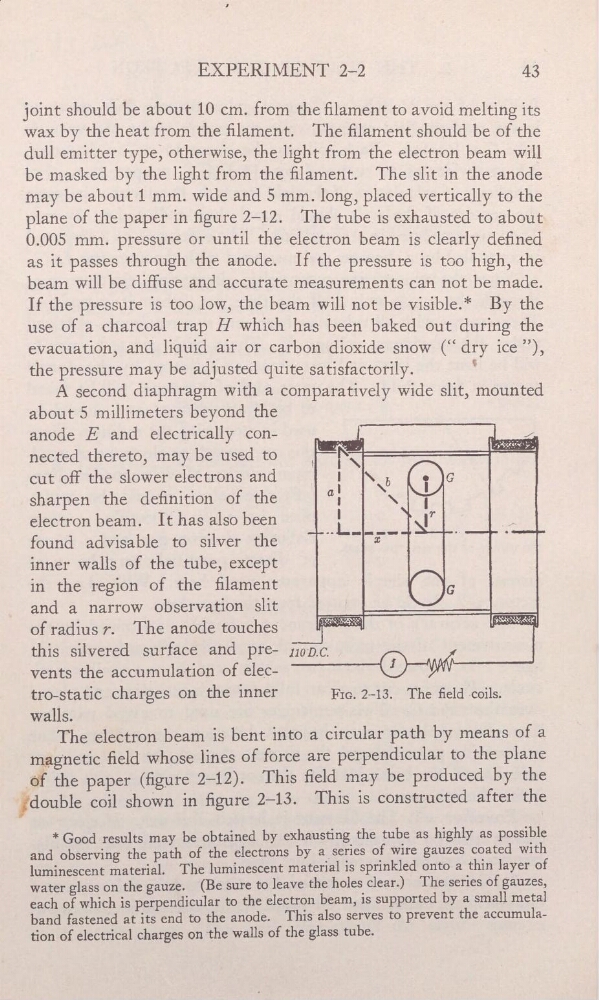
Fm. 2_13_
The e1dÎcoils.
,
walls.
[
'
The electron beam is bent into a circular path by means of a
eld whose lines of force arepe‘rpendicular to the plane
_,6Ïf “the paper (gure 2—12). This field may
be produced byth—e
'
coil shown in gure 2—13. This is constructed after the
'
'
* Good-results may be obtained by exha‘usting the tube as highly
possible
_
_
and observing the
the electrons by a_series of Wire
coated with
“_
lumihescent material.
Thé
material" is sprinkled onto a thin layer of
.
.
water glass on the gauze. ”(Be Sure to leave the holes clear.) The series
of gauzes,
_
,
each of which is perpendicular to the electron beam, is supported by a small metal
'
band fastenéd at its end to the anode.
This also serves to prevent the accumula—
tion of electrical chargesgon the Walls of the glass tube.
.
,
L‘
43
joint should be about 10 cm. from the lament to avoid melting its
wax by the heat from the lament. The lament should be of the
dull emitter type, otherwise, the light from the electron beam Will
be masked by the light from the lament. The slit in the anode
imay be about 1 mm. wide and 5 mm. long, placed vertically to the
plane of the paper
in gure 2—12. The tube is exhaust‘ed to
0.005 mm. pressure or until
beam is clearly dened
as it passes through the anode. If the pressure
is too high, the
'
beam will be diffuse and accurate measurements can not be made.
If the pressure
is too low, the beam will not be Visible.* By the
use of a charcoal trap H Which has been baked out during the
evacuation, and liquid air or carbon dioxide snow (“ dry ice ”),
the pressure may be adjusted quite satisfactorily.
A second diaphragm with a comparatively wide slit, mounted
-
about 5 millimeters beyond the
anode E and electrically con_
_
/
.
-:
..
nected thereto, may
be used to
{\\—_—
cut OH the slower electrons and
|
\
b
“a
sharpen the denition of the
“: ' \\
-
electron beam. It has also been
L
found adviSable to silver the
"
"'—”7_
inner walls of the tube, eXCept
in the region of the lament
.G
,
—
.
and a narrow observation slit
{
of radius r.
The anode touches
_
WM“
_
this silvered surface and pre- franc.
.
‘
_
'
_
vents the accumulation of
°
"
_
—
tro—static charges on the inner »
—
Fm. 2_13_
The e1dÎcoils.
,
walls.
[
'
The electron beam is bent into a circular path by means of a
eld whose lines of force arepe‘rpendicular to the plane
_,6Ïf “the paper (gure 2—12). This field may
be produced byth—e
'
coil shown in gure 2—13. This is constructed after the
'
'
* Good-results may be obtained by exha‘usting the tube as highly
possible
_
_
and observing the
the electrons by a_series of Wire
coated with
“_
lumihescent material.
Thé
material" is sprinkled onto a thin layer of
.
.
water glass on the gauze. ”(Be Sure to leave the holes clear.) The series
of gauzes,
_
,
each of which is perpendicular to the electron beam, is supported by a small metal
'
band fastenéd at its end to the anode.
This also serves to prevent the accumula—
tion of electrical chargesgon the Walls of the glass tube.
.
,
L‘