

406
17.
SMALL CURRENT TECHNIQUE
be measured is applied
to
the needle N.
This needle is an
extremely thin platinum
sheet suspended at one end (instead of
the middle) and located symmetrically
with respect to the two
halves, close to the lower plates. The binants are surrounded
with a heavy metal sheath to help maintain a constant temperaS
ture.
The instrument has a volt—
?
age
sensitiveness about equal to
;)
ÆL
that of the Dolezalek type but,
.N.in
view
of
its
small capacity
——x'…
l
(about a e.s.u.), it is
recl
;
g; î
13
ord much smaller quantrt1es and
P
currents of electricity.
For exam"
ple, it has been used to measure
FIG' 17—20”
the ionization produced by a single
alpha particle.
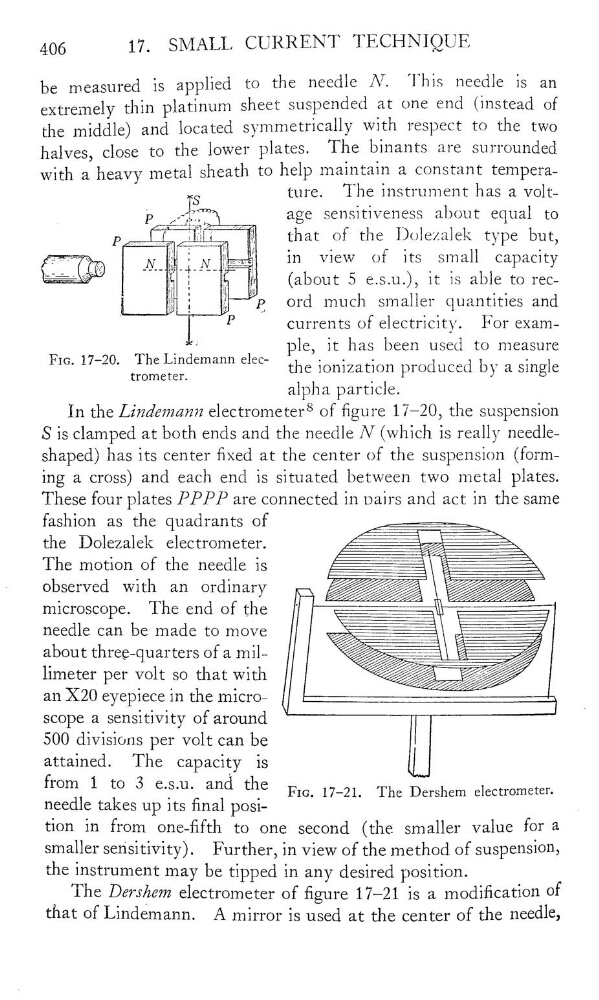
ln the Lindemcmn electrometer8 of gure 17—20> the suspension
8 is clamped at both ends and the needle N (which is really needle—
shaped) has its center fixed at the center of the suspension (forming a cross) and each end is situated between two metal plates.
These four plates PPPP are connected in pairs and act in the same
fashion as the quadrants of
__==_
the Dolezalek electrometer.
The motion of the needle is
ËË
observed
With an ordinary
‘
////////,
microscope.
The end of the
___—\\
_
needle can be made to move
%
about three—quarters of a mil…
11meter per volt so
that with
———-—-———scope a sensitivity of around
500 divisions per volt can be
attained.
The
capacity is
from 1 to 3 €'_S'u'
and the FIG. 17—21. The Dershem electrometer.
needle takes up 1ts nal posr—
tion in from one—fth to one second (the smaller value for a
smaller sensitivity). Further, in view of the method of suspension:
the instrument may be tipped in any desired position.
The Dem/rem electrometer of gure 17—21 is a modication of
that of Lindémann.
A mirror is used at the center of the needle,
17.
SMALL CURRENT TECHNIQUE
be measured is applied
to
the needle N.
This needle is an
extremely thin platinum
sheet suspended at one end (instead of
the middle) and located symmetrically
with respect to the two
halves, close to the lower plates. The binants are surrounded
with a heavy metal sheath to help maintain a constant temperaS
ture.
The instrument has a volt—
?
age
sensitiveness about equal to
;)
ÆL
that of the Dolezalek type but,
.N.in
view
of
its
small capacity
——x'…
l
(about a e.s.u.), it is
recl
;
g; î
13
ord much smaller quantrt1es and
P
currents of electricity.
For exam"
ple, it has been used to measure
FIG' 17—20”
the ionization produced by a single
alpha particle.
ln the Lindemcmn electrometer8 of gure 17—20> the suspension
8 is clamped at both ends and the needle N (which is really needle—
shaped) has its center fixed at the center of the suspension (forming a cross) and each end is situated between two metal plates.
These four plates PPPP are connected in pairs and act in the same
fashion as the quadrants of
__==_
the Dolezalek electrometer.
The motion of the needle is
ËË
observed
With an ordinary
‘
////////,
microscope.
The end of the
___—\\
_
needle can be made to move
%
about three—quarters of a mil…
11meter per volt so
that with
———-—-———scope a sensitivity of around
500 divisions per volt can be
attained.
The
capacity is
from 1 to 3 €'_S'u'
and the FIG. 17—21. The Dershem electrometer.
needle takes up 1ts nal posr—
tion in from one—fth to one second (the smaller value for a
smaller sensitivity). Further, in view of the method of suspension:
the instrument may be tipped in any desired position.
The Dem/rem electrometer of gure 17—21 is a modication of
that of Lindémann.
A mirror is used at the center of the needle,