

17—15.
VARIOUS FORMS OF ELECTROMETERS 405
like ÊhfÎ
rotor plates of a variable condenser in a radio set. One
slet
o
xed plates and
the needle are connected to one terminal of
t1e instrument vyh11e
the other set of xed plates is joined to
the second binding post, so that the meter
.
operates idiostatically. The instrument is
rugged in construction and covers a wide
'
range of voltages (zero to many thousand)
either a.c. or de.
Unlike the D’Arsonval
type meters, it does not use any current
'
for its operation.
It requires leveling before
being used.
:
If the needle of a Dolezalek electrometer
is tilted slightly along its axis, the electro-static
and mechanical restoring cou les 0 ose each
-
other.
This means that a smîller ii£edle vol— :..-…-…Q
tage is
needed to produce a given deection F1G.17—18. The com,,
than if the couples aid each other, and that
ton electrometerthe instrument Will haveahigh sensitivity. In.
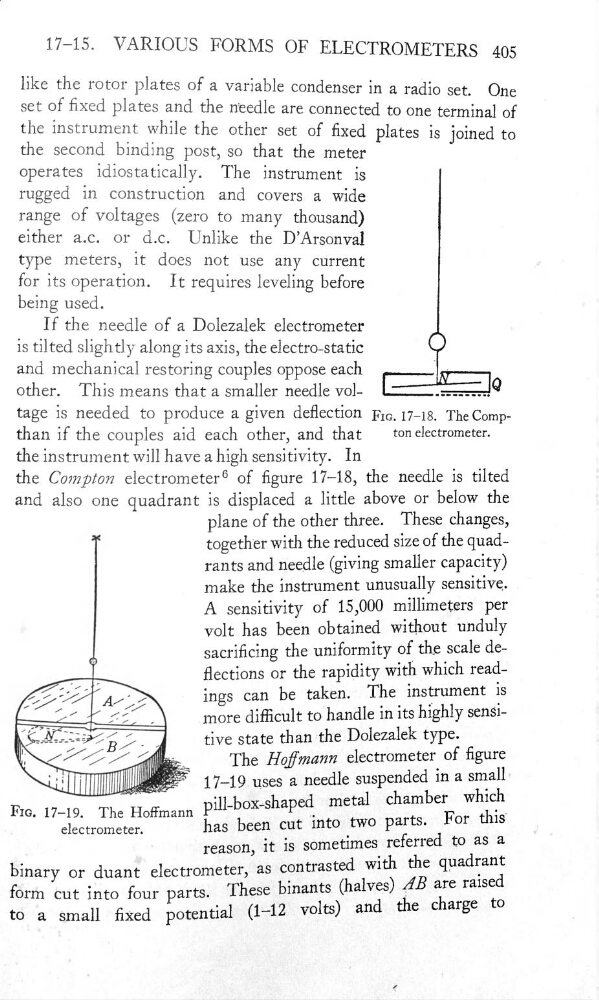
the Compton electrometer6 of gure 17—18, the needle is tilted
and also one quadrant is displaced a little above or below the
plane of the other three. These changes,
_
together With the reduced size of the qu—ad'
rants and needle (giving smaller capacity)
make the instrument unusually sensitive.
_
A sensitivity of 15,000
_
volt has been obtained without imduly
sacricing the uniformity
of the scale de—
.
_
ections or the rapid—ity
With which read-f
-
ings can be taken. The instrument is
‘
/
’
/—’
,
.more diicult to handle in its highly sensi—
—
/%3//,
tive state than
Dolezalek type.
,
//// /
The Homai7m electrometer of gure
.
'
'
'
17—19 uses a needle suspended in a small= -
Fm_
The Hoffmann
meta-l Chamber Which
-
electrometer.
'
has been Cllt '1nt0.ltW0 parts.
For -th_lS
;
_
,
reason,
it is: sometimes referred to as
a
‘
binary or duant electrometer, as côntrasted With the quadf_ant
.
form Cut into four parts. TheSe binan_ts (halV33)
to" a Small 'X€d potential
and the charge
to
VARIOUS FORMS OF ELECTROMETERS 405
like ÊhfÎ
rotor plates of a variable condenser in a radio set. One
slet
o
xed plates and
the needle are connected to one terminal of
t1e instrument vyh11e
the other set of xed plates is joined to
the second binding post, so that the meter
.
operates idiostatically. The instrument is
rugged in construction and covers a wide
'
range of voltages (zero to many thousand)
either a.c. or de.
Unlike the D’Arsonval
type meters, it does not use any current
'
for its operation.
It requires leveling before
being used.
:
If the needle of a Dolezalek electrometer
is tilted slightly along its axis, the electro-static
and mechanical restoring cou les 0 ose each
-
other.
This means that a smîller ii£edle vol— :..-…-…Q
tage is
needed to produce a given deection F1G.17—18. The com,,
than if the couples aid each other, and that
ton electrometerthe instrument Will haveahigh sensitivity. In.
the Compton electrometer6 of gure 17—18, the needle is tilted
and also one quadrant is displaced a little above or below the
plane of the other three. These changes,
_
together With the reduced size of the qu—ad'
rants and needle (giving smaller capacity)
make the instrument unusually sensitive.
_
A sensitivity of 15,000
_
volt has been obtained without imduly
sacricing the uniformity
of the scale de—
.
_
ections or the rapid—ity
With which read-f
-
ings can be taken. The instrument is
‘
/
’
/—’
,
.more diicult to handle in its highly sensi—
—
/%3//,
tive state than
Dolezalek type.
,
//// /
The Homai7m electrometer of gure
.
'
'
'
17—19 uses a needle suspended in a small= -
Fm_
The Hoffmann
meta-l Chamber Which
-
electrometer.
'
has been Cllt '1nt0.ltW0 parts.
For -th_lS
;
_
,
reason,
it is: sometimes referred to as
a
‘
binary or duant electrometer, as côntrasted With the quadf_ant
.
form Cut into four parts. TheSe binan_ts (halV33)
to" a Small 'X€d potential
and the charge
to