

404
17.
SMALL CURRENT TECHNIQUE
.
17—13.
Capacity of the Quadrant System.—This includes the
“capacity of the insulated quadrant, the connecting wires and the
insulated collector in the associated ionization chamber, or other
auxiliary equipment, With respect to the grounded casings. A
procedure identical With that just given for measuring the absolute
value of a current may be used.
Equations 17—15 and 17—16 give
ii
0 = co ——-———
<17—4)
l2 — [1
The 'inductional method of Harms"c oHers greater accuracy in
determining the capacity of an electrometer than that just
Although simple in operation, its discussion is too
detailed to be included here.
.
17—14.
Measurement of Quantity of Electricity.—If a quantity of electricity (g) is placed on an insulated quadrant system
having capacity (C), the 'needle Will be deected to a voltage (v).
_
Then
q = Cv
(17—18)
where allvalues are measured in the same units.
Here, :) is.
'
obtained from the voltage-deection curve.
17—15.
Various Forms of Electrometers.—The
previous discussion has centered about the Dole.
® @
zalek type since it is one of the most widely used
Ï
of the various forms.
Many other types have
'
,
‘
’
been designed, some using only two quadrants,
_
.
‘
others as many as six sectors in place of the usual
_
"
four of the quadrant form. In some, the potential,
,‘=
_
’ _. current or quantity to be measured is applied
,
_
_
,
to the quadrants while, in others, the needlelS
Ÿ PË
P
_
used and the quadrants are raised to a xed pO'
_‘
*
_tential.
In the following paragraphs, a
_
—
] given on each of the principal types. -
,
”
N
_,i
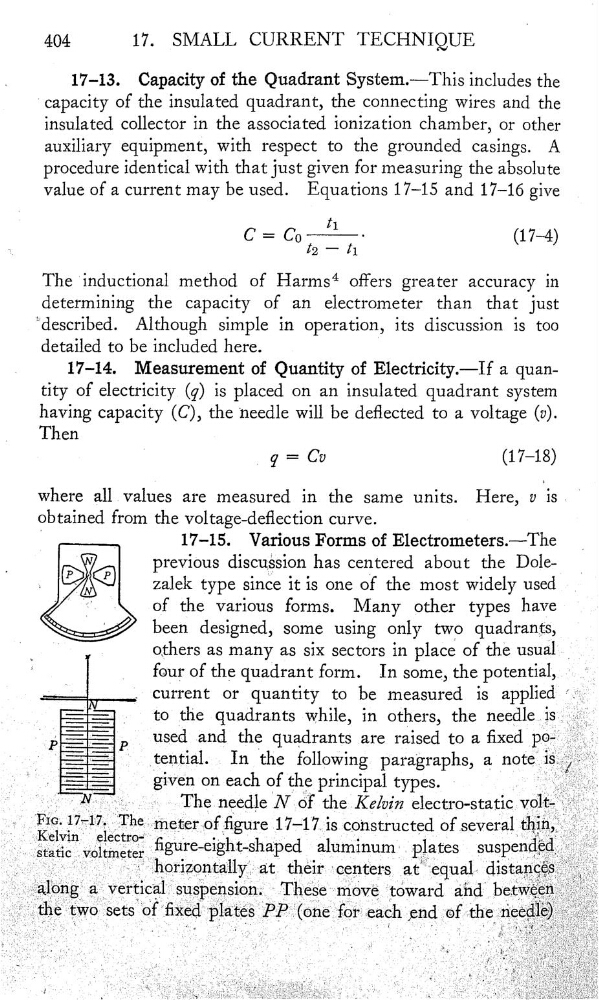
…Theneedle N et the
electro—static volt—
FIG
gure 17—17_is Constructed of .seVeral th1n,
f
Kelvm
'
ed aluminu ?
.
…
late
us
ended
.
u
P
_m_ P y
S
S, P
*h0r120ntallyat théif centers
dlstanœs
alongavemcalsuspenswn
,
"
between
17.
SMALL CURRENT TECHNIQUE
.
17—13.
Capacity of the Quadrant System.—This includes the
“capacity of the insulated quadrant, the connecting wires and the
insulated collector in the associated ionization chamber, or other
auxiliary equipment, With respect to the grounded casings. A
procedure identical With that just given for measuring the absolute
value of a current may be used.
Equations 17—15 and 17—16 give
ii
0 = co ——-———
<17—4)
l2 — [1
The 'inductional method of Harms"c oHers greater accuracy in
determining the capacity of an electrometer than that just
Although simple in operation, its discussion is too
detailed to be included here.
.
17—14.
Measurement of Quantity of Electricity.—If a quantity of electricity (g) is placed on an insulated quadrant system
having capacity (C), the 'needle Will be deected to a voltage (v).
_
Then
q = Cv
(17—18)
where allvalues are measured in the same units.
Here, :) is.
'
obtained from the voltage-deection curve.
17—15.
Various Forms of Electrometers.—The
previous discussion has centered about the Dole.
® @
zalek type since it is one of the most widely used
Ï
of the various forms.
Many other types have
'
,
‘
’
been designed, some using only two quadrants,
_
.
‘
others as many as six sectors in place of the usual
_
"
four of the quadrant form. In some, the potential,
,‘=
_
’ _. current or quantity to be measured is applied
,
_
_
,
to the quadrants while, in others, the needlelS
Ÿ PË
P
_
used and the quadrants are raised to a xed pO'
_‘
*
_tential.
In the following paragraphs, a
_
—
] given on each of the principal types. -
,
”
N
_,i
…Theneedle N et the
electro—static volt—
FIG
gure 17—17_is Constructed of .seVeral th1n,
f
Kelvm
'
ed aluminu ?
.
…
late
us
ended
.
u
P
_m_ P y
S
S, P
*h0r120ntallyat théif centers
dlstanœs
alongavemcalsuspenswn
,
"
between