

17—12.
CURRENT MEASUREMENTS
403
S’ changes in any way.
Both of these quantities do change some,
what and S’ is a complicated function of the needle potential.*
This is due to four couples; rst, the electrical couple of attraction
and repulsion of the electrical charges; second, the mechanical
restoring couple; third, the electrostatic distortion couple, and
fourth, an additional damping effect caused by the reaction of the
charges set up on the quadrants by the motion of the charged
needle, known as the i77dzrcli07m/ electrwîafic com‘ro/.
This last is
analogous to the damping elTect of a loop of wire on the moving
coil of a galvanometer. Thus, in order that the rates of deection
of the needle of the quadrant electrometer may be taken as
proportional to the currents to be compared, it is necessary to
use
the same part
of the scale and to keep the needle potential
xed.
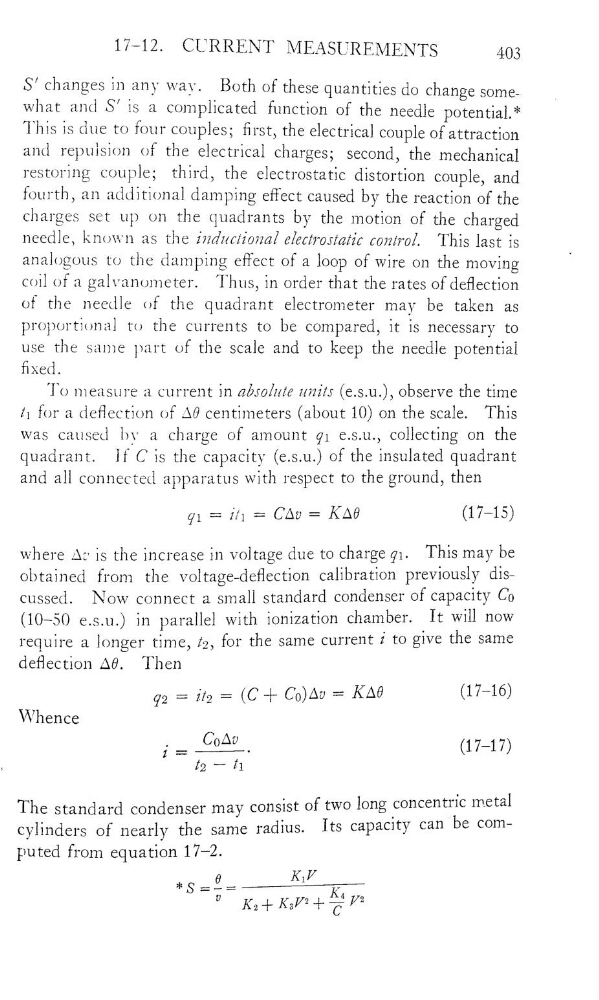
To measure a current in aéro/aie units (e.s.u.), observe the time
[1 for a detlection of A8 centimeters (about 10) on the scale. This
was
caused by a charge of amount gl e.s.u., collecting on the
quadrant.
lf C is the capacity (e.s.u.) of the insulated quadrant
and all connected apparatus
with respect to the ground, then
g1 = H] = CA?) = KAÛ
(17—15)
where Ac is the increase in voltage due to charge ÿ1.
This may be
obtained from the voltage-decction calibration previously dis—
cussed.
Now connect a small standard condenser of capacity Co
(IO—SO e.s.u.) in parallel with ionization chamber.
will now
require a longer time, Ï2, for the same current z' to give
the same
deection A6.
Then
=
,:;2 = (0+ Cg)AU = KA6
(17—16)
Whence
ŒM_
(nan
l‘2 — Îl
The standard condenser may
consist of two long concentriC
metal
cylinders of nearly the same radius. Its capaC1tY
can
be com—
puted from equation 17—2.
*S=g=____££;Î__
”
CURRENT MEASUREMENTS
403
S’ changes in any way.
Both of these quantities do change some,
what and S’ is a complicated function of the needle potential.*
This is due to four couples; rst, the electrical couple of attraction
and repulsion of the electrical charges; second, the mechanical
restoring couple; third, the electrostatic distortion couple, and
fourth, an additional damping effect caused by the reaction of the
charges set up on the quadrants by the motion of the charged
needle, known as the i77dzrcli07m/ electrwîafic com‘ro/.
This last is
analogous to the damping elTect of a loop of wire on the moving
coil of a galvanometer. Thus, in order that the rates of deection
of the needle of the quadrant electrometer may be taken as
proportional to the currents to be compared, it is necessary to
use
the same part
of the scale and to keep the needle potential
xed.
To measure a current in aéro/aie units (e.s.u.), observe the time
[1 for a detlection of A8 centimeters (about 10) on the scale. This
was
caused by a charge of amount gl e.s.u., collecting on the
quadrant.
lf C is the capacity (e.s.u.) of the insulated quadrant
and all connected apparatus
with respect to the ground, then
g1 = H] = CA?) = KAÛ
(17—15)
where Ac is the increase in voltage due to charge ÿ1.
This may be
obtained from the voltage-decction calibration previously dis—
cussed.
Now connect a small standard condenser of capacity Co
(IO—SO e.s.u.) in parallel with ionization chamber.
will now
require a longer time, Ï2, for the same current z' to give
the same
deection A6.
Then
=
,:;2 = (0+ Cg)AU = KA6
(17—16)
Whence
ŒM_
(nan
l‘2 — Îl
The standard condenser may
consist of two long concentriC
metal
cylinders of nearly the same radius. Its capaC1tY
can
be com—
puted from equation 17—2.
*S=g=____££;Î__
”