

17—15.
VARIOUS FORMS OF ELECTROMETERS 407‘
with consequent magnication of the movement and case of read,—
ing on a large scale. The needle can never touch the qùadrants,
eliminating the need for a series protective resistance and increas—
ing the life of the instrument. Provision is made for the adjùstment of the quadrants and the tension and orientation of the
needle.
In the instruments now available, the dimensions are
approximately one and one-half those in the Lindemann electrom—
eter.
The suspension is of quartz, metallized by the evaporation
_
process.
The unknown voltage is applied to the needle, in a
balanced circuit (see gure 17—15) With 50 volts each side of
for the quadrants (a total of 100 volts). The instrument may be
tipped in any position. The capacity is approximately 7 e.s.u.;
the period is less than one second. The
——
a
maximum sensitivity for stable opera—
ËË’
_
ËË
% ëä‘;
-
tion is about 4000 millimeters per volt,
| l
at one meter.
The sensitivity is greater
'
,
when a ne suspension is used.
It
_
_
increases very rapidly with increase in
K
5
'
'
quadrant voltage so that the supply
_
Ï _
'
batteries must be accurately constant,
'
'
especially at the higher sensitivities.
5
?
‘
The scale is uniform up
to a rotation of
,
î
,
‘
about ten degrees, beyond which the '—…;
:
…
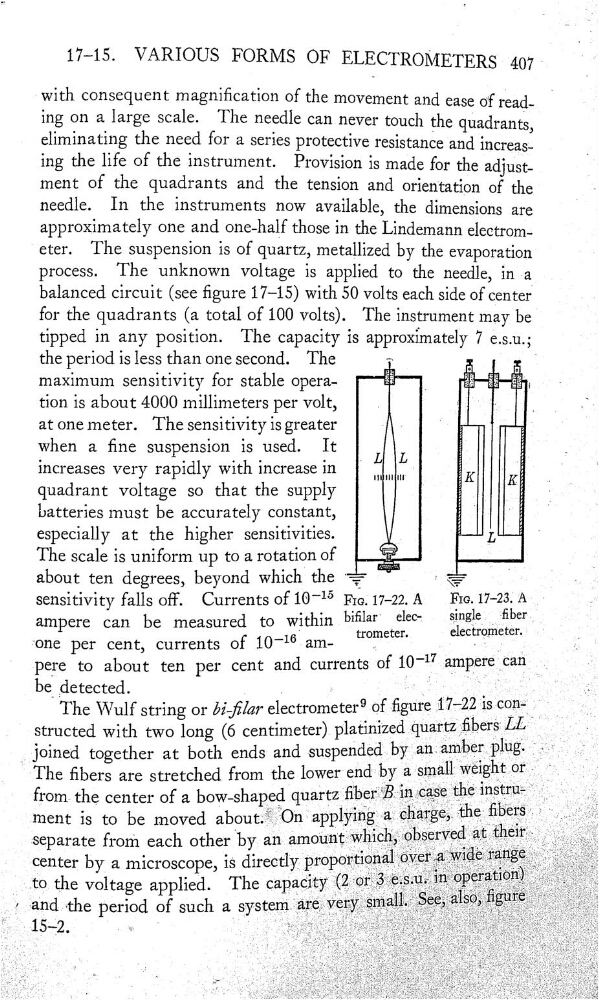
sensitivity falls off. Currents of 10—15 Fm. 17—22. A
Ere.
17—23. A
,
ampere can be measured to within
bilar '
elec“
.Tberï
trometer.
e ectrolete
_
roue
per cent, currents of 10—16am—
-
_,
’_
'
'
‘
pere
to
about ten per
cent and currents of 10—17
detected.
.
:»
_
The VJulf string or bi-lar electrometer9-Of gure
'
_
'
structed with two long (6 centimeter) platinîZ@d quafüberSLL
,
__
joined together at both ends and
The bers are stretched, from the lowerendby
‘
‘
from the center of a bow-shap€d quarth1efBlncasethemStm"
ment is to be moved
charge, the bers
VARIOUS FORMS OF ELECTROMETERS 407‘
with consequent magnication of the movement and case of read,—
ing on a large scale. The needle can never touch the qùadrants,
eliminating the need for a series protective resistance and increas—
ing the life of the instrument. Provision is made for the adjùstment of the quadrants and the tension and orientation of the
needle.
In the instruments now available, the dimensions are
approximately one and one-half those in the Lindemann electrom—
eter.
The suspension is of quartz, metallized by the evaporation
_
process.
The unknown voltage is applied to the needle, in a
balanced circuit (see gure 17—15) With 50 volts each side of
for the quadrants (a total of 100 volts). The instrument may be
tipped in any position. The capacity is approximately 7 e.s.u.;
the period is less than one second. The
——
a
maximum sensitivity for stable opera—
ËË’
_
ËË
% ëä‘;
-
tion is about 4000 millimeters per volt,
| l
at one meter.
The sensitivity is greater
'
,
when a ne suspension is used.
It
_
_
increases very rapidly with increase in
K
5
'
'
quadrant voltage so that the supply
_
Ï _
'
batteries must be accurately constant,
'
'
especially at the higher sensitivities.
5
?
‘
The scale is uniform up
to a rotation of
,
î
,
‘
about ten degrees, beyond which the '—…;
:
…
sensitivity falls off. Currents of 10—15 Fm. 17—22. A
Ere.
17—23. A
,
ampere can be measured to within
bilar '
elec“
.Tberï
trometer.
e ectrolete
_
roue
per cent, currents of 10—16am—
-
_,
’_
'
'
‘
pere
to
about ten per
cent and currents of 10—17
detected.
.
:»
_
The VJulf string or bi-lar electrometer9-Of gure
'
_
'
structed with two long (6 centimeter) platinîZ@d quafüberSLL
,
__
joined together at both ends and
The bers are stretched, from the lowerendby
‘
‘
from the center of a bow-shap€d quarth1efBlncasethemStm"
ment is to be moved
charge, the bers