

318
14.
ARTIFICIAL TRANSMUTATION
'
ruled out the 50 Mev value.
Thus, he identied the “radiations”
as particles of approximately the same mass as that of protons.
The tremendous penetratihg power of these particles in heavy
elements and their inability to ionize a gas led Chadwick to believe
that they were uncharged (neutrons). Without any electrical eld
of their own, neutrons do not interact with the electrical elds of
atoms through which they are passing and hence do not eject
electrons. A nuclear impact is required to stop a neutron. It has
been estimated that one collision with a nucleus may be expected
‘
in every three or four hundred yards of air and that several miles
,
!
would be required to stop all the neutrons in a group. This is to
'
be compared with a distance of one foot needed to stop the protons
‘
…
,
in a group
of the same velocity (3 X 109 cm./sec.).
_
,
The work of Chadwick was conrmed by Featherll, in 1933,
with an expansion chamber, as in gure 14—6d. The
ejected from beryllium (Be), were used to bombard nitrogen
atoms in the chamber D. Neutron tracks were not seen (hence the
dotted line) but nitrogen recoil tracks (N) were observed. Their
range was found to be 3.3 millimeters of standard air, equivalent
to 4.4 X 10⁸ centimeters per second and an energy of 1.4 MeVThe angle of recoil was measured on the steroscopic photographs
and the laws of conservation of energy and momentum applied to
this elastic collision (no loss of kinetic energy). The energies of the
_
neutrons was computed and a check of the previous work resulted.
In other work12 with expansion chambers two tracks have been
observed, starting from the same point; the neutron can cause
a transmutation. (See guré 14—66). .Many cases have been obas discussed later.
Ÿ:Ï_Ï
_
14—12.
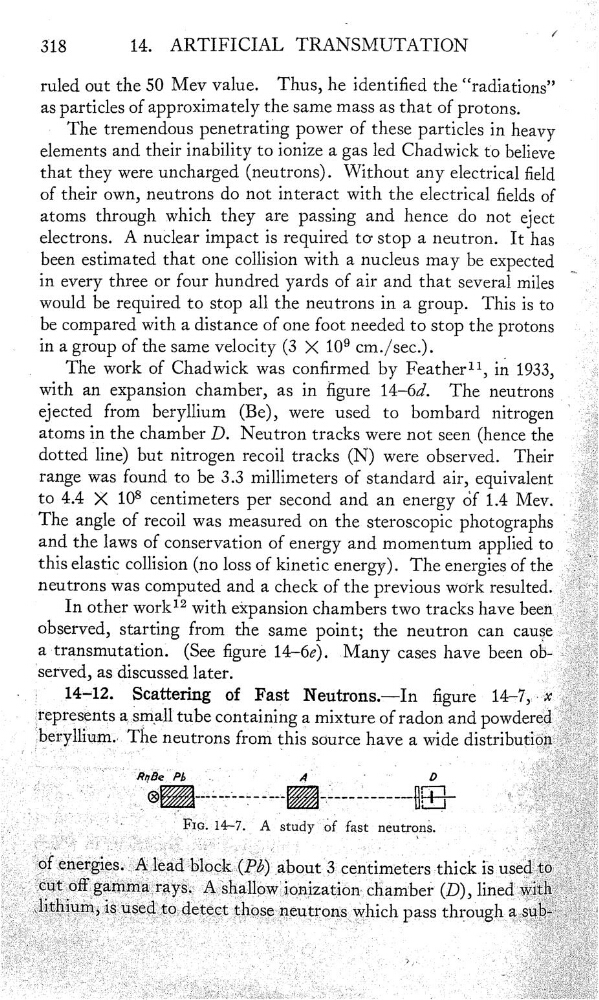
Scàtteng of Fast Neutrons.——In gure 14—7, - x
-
grepres‘ents a small tube containing a mixture of radon and powdered
beryll1umThe neutrons from this sCurce have a wide d1str1but10n
'
®““liE“
,
“
FIG.
fast nèutrqnè.
iîs usedt°
cutffgammarays Ashallowmnzatmhwba (D). hnedWïth
hthmm‘susedt0deœctthoseneutronswhmh pass through,asu
14.
ARTIFICIAL TRANSMUTATION
'
ruled out the 50 Mev value.
Thus, he identied the “radiations”
as particles of approximately the same mass as that of protons.
The tremendous penetratihg power of these particles in heavy
elements and their inability to ionize a gas led Chadwick to believe
that they were uncharged (neutrons). Without any electrical eld
of their own, neutrons do not interact with the electrical elds of
atoms through which they are passing and hence do not eject
electrons. A nuclear impact is required to stop a neutron. It has
been estimated that one collision with a nucleus may be expected
‘
in every three or four hundred yards of air and that several miles
,
!
would be required to stop all the neutrons in a group. This is to
'
be compared with a distance of one foot needed to stop the protons
‘
…
,
in a group
of the same velocity (3 X 109 cm./sec.).
_
,
The work of Chadwick was conrmed by Featherll, in 1933,
with an expansion chamber, as in gure 14—6d. The
ejected from beryllium (Be), were used to bombard nitrogen
atoms in the chamber D. Neutron tracks were not seen (hence the
dotted line) but nitrogen recoil tracks (N) were observed. Their
range was found to be 3.3 millimeters of standard air, equivalent
to 4.4 X 10⁸ centimeters per second and an energy of 1.4 MeVThe angle of recoil was measured on the steroscopic photographs
and the laws of conservation of energy and momentum applied to
this elastic collision (no loss of kinetic energy). The energies of the
_
neutrons was computed and a check of the previous work resulted.
In other work12 with expansion chambers two tracks have been
observed, starting from the same point; the neutron can cause
a transmutation. (See guré 14—66). .Many cases have been obas discussed later.
Ÿ:Ï_Ï
_
14—12.
Scàtteng of Fast Neutrons.——In gure 14—7, - x
-
grepres‘ents a small tube containing a mixture of radon and powdered
beryll1umThe neutrons from this sCurce have a wide d1str1but10n
'
®““liE“
,
“
FIG.
fast nèutrqnè.
iîs usedt°
cutffgammarays Ashallowmnzatmhwba (D). hnedWïth
hthmm‘susedt0deœctthoseneutronswhmh pass through,asu