

14—11.
DISCOVERY OF NEUTRONS (n)
317
long range protons, were ejected. The range of the protons was
found (with the absorber, Â) to be 26 centimeters, corresponding
to a velocity of 2.9 >< 109 centimeters per second or an energy of
4.3 MeV.
Assuming that the particle was a recoil proton set in
motion by the reversal of the inci—
_
,
dent radiation in a Compton collision, they found the energy of
P0 85
A
0
the unknown radiation to be 50
Mev.
This doesnot agree with
"‘
///1
]
the value of 15 Mev obtained by
(a)
Bothe and Becker, nor with that
of the alpha particle (5.3 Mev),
P0 85
H
A
0
nor with the reaction energy to be
x
7‘ '/
_:
expected when an alpha particle is
&
% %
E “
captured by a beryllium nucleus.
(bl
In 1932,Chadwick10 suggested
that
the
radiations
were
un—
P0 55
H
A
0
charged particles of mass compar—
able with that of protons.
These
Ë-—>Ë—W
are
called
neutrons
(onl).
He
proposed the following reaction:
(C)
4369 + 2He4
P0 55
0
’
__
12
1
_
_
GC
+ on + E0
(14 14)
The absorption of neutrons m
x
4
n
a
hydrogen—rich material, H in
(d)
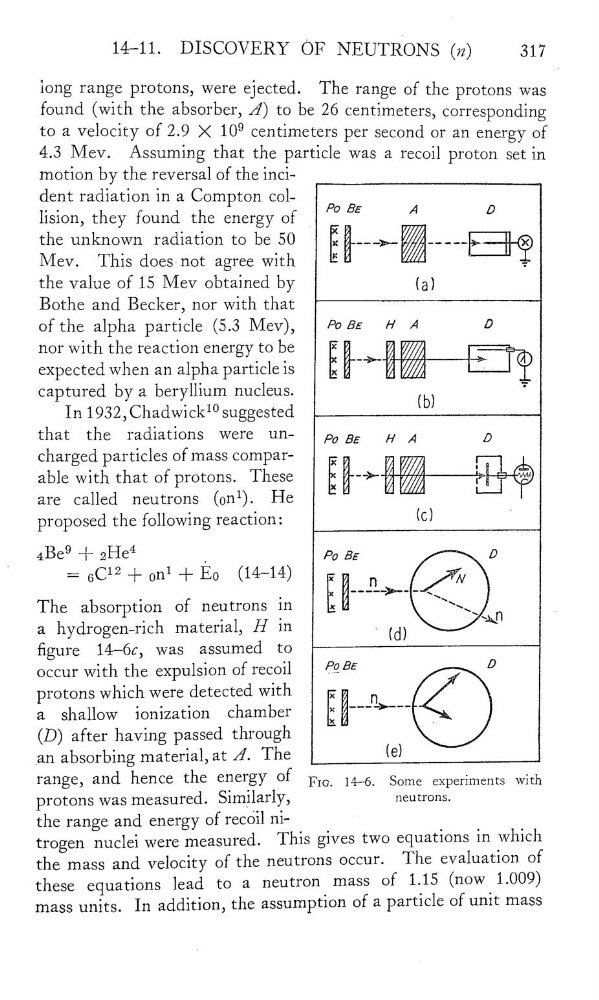
gure 14—66, was assumed to
occur with the expulsion of recoil
8.0. 55
—
0
protons which were detected with
x
;
n
<{
a
shallow
ionization
chamber
(D) after having passed through
'
_
.
an absorbing material, at Â. The
(e)
‘
'
range)
and hence the energy Of
F1G.
14—6.
Some experiments with
protons was measured. Similarly,
neutrons.
the range and energy
of recdil ni—
trogen nuclei were measured.
This gives two equations in which
the mass and velocity of the neutrons occur. The evaluation of
these equations lead to a neutron mass of 1.15 (now 1.009)
mass units. In addition, the assumption of a particle of unit mass
DISCOVERY OF NEUTRONS (n)
317
long range protons, were ejected. The range of the protons was
found (with the absorber, Â) to be 26 centimeters, corresponding
to a velocity of 2.9 >< 109 centimeters per second or an energy of
4.3 MeV.
Assuming that the particle was a recoil proton set in
motion by the reversal of the inci—
_
,
dent radiation in a Compton collision, they found the energy of
P0 85
A
0
the unknown radiation to be 50
Mev.
This doesnot agree with
"‘
///1
]
the value of 15 Mev obtained by
(a)
Bothe and Becker, nor with that
of the alpha particle (5.3 Mev),
P0 85
H
A
0
nor with the reaction energy to be
x
7‘ '/
_:
expected when an alpha particle is
&
% %
E “
captured by a beryllium nucleus.
(bl
In 1932,Chadwick10 suggested
that
the
radiations
were
un—
P0 55
H
A
0
charged particles of mass compar—
able with that of protons.
These
Ë-—>Ë—W
are
called
neutrons
(onl).
He
proposed the following reaction:
(C)
4369 + 2He4
P0 55
0
’
__
12
1
_
_
GC
+ on + E0
(14 14)
The absorption of neutrons m
x
4
n
a
hydrogen—rich material, H in
(d)
gure 14—66, was assumed to
occur with the expulsion of recoil
8.0. 55
—
0
protons which were detected with
x
;
n
<{
a
shallow
ionization
chamber
(D) after having passed through
'
_
.
an absorbing material, at Â. The
(e)
‘
'
range)
and hence the energy Of
F1G.
14—6.
Some experiments with
protons was measured. Similarly,
neutrons.
the range and energy
of recdil ni—
trogen nuclei were measured.
This gives two equations in which
the mass and velocity of the neutrons occur. The evaluation of
these equations lead to a neutron mass of 1.15 (now 1.009)
mass units. In addition, the assumption of a particle of unit mass