

14—13.
DISCOVERY OF POSITRONS (+e)
319
.
stance zÎ
.
The neutrons may be scattered to the side or they may
be captured in Â.
Measurements were made13 of the number of
neutrons reaching D as the length of  was increased. Then (as in
section 7—1) calculations weremade of the effective—cross—Section
(0) of the nuclei of  for neu—
'
trous.
The cross—section of the
5
"'
.
_Hg:°b —
neutron itself is icluded in the
5
_
.’
”'
values obtained.
4
z,,
Figure 14—8 was made by 0—3
_
Al_‘-$
using various elements at  and
2
__
-
shows _a regular increase of a
with atomic weight.
_
Of the neutrons which failed
0
50
’00
"“’
200
to
reach the chamber D, (g—
'
'
‘
ure 14—7) 3 lnaj oritY (90%) were
Nuclei-neutrdn cross—sections.
elastically scattered and the
remainder were absorbed or captured in Â. This was proved by
'
using toroids of material,' mounted axially with the dotted line,
instead of solid cylinders as shown. Then, neutrons which were
captùred did not reach D. However, most of the neutrons Wh1Ch
left the source at an angle with
were scattered by the
toroids.
_
-
'
14—13.
Discovery of Positrons (+e).—In 1932, Anderson“
mounted an expansion chamber (See chapter 18) in a vertical
X
coswc
_
_.
,
-
,
,
\\\
_
_
//
_//-,
._
_
,._—
'
'(bl
Fm_
.
Experiments with an expansion chamber in a str0ng magnetic
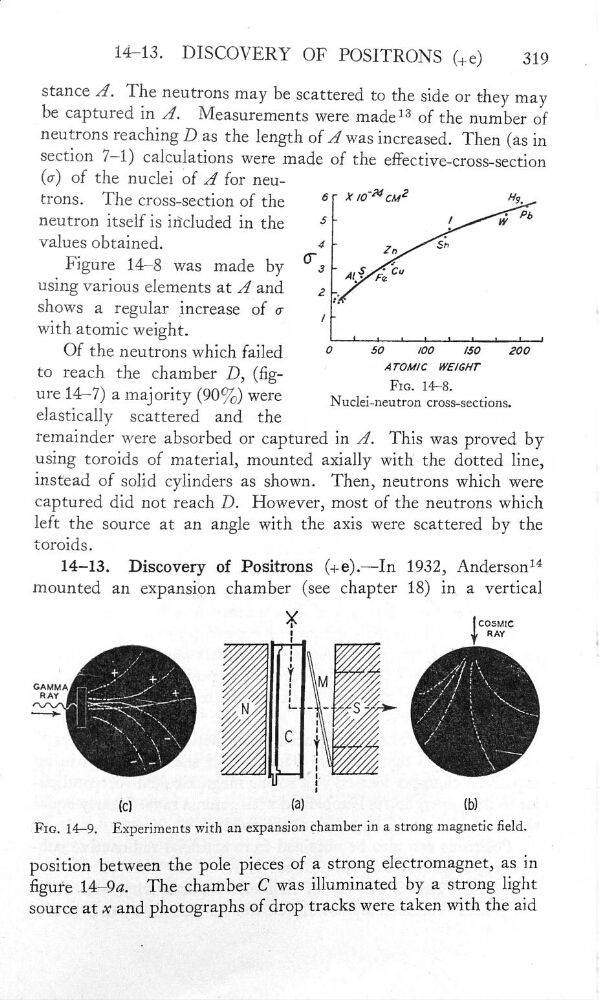
position betWeen the pole pieces of strong electromagnet, as in
gure _14—9a,_ The chainbenCw’as11lum1nated by astronghght
_
sour ce at x and photographs of drop tracks were taken w1th the
a1d
DISCOVERY OF POSITRONS (+e)
319
.
stance zÎ
.
The neutrons may be scattered to the side or they may
be captured in Â.
Measurements were made13 of the number of
neutrons reaching D as the length of  was increased. Then (as in
section 7—1) calculations weremade of the effective—cross—Section
(0) of the nuclei of  for neu—
'
trous.
The cross—section of the
5
"'
.
_Hg:°b —
neutron itself is icluded in the
5
_
.’
”'
values obtained.
4
z,,
Figure 14—8 was made by 0—3
_
Al_‘-$
using various elements at  and
2
__
-
shows _a regular increase of a
with atomic weight.
_
Of the neutrons which failed
0
50
’00
"“’
200
to
reach the chamber D, (g—
'
'
‘
ure 14—7) 3 lnaj oritY (90%) were
Nuclei-neutrdn cross—sections.
elastically scattered and the
remainder were absorbed or captured in Â. This was proved by
'
using toroids of material,' mounted axially with the dotted line,
instead of solid cylinders as shown. Then, neutrons which were
captùred did not reach D. However, most of the neutrons Wh1Ch
left the source at an angle with
were scattered by the
toroids.
_
-
'
14—13.
Discovery of Positrons (+e).—In 1932, Anderson“
mounted an expansion chamber (See chapter 18) in a vertical
X
coswc
_
_.
,
-
,
,
\\\
_
_
//
_//-,
._
_
,._—
'
'(bl
Fm_
.
Experiments with an expansion chamber in a str0ng magnetic
position betWeen the pole pieces of strong electromagnet, as in
gure _14—9a,_ The chainbenCw’as11lum1nated by astronghght
_
sour ce at x and photographs of drop tracks were taken w1th the
a1d