

14-7. RESONANCE PENETRATION
.
313
of protons (1Hl) were emitted when a thick target of aluminum
(13Al27) was bombarded with alpha particles (2He4). The use of
a
means that alpha particles of all energies from the
.
maximum (5.3 MeV, for polonium) down to zero are in
due to
their retardation as they enter the aluminum. InasInuCh as the
,
protons did not leave the nuclei (at a given angle of emission)
_
with a continuous distribution of ener‘
.
gies similar to that of the incident
—,
particle, there must be certain favored
'
—
'
'
energy groups of the incident particles % -
_
.
which cause copious emission of pro— @"
*
.
tons; i-.e., there is a resonance p/ze- ?:
'
'
nommon between the protons and the 2
_
.
_
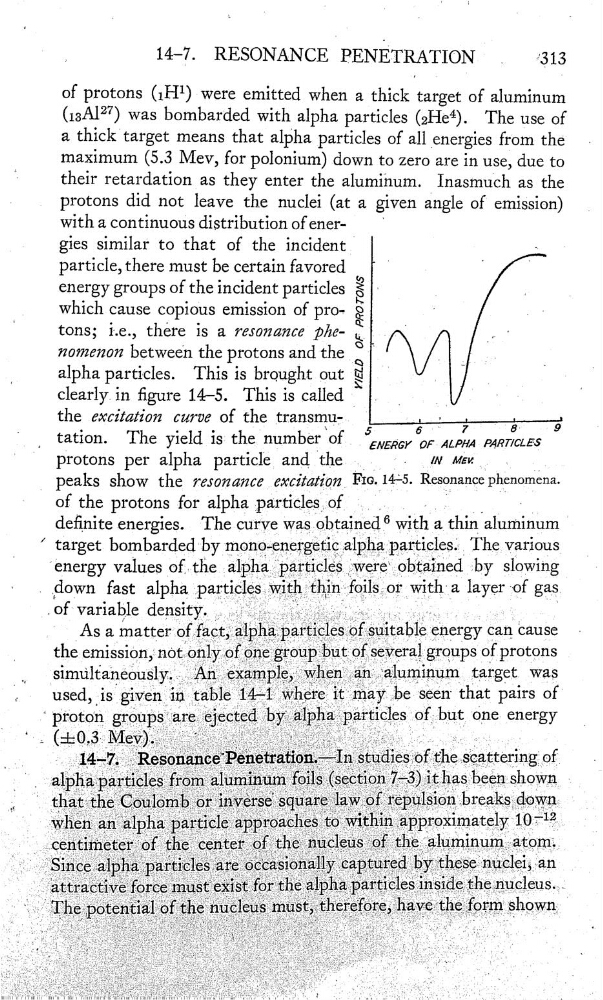
alpha particles. This is brought ont %’
_
clearly in gure 14—5. This is called
.
_
,
'
the excitation curve of the transmu:
»
«
.
.
.
.
»
_
\
'
5
5
'
7
9
tation.
The yield 13 the number of…
OF ALPHA pAR7‘/ÇLES
‘
protons per alpha particle and the
.
MLsu_
.
peaks show the resonance excitation FIG-_l4—5_- ResP}îäCê PhÇn0menaof the protons for alpha particles,of
,
_
»
.
_.
_
'
denite energies. The curve was.obtair_red_._6 with a thin aluminum
’
target bombardedbymono-energet1calphapart1cles The various
'
'ènergy values of the alphaparücles
»by sl°Wîng
'
—
own fast alpha =P@€ËiÇlÊS Withthmf°sor …Wäthia laY@f î'°f
-0f variable d€nSÎÎY—_
…
-
8
As & matteroffactalphapaft1desofsu1tableîçïgy
'
.
thé emission; notonlyofonegrwpbutofseV6raîgmups Of Pf0t0ns
.,
s1multaneouslyAnexamplewhenanalummum
was
1447ResonancePeeaüon—Instudles0fthescattengüfï»
'
‘
”
.
313
of protons (1Hl) were emitted when a thick target of aluminum
(13Al27) was bombarded with alpha particles (2He4). The use of
a
means that alpha particles of all energies from the
.
maximum (5.3 MeV, for polonium) down to zero are in
due to
their retardation as they enter the aluminum. InasInuCh as the
,
protons did not leave the nuclei (at a given angle of emission)
_
with a continuous distribution of ener‘
.
gies similar to that of the incident
—,
particle, there must be certain favored
'
—
'
'
energy groups of the incident particles % -
_
.
which cause copious emission of pro— @"
*
.
tons; i-.e., there is a resonance p/ze- ?:
'
'
nommon between the protons and the 2
_
.
_
alpha particles. This is brought ont %’
_
clearly in gure 14—5. This is called
.
_
,
'
the excitation curve of the transmu:
»
«
.
.
.
.
»
_
\
'
5
5
'
7
9
tation.
The yield 13 the number of…
OF ALPHA pAR7‘/ÇLES
‘
protons per alpha particle and the
.
MLsu_
.
peaks show the resonance excitation FIG-_l4—5_- ResP}îäCê PhÇn0menaof the protons for alpha particles,of
,
_
»
.
_.
_
'
denite energies. The curve was.obtair_red_._6 with a thin aluminum
’
target bombardedbymono-energet1calphapart1cles The various
'
'ènergy values of the alphaparücles
»by sl°Wîng
'
—
own fast alpha =P@€ËiÇlÊS Withthmf°sor …Wäthia laY@f î'°f
-0f variable d€nSÎÎY—_
…
-
8
As & matteroffactalphapaft1desofsu1tableîçïgy
'
.
thé emission; notonlyofonegrwpbutofseV6raîgmups Of Pf0t0ns
.,
s1multaneouslyAnexamplewhenanalummum
was
1447ResonancePeeaüon—Instudles0fthescattengüfï»
'
‘
”