

312
14.
ARTÏFIClAL TRANSMUTATION
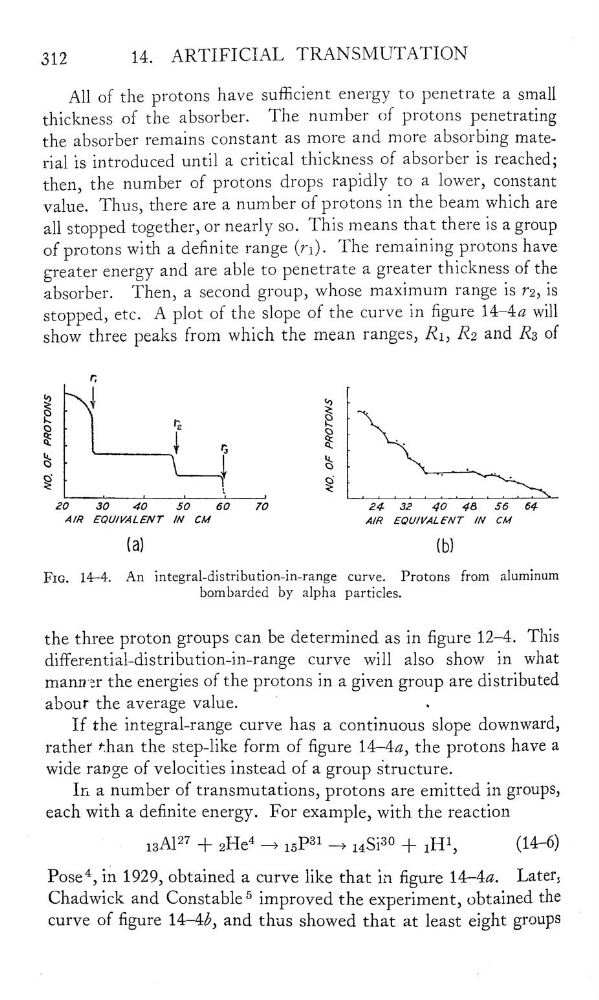
All of the protons
have sufcient energy to penetrate a small
thickness of the absorber.
The number of protons penetrating
the absorber remains constant as more and more absorbing mate—
rial is introduced until a critical thickness of absorber is reached;
then, the number of protons drops rapidly to a lower, constant
value. Thus, there are a number ofprotons in the beam which are
all stopped together, or nearly so. This means that there is a group
of protons
with a denite range (71). The remaining protons have
greater energy
and are able to penetrate a greater thickness of the
absorber.
Then, a second group,
whose maximum range is 7"2, is
stopped, etc. A plot of the slope of the curve in gure 14—441 will
show three peaks from which the mean ranges, R1, R2 and R3 of
r,
s
,,
È
i
r
b.
3
°.
1
°
_
.
.
%
%
'
20
30
40
50
60
70
24—
32
40
46
56
64
Ah?
EOU/VÂLEI‘VT
/N
CM
AIR
EOU/VALENÏ
/N
CM
(8)
(bl
Flo.
14—4.
An
integral—distribution—in—range curve.
Protons from aluminum
bombarded by alpha particles.
the three proton groups can be determined as in gure 12—4. This
differential-distribution—in—range curve will also show in what
manner the energies of the protons in a given group are distributed
about the average value.
'
.
If the integral-range curve has a continuous slope downward,
rather than the step-like form of gure 14—4a, the protons
have a
Wide range of velocities instead of a group structure.
In a number of transmutations, protons are emitted in groups,
each with a denite energy. For example, with the reaction
13Al27 + 21‘I(ä4 _) 15P31 ——> 148130 + 1H1,
Pose4, in 1929, obtained a curve like that in gure 14—461. Laten
Chadwick and Constable5 improved the experiment, obtained the
curve of gure 14—45, and thus showed that at least eight groups
14.
ARTÏFIClAL TRANSMUTATION
All of the protons
have sufcient energy to penetrate a small
thickness of the absorber.
The number of protons penetrating
the absorber remains constant as more and more absorbing mate—
rial is introduced until a critical thickness of absorber is reached;
then, the number of protons drops rapidly to a lower, constant
value. Thus, there are a number ofprotons in the beam which are
all stopped together, or nearly so. This means that there is a group
of protons
with a denite range (71). The remaining protons have
greater energy
and are able to penetrate a greater thickness of the
absorber.
Then, a second group,
whose maximum range is 7"2, is
stopped, etc. A plot of the slope of the curve in gure 14—441 will
show three peaks from which the mean ranges, R1, R2 and R3 of
r,
s
,,
È
i
r
b.
3
°.
1
°
_
.
.
%
%
'
20
30
40
50
60
70
24—
32
40
46
56
64
Ah?
EOU/VÂLEI‘VT
/N
CM
AIR
EOU/VALENÏ
/N
CM
(8)
(bl
Flo.
14—4.
An
integral—distribution—in—range curve.
Protons from aluminum
bombarded by alpha particles.
the three proton groups can be determined as in gure 12—4. This
differential-distribution—in—range curve will also show in what
manner the energies of the protons in a given group are distributed
about the average value.
'
.
If the integral-range curve has a continuous slope downward,
rather than the step-like form of gure 14—4a, the protons
have a
Wide range of velocities instead of a group structure.
In a number of transmutations, protons are emitted in groups,
each with a denite energy. For example, with the reaction
13Al27 + 21‘I(ä4 _) 15P31 ——> 148130 + 1H1,
Pose4, in 1929, obtained a curve like that in gure 14—461. Laten
Chadwick and Constable5 improved the experiment, obtained the
curve of gure 14—45, and thus showed that at least eight groups