

14—6.
THE E]ECTED PROTONS
311
Original nucleus + incident particle —> compound nucleus ——>
residual nucleus + ejected particle.
In general,
Â+P——>C—>B+Q,
(14—4)
where zÏ and B are the original and residual nuclei, P and Q the
incident and ejected particles, respectively, and C is the compound
nucleus. As we shall see later, Q may be a photon, in which case the
process is described as a radiative capture. If P is a photon and Q
is a material particle we have a photoelectric effect. If Q and P
are identical particles the process is one of scattering while if they
differ, we have a capture transmutation.
From the range of the residual nucleus (track C, gure 14—3)
a crude estimate was made of its velocity (m). Then, from its
momentum
as computed in the preceding section, its mass
was
calculated and found to be, approximately that of oxygen
seventeen.
This isotope (O”) was not discovered until four years
later.
(See section 10—8).
.
Conversely, when the residual nucleus was chosen as oxygen—
seventeen, its velocity and its kinetic energy could be calculated
with fair accuracy. It was then found that the total kinetic energy
after the collision was less than that of the incident particle by
approximately nineteen per
cent.
Using the same symbols as in
equation 14—1,
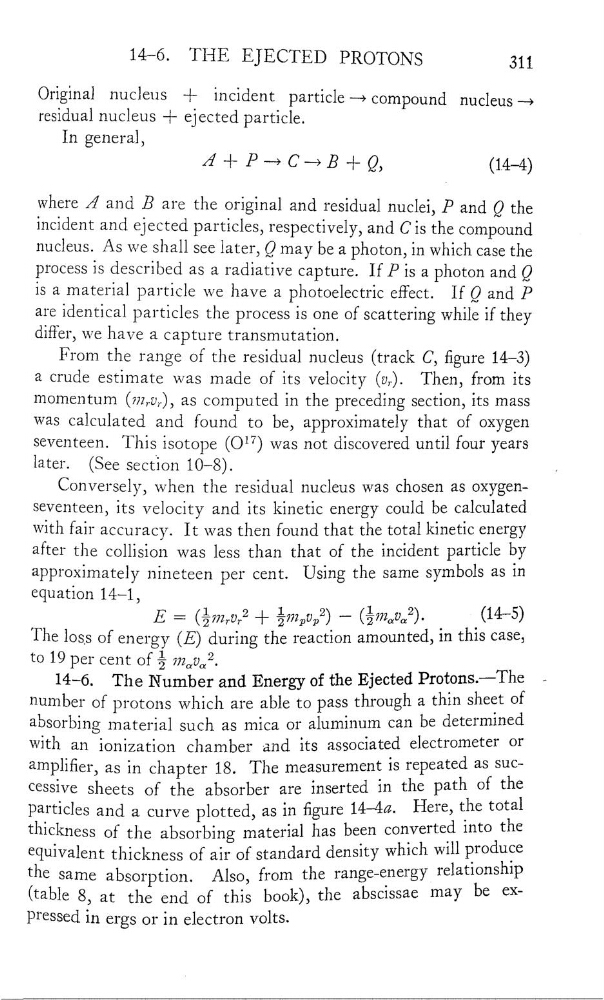
E : (%7nrvr2 + %777p0p2) "— (%maîia2).
.<14_5)
The loss of energy (E) during the reaction amounted, m this case,
to 19 per cent of% 77zava2.
14—6.
The Number and Energy of the Ej6Ct6d Protons.——The —
number of protons which are able to pass through a thin sheet
of
absorbing material such as mica or aluminum can be determined
with an ionization chamber and its associated €1€th0meter or
amplier, as in chapter 18. The measurement is r€Peated as suc“
cessive sheets of the absorber are inserted in the Path Of the
particles and a curve plotted, as in gure 14—4a. Here, the
'£O'Ca1
thickness of the absorbing material has been converted
into the
equivalent thickness of air of standard density Which Will produce
the same absorption. Also, from the range—énergY
relationship
(table 8, at the end of this book), the absc1ssae may be ex—
pressed in ergs or in electron volts.
THE E]ECTED PROTONS
311
Original nucleus + incident particle —> compound nucleus ——>
residual nucleus + ejected particle.
In general,
Â+P——>C—>B+Q,
(14—4)
where zÏ and B are the original and residual nuclei, P and Q the
incident and ejected particles, respectively, and C is the compound
nucleus. As we shall see later, Q may be a photon, in which case the
process is described as a radiative capture. If P is a photon and Q
is a material particle we have a photoelectric effect. If Q and P
are identical particles the process is one of scattering while if they
differ, we have a capture transmutation.
From the range of the residual nucleus (track C, gure 14—3)
a crude estimate was made of its velocity (m). Then, from its
momentum
as computed in the preceding section, its mass
was
calculated and found to be, approximately that of oxygen
seventeen.
This isotope (O”) was not discovered until four years
later.
(See section 10—8).
.
Conversely, when the residual nucleus was chosen as oxygen—
seventeen, its velocity and its kinetic energy could be calculated
with fair accuracy. It was then found that the total kinetic energy
after the collision was less than that of the incident particle by
approximately nineteen per
cent.
Using the same symbols as in
equation 14—1,
E : (%7nrvr2 + %777p0p2) "— (%maîia2).
.<14_5)
The loss of energy (E) during the reaction amounted, m this case,
to 19 per cent of% 77zava2.
14—6.
The Number and Energy of the Ej6Ct6d Protons.——The —
number of protons which are able to pass through a thin sheet
of
absorbing material such as mica or aluminum can be determined
with an ionization chamber and its associated €1€th0meter or
amplier, as in chapter 18. The measurement is r€Peated as suc“
cessive sheets of the absorber are inserted in the Path Of the
particles and a curve plotted, as in gure 14—4a. Here, the
'£O'Ca1
thickness of the absorbing material has been converted
into the
equivalent thickness of air of standard density Which Will produce
the same absorption. Also, from the range—énergY
relationship
(table 8, at the end of this book), the absc1ssae may be ex—
pressed in ergs or in electron volts.