

314
14.
ARTIFICIAL TRANSMUTATION
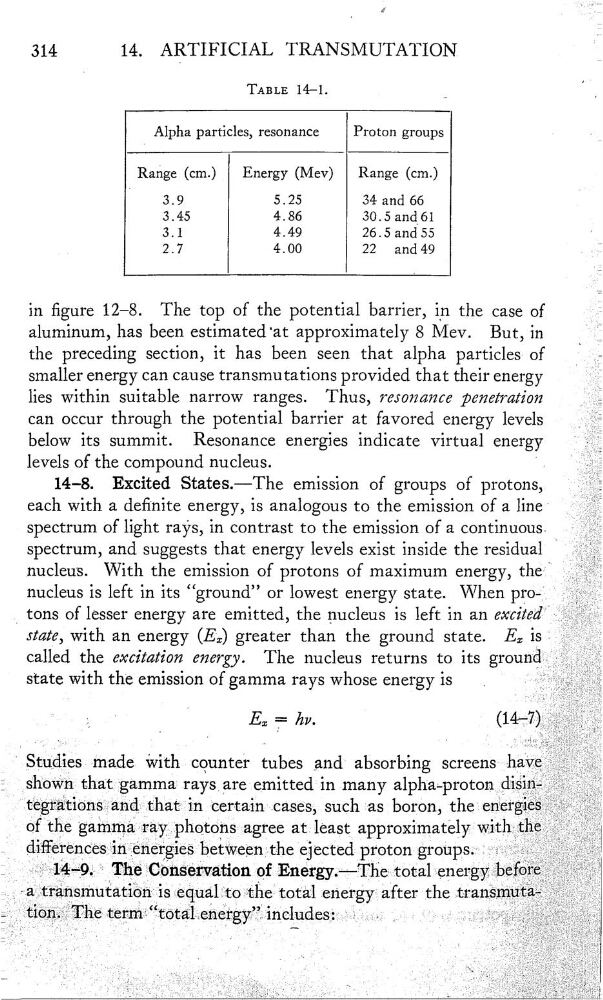
TABLE 14—1.
_
Alpha particles, resonance
Proton groups
,
Range (cm.)
Energy (MeV)
Range (cm.)
3.9
5.25
34and 66
3.45
4.86
30.5and_61
3.1
4.49
26.5 and55
‘
2.7
4.00
22
and49
…
in gure 12—8. The top of the potential barrier, in the case of
aluminum, has been estimated'at approximately 8 Mev. But, in
the preceding section, it has been seen that alpha particles of
smaller energy can cause transmutations provided that their energy
lies within suitable marrow ranges.
Thus, resonance penetration
can occur through the potential barrier at favored energy levels
below its summit.
Resonance energies indicate virtual energy
]
levels of the compound nucleus.
'
.
14—8.
Excited States.—The emission of groups
of protons,
each with a denite energy, is analogous to the emission of a line
spectrum of light raÿs, in contrast to the emission of a continuous …‘ ÏÏ
spectrum, and suggests that energy levels exist inside the residual
nucleus.
With the emission of protons of maximum energy,
nucleus is left in its “ground” or lowest energy state. When pro_
tons of lesser energy are emitted, the nucleus is left in an excited
state, with an energy
greater than the ground state.
is
called the excitation energy.
The nucleus returns to its ground
state with the emission of gamma rays whose energy is
_
'
Ex .= hv<14—7)
'
Studies «made With counter tubes and absorbing screenshave
shown: that. gamma rays_
in many alpha-protondlsmcertain:catse‘s, such as boron, the energ1€S
of the gamma—ray}… photons agree atleast approximately
,
14—9
The
of Energy—Thetotalenergybef0re
atransmutaüonisïecË1ualÿto é—ï’èheÏ total energy—3 after the t ransmut a[
tlonThe termtotalenergylnclude8 , . =
14.
ARTIFICIAL TRANSMUTATION
TABLE 14—1.
_
Alpha particles, resonance
Proton groups
,
Range (cm.)
Energy (MeV)
Range (cm.)
3.9
5.25
34and 66
3.45
4.86
30.5and_61
3.1
4.49
26.5 and55
‘
2.7
4.00
22
and49
…
in gure 12—8. The top of the potential barrier, in the case of
aluminum, has been estimated'at approximately 8 Mev. But, in
the preceding section, it has been seen that alpha particles of
smaller energy can cause transmutations provided that their energy
lies within suitable marrow ranges.
Thus, resonance penetration
can occur through the potential barrier at favored energy levels
below its summit.
Resonance energies indicate virtual energy
]
levels of the compound nucleus.
'
.
14—8.
Excited States.—The emission of groups
of protons,
each with a denite energy, is analogous to the emission of a line
spectrum of light raÿs, in contrast to the emission of a continuous …‘ ÏÏ
spectrum, and suggests that energy levels exist inside the residual
nucleus.
With the emission of protons of maximum energy,
nucleus is left in its “ground” or lowest energy state. When pro_
tons of lesser energy are emitted, the nucleus is left in an excited
state, with an energy
greater than the ground state.
is
called the excitation energy.
The nucleus returns to its ground
state with the emission of gamma rays whose energy is
_
'
Ex .= hv<14—7)
'
Studies «made With counter tubes and absorbing screenshave
shown: that. gamma rays_
in many alpha-protondlsmcertain:catse‘s, such as boron, the energ1€S
of the gamma—ray}… photons agree atleast approximately
,
14—9
The
of Energy—Thetotalenergybef0re
atransmutaüonisïecË1ualÿto é—ï’èheÏ total energy—3 after the t ransmut a[
tlonThe termtotalenergylnclude8 , . =