

250
11.
SPONTANEOÜS DISINTEGRATION
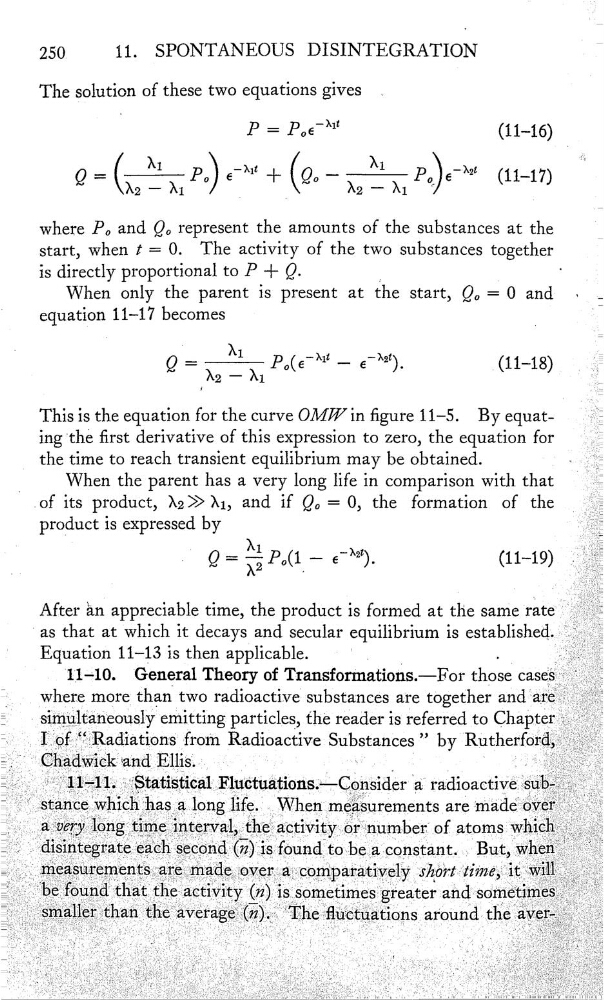
The solution of these two equations gives
P = Poe—“l‘
(11—16)
>\1
>\1
:
——-—
P)
e_>‘1t + ( — —— P e')‘2t 11—17
Q
(Âz—Âl 0
_
QG
>\2—)\1
0‘
(
)
where Po and QG represent the amounts of the substances at the
start, when ; = 0.
The activity of the two substances together
is directly proportional to P + Q.
-
When only the parent is present at the start, Q, = 0 and
'
equation 11—17 becomes
‘
.
)\1
_
_
[
Q = —— Po(e
“‘
—
e
M).
,(11—18)
>\2 — >\1
*:
This is the equation for the curve OMW in gure 11—5. By equating “the rst derivative of this expression to zero, the equation for
the time to reach transient equilibrium may be obtained.
_
When the parent has a very long life in comparison with that
of its product, )12 >> )\1, and if Q, = 0, the formation of the
product is expressed by
_
.
Q =
—
€
zi)_
(11—19)
After àn appreciable time, the product is formed at the same rate
'
as that at which it decays and secular equilibrium is established.
Equation 11—13 is then applicable.
“
,
,
.
_
‘Il—10.
General Theory of Transformations.—For those cases
where more than two
substances a're together and are
eritting particles, the reader is referred to Chapter
Iof“Rad1at10ns from Radioactive Substances
”
by Rutherford,
StanceWhlchhasalonghfe‘
are madeover
smallerthantheavefage@)Theuctuaüons àf0und theaV€r
11.
SPONTANEOÜS DISINTEGRATION
The solution of these two equations gives
P = Poe—“l‘
(11—16)
>\1
>\1
:
——-—
P)
e_>‘1t + ( — —— P e')‘2t 11—17
Q
(Âz—Âl 0
_
QG
>\2—)\1
0‘
(
)
where Po and QG represent the amounts of the substances at the
start, when ; = 0.
The activity of the two substances together
is directly proportional to P + Q.
-
When only the parent is present at the start, Q, = 0 and
'
equation 11—17 becomes
‘
.
)\1
_
_
[
Q = —— Po(e
“‘
—
e
M).
,(11—18)
>\2 — >\1
*:
This is the equation for the curve OMW in gure 11—5. By equating “the rst derivative of this expression to zero, the equation for
the time to reach transient equilibrium may be obtained.
_
When the parent has a very long life in comparison with that
of its product, )12 >> )\1, and if Q, = 0, the formation of the
product is expressed by
_
.
Q =
—
€
zi)_
(11—19)
After àn appreciable time, the product is formed at the same rate
'
as that at which it decays and secular equilibrium is established.
Equation 11—13 is then applicable.
“
,
,
.
_
‘Il—10.
General Theory of Transformations.—For those cases
where more than two
substances a're together and are
eritting particles, the reader is referred to Chapter
Iof“Rad1at10ns from Radioactive Substances
”
by Rutherford,
StanceWhlchhasalonghfe‘
are madeover
smallerthantheavefage@)Theuctuaüons àf0und theaV€r