

11—9.
TRANSFORMATION THEORY
249
With a parent of very long life, the curve of gure 11—5 would
rise to a maximum and remain constant, as OMN.
In the present
case, however, the thorium B is decaying at a moderate rate, so
the activity drops to W as time goes on. The curve PMW
decreases to half value in 10.6 hours, which is the half-life of
thorium B.
The rapid rise OM is due to the fact that thorium C
is being formed at a greater rate than it is decaying. These two
rate-s are equal at the maximum M where a condition of z‘mmiem‘
.equi/z'ôrium exists.
As a second illustration of the case where the parent transforms
very rapidly, we may take the active deposit of radium. On
decaying, radium produces a gas called radium emanation or radon.
This, in turn, decays into radium A, as a solid deposit on the walls
of the containing vessel. This, in turn, changes into radium B,
,
then C, C’ and C”.
A, B, C, C' and C" form the sizon‘ life alive
deposit.
They are followed by D, E and F (Polonium), which
constitute the long lzfe active deposit. F changes into lead which
undergoes no further changes as far as we can tell.
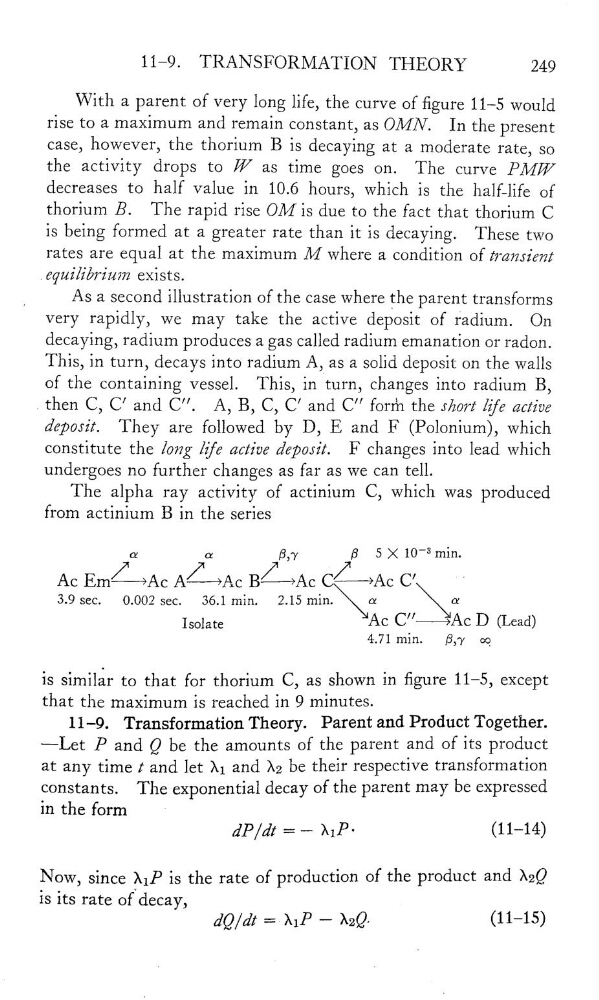
The alpha ray activity of actinium C, which was produced
from actinium B in the series
a
a
,8,7
6
5 >< 10“3 min.
Ac
ALAC BLAC C—/‘——>Ac c'
,
3.9 sec.
0.002 sec.
36.1 min.
2.15
min.\œ
\a
Isolate
AC C"—>AC D (Lead)
4.71 min.
,8,'y
oo_
is similar to that for thorium C, as shown in gure 11—5, except
that the maximum is reached in 9 minutes.
1 1—9.
Transformation Theory. Parent and Product Together.
—Let P and Q be the amounts of the parent and of its product
at any time ; and let )\1 and )\2 be their respective transformation
constants.
The exponential decay of the parent may be expressed
in the form
'
dP/dt = —— À1P°
(11—14)
Now, since MP is the rate of production of the product and À2Q
is its rate of decay,
dQ/dz‘ = le — >.2Q.
(11—15)
TRANSFORMATION THEORY
249
With a parent of very long life, the curve of gure 11—5 would
rise to a maximum and remain constant, as OMN.
In the present
case, however, the thorium B is decaying at a moderate rate, so
the activity drops to W as time goes on. The curve PMW
decreases to half value in 10.6 hours, which is the half-life of
thorium B.
The rapid rise OM is due to the fact that thorium C
is being formed at a greater rate than it is decaying. These two
rate-s are equal at the maximum M where a condition of z‘mmiem‘
.equi/z'ôrium exists.
As a second illustration of the case where the parent transforms
very rapidly, we may take the active deposit of radium. On
decaying, radium produces a gas called radium emanation or radon.
This, in turn, decays into radium A, as a solid deposit on the walls
of the containing vessel. This, in turn, changes into radium B,
,
then C, C’ and C”.
A, B, C, C' and C" form the sizon‘ life alive
deposit.
They are followed by D, E and F (Polonium), which
constitute the long lzfe active deposit. F changes into lead which
undergoes no further changes as far as we can tell.
The alpha ray activity of actinium C, which was produced
from actinium B in the series
a
a
,8,7
6
5 >< 10“3 min.
Ac
ALAC BLAC C—/‘——>Ac c'
,
3.9 sec.
0.002 sec.
36.1 min.
2.15
min.\œ
\a
Isolate
AC C"—>AC D (Lead)
4.71 min.
,8,'y
oo_
is similar to that for thorium C, as shown in gure 11—5, except
that the maximum is reached in 9 minutes.
1 1—9.
Transformation Theory. Parent and Product Together.
—Let P and Q be the amounts of the parent and of its product
at any time ; and let )\1 and )\2 be their respective transformation
constants.
The exponential decay of the parent may be expressed
in the form
'
dP/dt = —— À1P°
(11—14)
Now, since MP is the rate of production of the product and À2Q
is its rate of decay,
dQ/dz‘ = le — >.2Q.
(11—15)