

'
'
11—11.
STATISTICAL FLUCTUATIONS
251
age
value Will be brought out clearly by using a feeble radioactive
source and a sensitive detector.
Then, the emission of single alpha
particles and the disintegration of individual atoms may be noted.
It will be found, for example, that during the rst ten minutes
‘
100 atoms disintegrated,
during the next ten minutes 101
atoms ejected alpha particles, during the third interval, 98, etc.
-
The distribution of the observed number ar0und the average
can
be determined from probability considerations 2 and is represented by the Gaussian error curve when ?? is large.
_
_
_
An electroscope or a counter tube (see chapters 17 and 18)
has a
“
natural leak,”
“
residual count
”
or background of activity
'
_
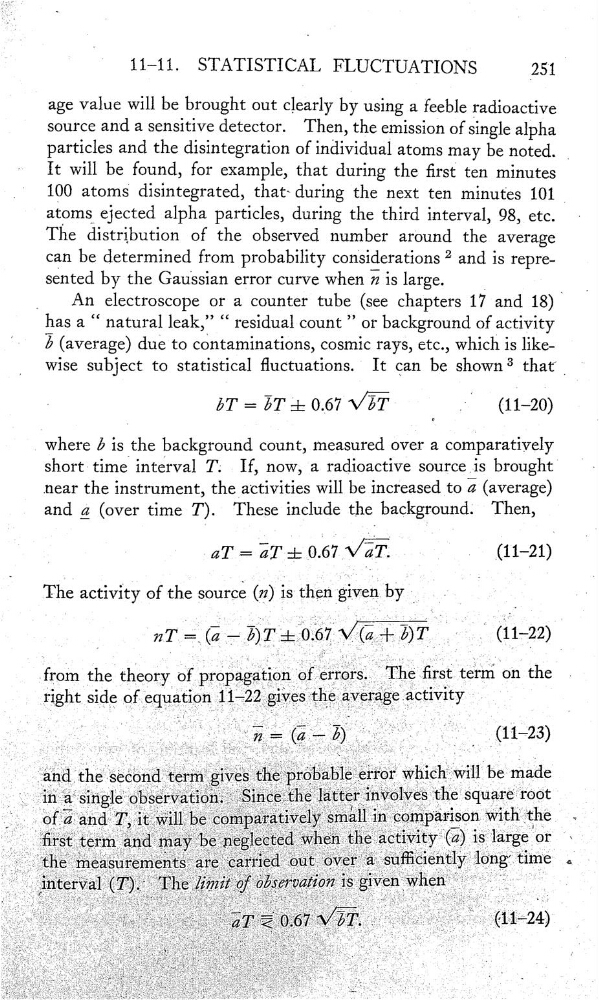
b (average) due to contaminations, cosmic rays, etc., which is likeWise subject to statistical uctuations. It can be shown3 that”
'
âT = ZT il: 0.67 VZT;
(11—20)
where 5 is the background count, measured over a comparatively
shorttime interval T.If, now, a radioactive source ,is brought
near the instrument, theactivities Will be increased to a (average)
.
and g (over time T).
These include the background; Then,
_
'
,
aT : ËT :l: O.67_'V_ 5T.
—
(11—21)
The activity of the source (71) is
bÿ
°
_
‘
Æ_=ÿ.. @ _z)TÎOÔ7\/(+z)r
<+22>
frein
theory
œh °“ the
'
ght side
fl.
E=(ä-Z)
___(11+23)
-—Ï—
1
=
,…«-w
: '
-
ofaandTltwlbecamaratwelÿsmamœmPa_80nmththe *
themeasurementsar€Cf°lrf1€d@ut@VÊI'aS‘1î‘3‘mYkmgüme ‘ \
*
'
11—11.
STATISTICAL FLUCTUATIONS
251
age
value Will be brought out clearly by using a feeble radioactive
source and a sensitive detector.
Then, the emission of single alpha
particles and the disintegration of individual atoms may be noted.
It will be found, for example, that during the rst ten minutes
‘
100 atoms disintegrated,
during the next ten minutes 101
atoms ejected alpha particles, during the third interval, 98, etc.
-
The distribution of the observed number ar0und the average
can
be determined from probability considerations 2 and is represented by the Gaussian error curve when ?? is large.
_
_
_
An electroscope or a counter tube (see chapters 17 and 18)
has a
“
natural leak,”
“
residual count
”
or background of activity
'
_
b (average) due to contaminations, cosmic rays, etc., which is likeWise subject to statistical uctuations. It can be shown3 that”
'
âT = ZT il: 0.67 VZT;
(11—20)
where 5 is the background count, measured over a comparatively
shorttime interval T.If, now, a radioactive source ,is brought
near the instrument, theactivities Will be increased to a (average)
.
and g (over time T).
These include the background; Then,
_
'
,
aT : ËT :l: O.67_'V_ 5T.
—
(11—21)
The activity of the source (71) is
bÿ
°
_
‘
Æ_=ÿ.. @ _z)TÎOÔ7\/(+z)r
<+22>
frein
theory
œh °“ the
'
ght side
fl.
E=(ä-Z)
___(11+23)
-—Ï—
1
=
,…«-w
: '
-
ofaandTltwlbecamaratwelÿsmamœmPa_80nmththe *
themeasurementsar€Cf°lrf1€d@ut@VÊI'aS‘1î‘3‘mYkmgüme ‘ \
*