

10—2.
POSI‘TI'VE RAY PARABOLAS
225
line is that of a parabola whose vertex is at the origin. Each parabola is due to particles of the same ratio of charge to mass (EI/À!)
but of different velocities. ‘
In gure 10—1, the faster particles were
deected tof and the slower ones to's.
'
It is found that several parabôlas appear simultaneously. Each
'
is due to particles of a given charge to mass ratio. If the charges
are the same, the difÏerent parabolas are due to particles of dif—.
ferent masses.
Thus the parabola 3 in gure 10—1 was caused
by a group of particles whose mass Was small compared with those
in the groups which produced parabolas_ 2 or 1. The greater the
mass of a particle, the less easily is it deected.
”
Occasionally higher order parabolas are observed. These lines
are due to particles of diering charge but identical mass. The»
._
greater the charge, the greater the deection. For example, a
line near the € axis in gure 10—1 might be due to, singly ionized
mercury atoms, Hg+, i.e.,atoms from which bne electron has been
removed.
The second order parabola is displaced farther from the
axis and would be due to doubly ionizèd mercury atoms, Hg++,
While the third order line would be due to trebly ionized mercury
atoms Hg+++.
,
,
.
…
_
"At very
the
but at higher pressures,…when some of the positive
their charge over a por_
tion of their path,
that a general fog_ging
of the screen is
produced or the
to , the origin (0 in gure
'
10—_1). Also, at
the’posi'tiVe
ion on
rare
‘
.
'
,
Çÿ//B
_
…
—
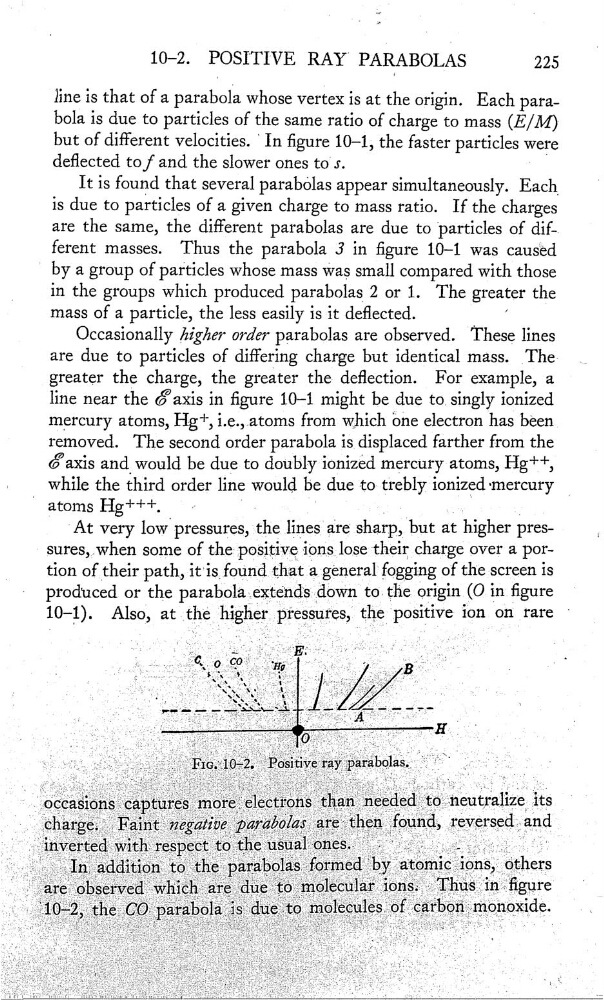
Fram—2POSItlvera—YParbdas
'
POSI‘TI'VE RAY PARABOLAS
225
line is that of a parabola whose vertex is at the origin. Each parabola is due to particles of the same ratio of charge to mass (EI/À!)
but of different velocities. ‘
In gure 10—1, the faster particles were
deected tof and the slower ones to's.
'
It is found that several parabôlas appear simultaneously. Each
'
is due to particles of a given charge to mass ratio. If the charges
are the same, the difÏerent parabolas are due to particles of dif—.
ferent masses.
Thus the parabola 3 in gure 10—1 was caused
by a group of particles whose mass Was small compared with those
in the groups which produced parabolas_ 2 or 1. The greater the
mass of a particle, the less easily is it deected.
”
Occasionally higher order parabolas are observed. These lines
are due to particles of diering charge but identical mass. The»
._
greater the charge, the greater the deection. For example, a
line near the € axis in gure 10—1 might be due to, singly ionized
mercury atoms, Hg+, i.e.,atoms from which bne electron has been
removed.
The second order parabola is displaced farther from the
axis and would be due to doubly ionizèd mercury atoms, Hg++,
While the third order line would be due to trebly ionized mercury
atoms Hg+++.
,
,
.
…
_
"At very
the
but at higher pressures,…when some of the positive
their charge over a por_
tion of their path,
that a general fog_ging
of the screen is
produced or the
to , the origin (0 in gure
'
10—_1). Also, at
the’posi'tiVe
ion on
rare
‘
.
'
,
Çÿ//B
_
…
—
Fram—2POSItlvera—YParbdas
'