

‘
224
10.
POSITIVE RAYS AND ISOTOPES
'
-
'
'
'
h
b
t d 1
b
of light em1331on from hydrogen ions as een compu e
as a
out,
10‘7 seconds.
10—2.
Positive Ray Parabolas.—In 1907, ]. ]. Thomson2
studied the nature of positive rays by means of electric and
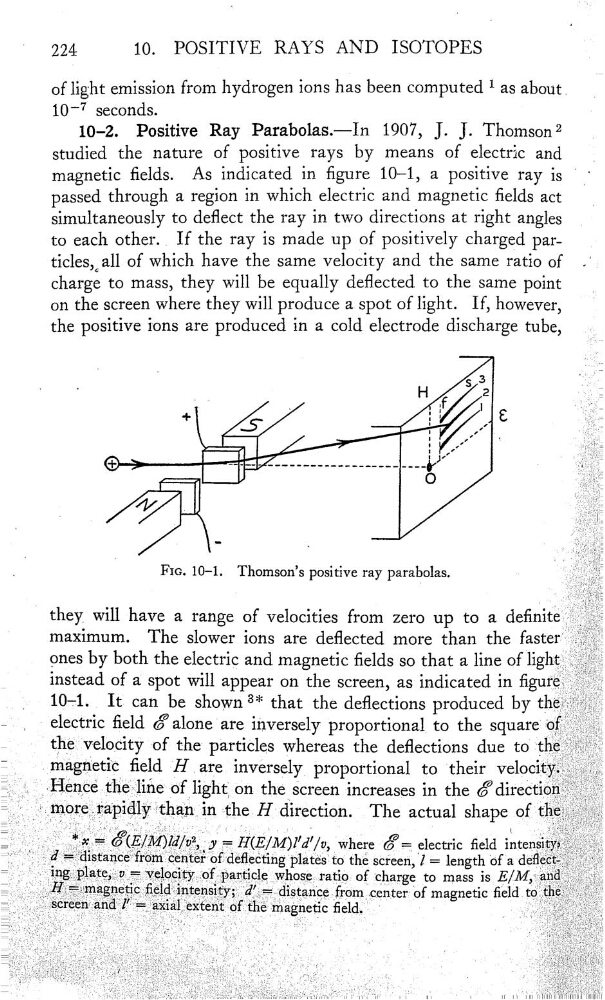
magnetic elds. As indicated in gure 10—1, a positive ray is
passed through a region in which electric and magnetic elds act
simultaneously to deect the ray in two direct10ns at right angles
to each other.
_
If the ray is made up of positively charged par.
_
ticles,all of which have the same velocity and the same ratio of
charge to mass, they will be equally deected to the same point
on the screen where they Will produce a spot of light. If, however,
the positive ions are produced in a cold electrode discharge tube,
.
3
‘"
_ç
? /
,
€
::
.U
0
.
/
“%
Ü]
_
FIG. 10—1.
Thomson’s positive ray parabolas.
they will have a range of velocities from zero up
to a demte
maximum.
The slower ions are deected more than the faster
ones by both the electric and magnetic elds so that a line of light
instead of a spot Will appear on the screen, as indicated in gure
‘ …
Ït can be shown
3* that the deections produced by the
—
electric eld éa alone‘are inversely proportional to the square of
'
the“… Velocity of the particles whereas the deections due
the
.magnetic eld H are inversely proportional to their veloc1ty
}
of light on the screen increases in the (Ë direction
ZŸ‘ * morerap1dlythan in the H ‘ direction. The actual shape of the
*x=@æ(E/M>ld/v2y = H(E/M)Z’d’/v, where
electric eld mtensxty
plates to the screen, 1 = length Of & deeCt—>’
î
ratio of charge to mass is,E/M,and
{,_H=magneticeldmten51ty, Ï,Î
center
magnetic eld tothe
'
…
…
224
10.
POSITIVE RAYS AND ISOTOPES
'
-
'
'
'
h
b
t d 1
b
of light em1331on from hydrogen ions as een compu e
as a
out,
10‘7 seconds.
10—2.
Positive Ray Parabolas.—In 1907, ]. ]. Thomson2
studied the nature of positive rays by means of electric and
magnetic elds. As indicated in gure 10—1, a positive ray is
passed through a region in which electric and magnetic elds act
simultaneously to deect the ray in two direct10ns at right angles
to each other.
_
If the ray is made up of positively charged par.
_
ticles,all of which have the same velocity and the same ratio of
charge to mass, they will be equally deected to the same point
on the screen where they Will produce a spot of light. If, however,
the positive ions are produced in a cold electrode discharge tube,
.
3
‘"
_ç
? /
,
€
::
.U
0
.
/
“%
Ü]
_
FIG. 10—1.
Thomson’s positive ray parabolas.
they will have a range of velocities from zero up
to a demte
maximum.
The slower ions are deected more than the faster
ones by both the electric and magnetic elds so that a line of light
instead of a spot Will appear on the screen, as indicated in gure
‘ …
Ït can be shown
3* that the deections produced by the
—
electric eld éa alone‘are inversely proportional to the square of
'
the“… Velocity of the particles whereas the deections due
the
.magnetic eld H are inversely proportional to their veloc1ty
}
of light on the screen increases in the (Ë direction
ZŸ‘ * morerap1dlythan in the H ‘ direction. The actual shape of the
*x=@æ(E/M>ld/v2y = H(E/M)Z’d’/v, where
electric eld mtensxty
plates to the screen, 1 = length Of & deeCt—>’
î
ratio of charge to mass is,E/M,and
{,_H=magneticeldmten51ty, Ï,Î
center
magnetic eld tothe
'
…
…