

226
10.
POSITIVE RAYS AND ISOTOPES
Ï' _;fÏl
Inäsmuch as the @@ and H axes do not appear on the screen,
_
nor upon a photographie plate placed in the same position, the
locatidn of the lines is determined by reversing the magnetic eld
during the exposure.
A record such as that in gure 10—2 is then
-
obtained.
It is, however, customary to obtain parabolas of the
unknown and of a substance of standard mass on the same plate.
Measurements of the distanc‘es between the parabolas then permits
'
of the mass of the unknown in terms of the
standard.
The higher order lines may be used to advantage to
*
'
compare
two masses which differ widely from each other.
10—3.
_Aston’s Mass Spectrograph.—Aston4 has improved
the Thomson parabola method so that ions of different velocities
but identical E/M are brought to the same focus. This velocity
focus method increased the resolving power so that it was possible to distinguish between ions whose masses diPfer by only 1
part in 600, as contras'ted with 1 in 20 of Thomson’s method.
The accuracy of the Aston method of determining the ratio of
two masses is 1 in 10,000.
This method of mass analysis has »_
proved 'to be more accurate than the chemical methods of de‘
termining atomic weights.
'
An extensive and detailed study of the different atomic masses
of the elements was made.
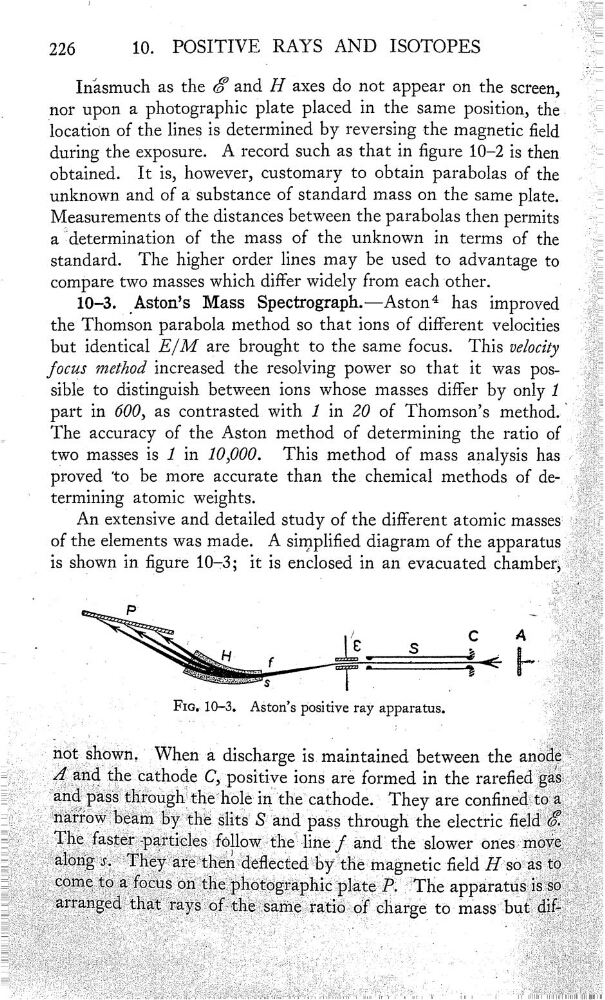
A simplied diagram of the apparatus
_
is shown in gure
it is enclosed in an evacuated chamber,
-
'
,
c
A
_
—
.
,
F1G.- 10—3.
As'ton’s positive ray apparatus.
*
not shown ' When a discharge is maintained between the anode
Aand the ‘Ç_athode C,;positive ions are formed in the
narrowbeamythe sllts S and pass through the electric eldË
îThefaStefPaftldesfollowthe line—f -äfnd the slower onesm0V
—arrangedthatmys0fthesameratwoffëlîafgë t° massbutd1f
10.
POSITIVE RAYS AND ISOTOPES
Ï' _;fÏl
Inäsmuch as the @@ and H axes do not appear on the screen,
_
nor upon a photographie plate placed in the same position, the
locatidn of the lines is determined by reversing the magnetic eld
during the exposure.
A record such as that in gure 10—2 is then
-
obtained.
It is, however, customary to obtain parabolas of the
unknown and of a substance of standard mass on the same plate.
Measurements of the distanc‘es between the parabolas then permits
'
of the mass of the unknown in terms of the
standard.
The higher order lines may be used to advantage to
*
'
compare
two masses which differ widely from each other.
10—3.
_Aston’s Mass Spectrograph.—Aston4 has improved
the Thomson parabola method so that ions of different velocities
but identical E/M are brought to the same focus. This velocity
focus method increased the resolving power so that it was possible to distinguish between ions whose masses diPfer by only 1
part in 600, as contras'ted with 1 in 20 of Thomson’s method.
The accuracy of the Aston method of determining the ratio of
two masses is 1 in 10,000.
This method of mass analysis has »_
proved 'to be more accurate than the chemical methods of de‘
termining atomic weights.
'
An extensive and detailed study of the different atomic masses
of the elements was made.
A simplied diagram of the apparatus
_
is shown in gure
it is enclosed in an evacuated chamber,
-
'
,
c
A
_
—
.
,
F1G.- 10—3.
As'ton’s positive ray apparatus.
*
not shown ' When a discharge is maintained between the anode
Aand the ‘Ç_athode C,;positive ions are formed in the
narrowbeamythe sllts S and pass through the electric eldË
îThefaStefPaftldesfollowthe line—f -äfnd the slower onesm0V
—arrangedthatmys0fthesameratwoffëlîafgë t° massbutd1f