

.
8—5.
MOBILITY
-
.
°
161
found
is 1.6 >< 10.—6 >< 722, whereas for uncharged parti'
cles the kinetic theory gives the
number of collisionsper second per
cc. as l.25
>< 10“10 X 722. _It
IS concluded that, due to electrical
attractions, the number of collisions resulting in recombination is
10,000 times greater than the number of collisions between neutral
,
particles.
_
'
-
_
8—5.
Môbity.4—The mobility of an ion is dened as its veloc-'
1ty m cent1meters per second under an accelerating potential of
one volt per
This is the average velocity of drift of
the ions due to— the êlectrical eld and it is superimposed on the
irregular kinetic motions of the charged particles.
are two basic schemes for measuring the mobilities of
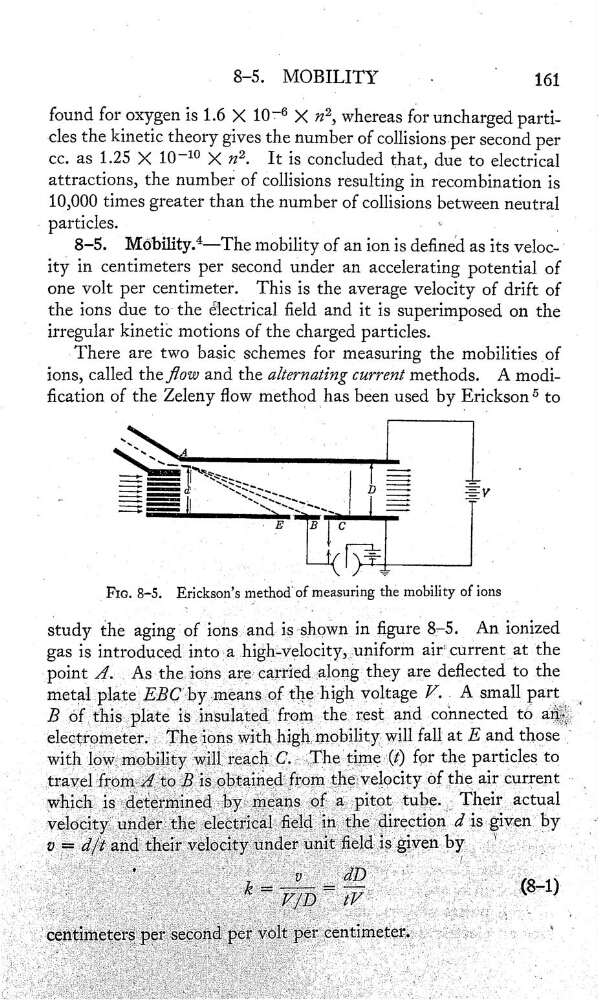
ions, called the aw and the a]ærnang current methods. A modication of the Zeleny ow methodhas been used by Erickson5 to
Ë=
|
.
!
D
%
ÊV
'
-
_E ' ÎBÎ
]
c
!
'
_
FIG. 8—5.
Erickson’s method'of measuring the mobility of ions
study the agingïof
inguré 8,—5. An ionized
gas is introduced
the
point Â.
deected to the
the,highvoltage
[7
.
.
A small part
…
Bofthlsplatelsmsu1atedfromtherest arid connected to an
_
electmmeœrTheionsWithh1ghmob111tywillfall
at E and those
'
"
wh1chlsdetermmedbymeansofap1tottube Their…actual
‘
‘
«;
vé =d/Z‘andthelrvelocüÿundel‘umteldlsglVen bY Ÿ:
-
-
…
l'
,
=
='—*'7
f
vd
.
'
-
…
f
_
_—
8—5.
MOBILITY
-
.
°
161
found
is 1.6 >< 10.—6 >< 722, whereas for uncharged parti'
cles the kinetic theory gives the
number of collisionsper second per
cc. as l.25
>< 10“10 X 722. _It
IS concluded that, due to electrical
attractions, the number of collisions resulting in recombination is
10,000 times greater than the number of collisions between neutral
,
particles.
_
'
-
_
8—5.
Môbity.4—The mobility of an ion is dened as its veloc-'
1ty m cent1meters per second under an accelerating potential of
one volt per
This is the average velocity of drift of
the ions due to— the êlectrical eld and it is superimposed on the
irregular kinetic motions of the charged particles.
are two basic schemes for measuring the mobilities of
ions, called the aw and the a]ærnang current methods. A modication of the Zeleny ow methodhas been used by Erickson5 to
Ë=
|
.
!
D
%
ÊV
'
-
_E ' ÎBÎ
]
c
!
'
_
FIG. 8—5.
Erickson’s method'of measuring the mobility of ions
study the agingïof
inguré 8,—5. An ionized
gas is introduced
the
point Â.
deected to the
the,highvoltage
[7
.
.
A small part
…
Bofthlsplatelsmsu1atedfromtherest arid connected to an
_
electmmeœrTheionsWithh1ghmob111tywillfall
at E and those
'
"
wh1chlsdetermmedbymeansofap1tottube Their…actual
‘
‘
«;
vé =d/Z‘andthelrvelocüÿundel‘umteldlsglVen bY Ÿ:
-
-
…
l'
,
=
='—*'7
f
vd
.
'
-
…
f
_
_—