

162
8.
ELECTRICITY THROUGH GASES
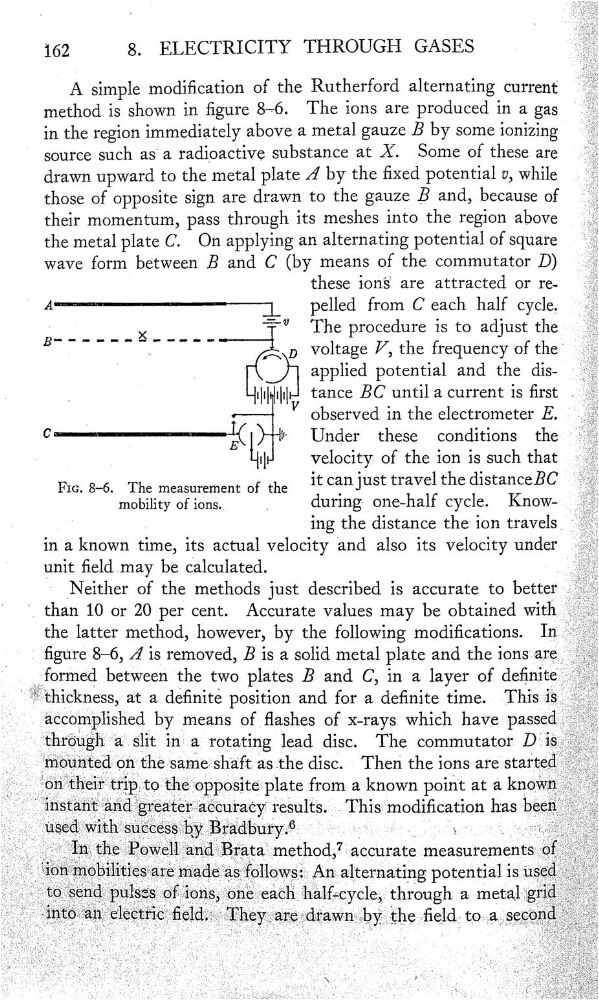
A simple modication of the Rutherford alternating current
method is shown in gure 8—6. The ions are produced in a gas
in the region immediately above a metal gauze B by some ionizing
source such as” a radioactive substance at X.
Some of these are
;
drawn upward to the metal plate  by the xed potential 0, while
those of opposite sign are drawn to the gauze B and, because of
their momentum, pass through its meshes into the region above
the metal plate C. On applying an alternating potential of square
wave form between B and C (by means of the commutator D)
these ions are attracted or re—
AW].
pelled from C each half cycle,
'
><
;”
The procedure is to adjust the
_
_
_
_
-
_
_
_
_
A
D
voltage V
,
the frequency of the“
'
applied potential and the dis_
_
.… ||||V
tance BC until a current is rst
_
observed in the electromet'er E. '
1"
Under
these
conditions
the
-
l —M
velocity of the ion is such that
PIG. 8—6.
The measurement of the
it canjUSt travel the diStanceBc
mobility ofions._
_
during one—half cycle.
Know—
-
'
.
ing the distance the ion
in a known time, its actual velocity and also its velocity under
‘
unit eld may be calculated.
'
Neither of the methods just described is accurate to better
‘
‘_ than 10 or 20 per
cent.
Accurate values may be obtained W1th‘
the latter method, however, by the following modications. In
.
.
gure 8—6, Â is removed,
is a solid metal plate and the
'
betWeen the two plates B and C
,
in a layer of denite
jy
'
at 'a dénité position and for a denite time. This 18
by means
of ashes of X—rays which have passed
»
through ÿ“ànSlit in a rotating lead disc. The commutator D5 13
j j ._ mounted
as the disc.
Then the ions are started
j 1nStantandgœateraccuracy results.
modication has been
wnmoltlesaremadeasfollows
8.
ELECTRICITY THROUGH GASES
A simple modication of the Rutherford alternating current
method is shown in gure 8—6. The ions are produced in a gas
in the region immediately above a metal gauze B by some ionizing
source such as” a radioactive substance at X.
Some of these are
;
drawn upward to the metal plate  by the xed potential 0, while
those of opposite sign are drawn to the gauze B and, because of
their momentum, pass through its meshes into the region above
the metal plate C. On applying an alternating potential of square
wave form between B and C (by means of the commutator D)
these ions are attracted or re—
AW].
pelled from C each half cycle,
'
><
;”
The procedure is to adjust the
_
_
_
_
-
_
_
_
_
A
D
voltage V
,
the frequency of the“
'
applied potential and the dis_
_
.… ||||V
tance BC until a current is rst
_
observed in the electromet'er E. '
1"
Under
these
conditions
the
-
l —M
velocity of the ion is such that
PIG. 8—6.
The measurement of the
it canjUSt travel the diStanceBc
mobility ofions._
_
during one—half cycle.
Know—
-
'
.
ing the distance the ion
in a known time, its actual velocity and also its velocity under
‘
unit eld may be calculated.
'
Neither of the methods just described is accurate to better
‘
‘_ than 10 or 20 per
cent.
Accurate values may be obtained W1th‘
the latter method, however, by the following modications. In
.
.
gure 8—6, Â is removed,
is a solid metal plate and the
'
betWeen the two plates B and C
,
in a layer of denite
jy
'
at 'a dénité position and for a denite time. This 18
by means
of ashes of X—rays which have passed
»
through ÿ“ànSlit in a rotating lead disc. The commutator D5 13
j j ._ mounted
as the disc.
Then the ions are started
j 1nStantandgœateraccuracy results.
modication has been
wnmoltlesaremadeasfollows