

160
8.
ELECTRICITY THROUGH GASES
1. By direct impact by moving positive or negative charges.
2. By electromagnetic radiation such as X—1'ays, ultra—violet
light or gamma rays.
3. By heat or thermionic emission.
In order to learn more of the nature of ions, we shall now study
in greater detail their recombination and mobility.
8—4.
RecombinationÊ—This is measured by the rate of decay
_
of the ionization after the ionizing source has been removed. Since
the charges are in motion, they do not all recombine at the same
time.
Rutherford has determined the rate of recombination in
several cases by the following method..
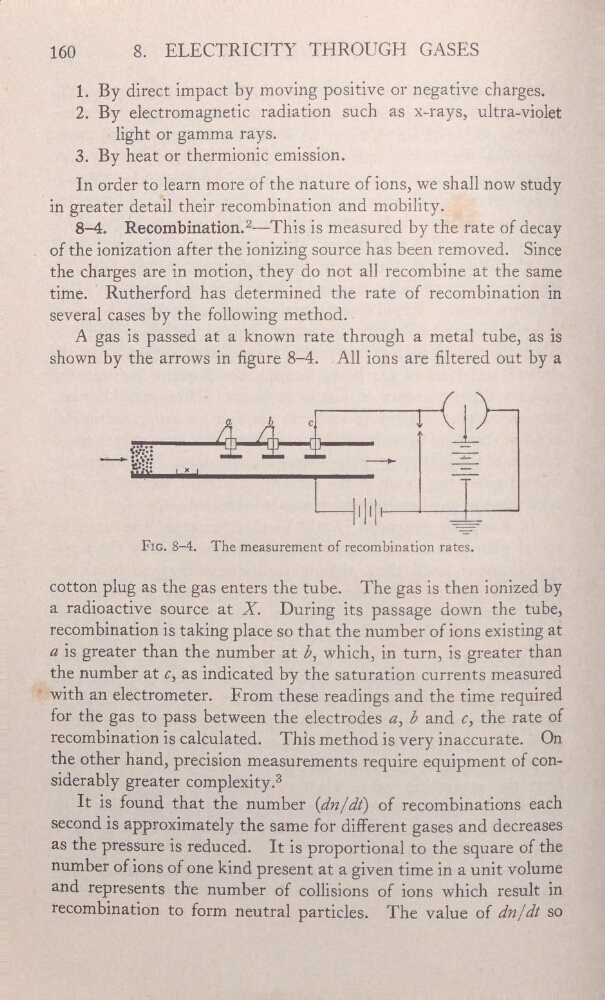
A gas is passed at a known rate through a metal tube, as is
shown by the arrows in gure 8—4. All ions are ltered out by a
._J
_,
—:—
r«'--a
x
E
.
Gill]
FIG. 8—4.
The measurement of recombination rates.
cotton plug as the gas enters the tube.
gas is then ionized by
a
radioactive source at X.
During its passage down the tube,
recombination is taking place so that the number of ions existing at
a is greater than the number at 5, which, in turn, is greater
than
…
the number at 6, as indicated by the saturation currents measured
=îî‘fWith an electrometer. From these readings and the time required
for the gas to pass between the electrodes a, 5 and c, the rate of
recombination is calculated. This method is very inaccurate. On
_
the other hand, precision measurements require equipment of con—
siderably greater complexity.3
*It is found that the number (dn/dl) of recombinations each
,
second is approximately the same for different gases and decreases
as the pressure is reduced. It is proportional to the square of the
number of ions of one kind present at a given time in a unit volume
,
and represents the number of collisions of ions which result in
;
recombination to form neutral particles. The value of
So
8.
ELECTRICITY THROUGH GASES
1. By direct impact by moving positive or negative charges.
2. By electromagnetic radiation such as X—1'ays, ultra—violet
light or gamma rays.
3. By heat or thermionic emission.
In order to learn more of the nature of ions, we shall now study
in greater detail their recombination and mobility.
8—4.
RecombinationÊ—This is measured by the rate of decay
_
of the ionization after the ionizing source has been removed. Since
the charges are in motion, they do not all recombine at the same
time.
Rutherford has determined the rate of recombination in
several cases by the following method..
A gas is passed at a known rate through a metal tube, as is
shown by the arrows in gure 8—4. All ions are ltered out by a
._J
_,
—:—
r«'--a
x
E
.
Gill]
FIG. 8—4.
The measurement of recombination rates.
cotton plug as the gas enters the tube.
gas is then ionized by
a
radioactive source at X.
During its passage down the tube,
recombination is taking place so that the number of ions existing at
a is greater than the number at 5, which, in turn, is greater
than
…
the number at 6, as indicated by the saturation currents measured
=îî‘fWith an electrometer. From these readings and the time required
for the gas to pass between the electrodes a, 5 and c, the rate of
recombination is calculated. This method is very inaccurate. On
_
the other hand, precision measurements require equipment of con—
siderably greater complexity.3
*It is found that the number (dn/dl) of recombinations each
,
second is approximately the same for different gases and decreases
as the pressure is reduced. It is proportional to the square of the
number of ions of one kind present at a given time in a unit volume
,
and represents the number of collisions of ions which result in
;
recombination to form neutral particles. The value of
So