

_
5—3.
FREE ELECTRONS
A METAL
105
the usual type, which originated in the movements of the" free
electrons in the grid circuit of the rst__tube, sets
lower limit to
_
the possible signal-to_-noise ratio… This noise has been found to be
proportional to the resistance of the grid circuit and to the Width
of the frequency band which is to be arñplied.
As stated before, some of the free electrons in a metal are trav'
elling faster than others. Consider, rst, only a portion of these
electrons, those which have velocities in an exceedingly small
'
velocity range dv. Next, compare the number of electrons in one
,
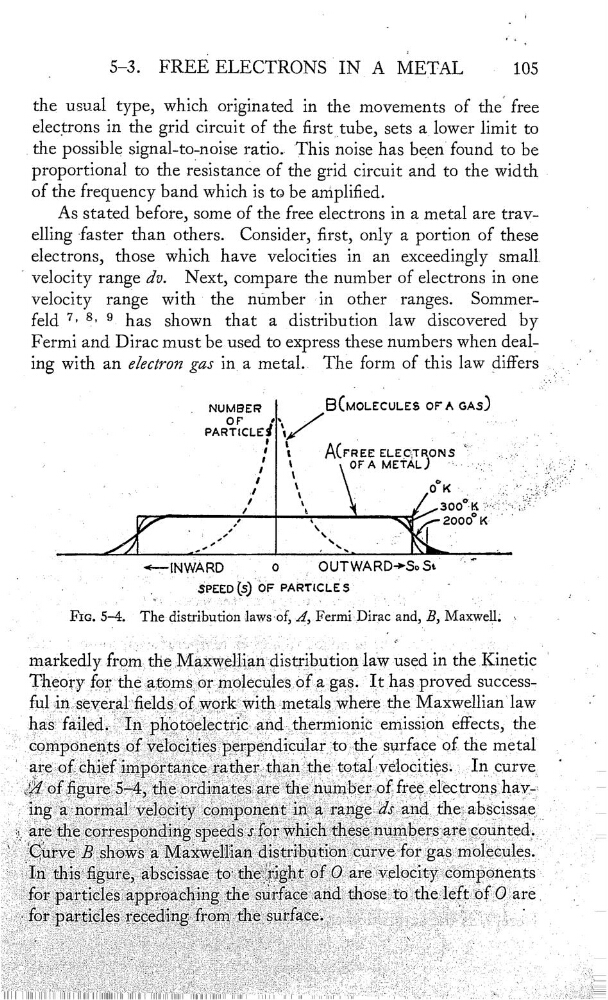
velocity range with the number in other ranges. Sommerfeld 7, S’ 9 has shown that a distribution law discovered by
Fermi and Dirac must be used to express these numbers when deal—
ing With an electron gas in a metal.. The form of this law differs
._
*
'
NUMBER
BCM0LECULES 0F‘A GAS)
..
op
"
.
.
_
_
PARTtCLE! \/
—
-
.
|
'
'
;
\
‘A(F‘REE ELEC—_TRONS
_
,
_,
\\
OFA METAL)
—._
_
-
_
’
'
,I'
“
°°K
'
_
,’
\
,
300°1 6K
-'
.
Vf
_
,/
\\
’
\“.—_
2000 K
/
\
'
.
.
'
'
.
0
0UTWARD+SoS«
‘'
‘
'
,
7
.
PAÊQTICLÈS‘
'
,
FIS. 5—4.
The distribution laws cf,
Fermi'Dirac and, B, Maxwell;
markedly
the
law used in the Kinetic
'
Theô‘rÿ flotr theatomsormoleculesofa gas—. 1-thas Provcd SHCCÈSS—
'
,
the Maxwellian
"
law
-'
mganormalVelomtyœmp0nentmarangedsandtheabsc188%
'
-
Curvesh0WSaMaxwelhanàst11butwncurvef0rgasm01ecules
Inthwgureabsœssaetther1ght0fareV610Cltÿcompenents =
'
'
f0rpart1desapmachmgthesurfaœandthosetotheleftof0are ! ‘f
5—3.
FREE ELECTRONS
A METAL
105
the usual type, which originated in the movements of the" free
electrons in the grid circuit of the rst__tube, sets
lower limit to
_
the possible signal-to_-noise ratio… This noise has been found to be
proportional to the resistance of the grid circuit and to the Width
of the frequency band which is to be arñplied.
As stated before, some of the free electrons in a metal are trav'
elling faster than others. Consider, rst, only a portion of these
electrons, those which have velocities in an exceedingly small
'
velocity range dv. Next, compare the number of electrons in one
,
velocity range with the number in other ranges. Sommerfeld 7, S’ 9 has shown that a distribution law discovered by
Fermi and Dirac must be used to express these numbers when deal—
ing With an electron gas in a metal.. The form of this law differs
._
*
'
NUMBER
BCM0LECULES 0F‘A GAS)
..
op
"
.
.
_
_
PARTtCLE! \/
—
-
.
|
'
'
;
\
‘A(F‘REE ELEC—_TRONS
_
,
_,
\\
OFA METAL)
—._
_
-
_
’
'
,I'
“
°°K
'
_
,’
\
,
300°1 6K
-'
.
Vf
_
,/
\\
’
\“.—_
2000 K
/
\
'
.
.
'
'
.
0
0UTWARD+SoS«
‘'
‘
'
,
7
.
PAÊQTICLÈS‘
'
,
FIS. 5—4.
The distribution laws cf,
Fermi'Dirac and, B, Maxwell;
markedly
the
law used in the Kinetic
'
Theô‘rÿ flotr theatomsormoleculesofa gas—. 1-thas Provcd SHCCÈSS—
'
,
the Maxwellian
"
law
-'
mganormalVelomtyœmp0nentmarangedsandtheabsc188%
'
-
Curvesh0WSaMaxwelhanàst11butwncurvef0rgasm01ecules
Inthwgureabsœssaetther1ght0fareV610Cltÿcompenents =
'
'
f0rpart1desapmachmgthesurfaœandthosetotheleftof0are ! ‘f