

water particles in the bowl have moved but little and at a comparatively low velocity. As water continues to pour
in from one side,
the discharge continues from the other side until nally some
‘
the water particles have actually travelled across the bowl. In a
straight wire, the effect of the application of an electromotive force "
is propagated with the velocity of light, or just a little less, even
though the drift motion of the free electrons is only a few centi—
meters per second. Conceivably, a free electron at one end of the
wire might eventually reach the other end.
The concept of free electrons in a metal has been used to
explain the transfer of heat from one point to another.
The
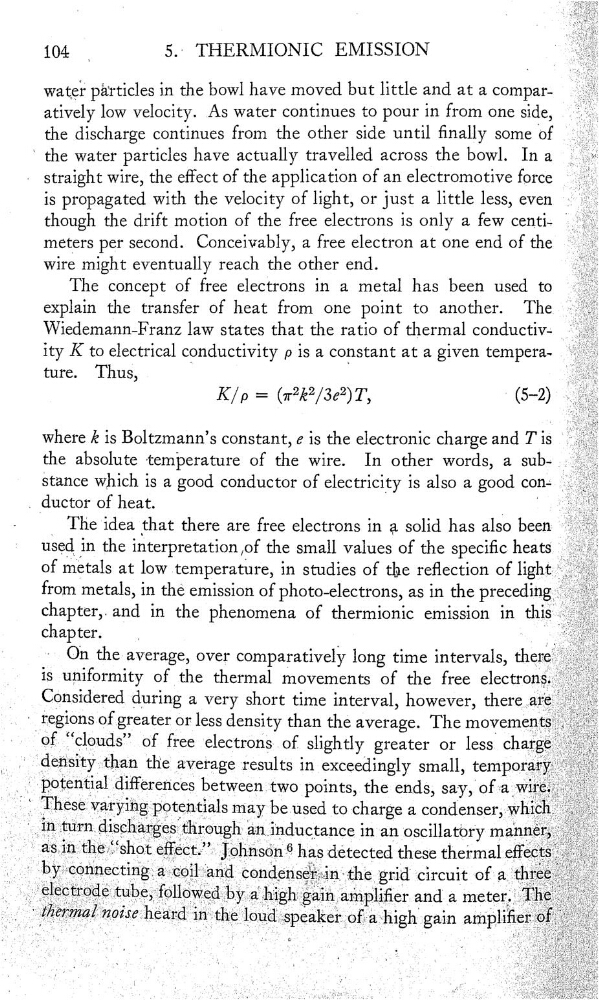
Wiedemann-Franz law states that the ratio of thermal conductivity K to electrical conductivity p is a constant at a given tempera—
ture.
Thus,
K/p =
where % is Boltzmann’s constant, 6 is the electronic charge and T is
the absolute temperature of the wire.
In other words, a sub—
Stance which is a good conductor of electricity is also a good
_ductor of heat.
’
,
-
_
The idea that there are free electrons in a solid has also been
used in the interpretation,of the small values of the specic heatS
of metals at low temperature, in studies of the reection of light
from metals, in the emission of photo-electrons, as in the
chapter, and in the phenomena of thermionic emission in thls
chapter.
‘
On the» average, over comparativelÿ long time intervals, there
is uniformity of the thermal movements of the free electrons
considered during a very short time interval, however,
‘
-
_
regi0ns.of greater or less density than the average. The movements
,
'Of “clouds”
of free electrons of slightly greater or less charge
.,
den31tythan the
results in exceedingly small, temporary
between.two points, the ends, say,of
TheseVarÿlg}potehtials may beused to charge a
‘
mmmdmhargesthrough
in an oscillatbr‘y manner
asmthe“Sh0t€ff6Ct’ ’]Ohnsonô has detected these
l/zermalno” ? heard 1n thelouclspeakerofah1gh gain
in from one side,
the discharge continues from the other side until nally some
‘
the water particles have actually travelled across the bowl. In a
straight wire, the effect of the application of an electromotive force "
is propagated with the velocity of light, or just a little less, even
though the drift motion of the free electrons is only a few centi—
meters per second. Conceivably, a free electron at one end of the
wire might eventually reach the other end.
The concept of free electrons in a metal has been used to
explain the transfer of heat from one point to another.
The
Wiedemann-Franz law states that the ratio of thermal conductivity K to electrical conductivity p is a constant at a given tempera—
ture.
Thus,
K/p =
where % is Boltzmann’s constant, 6 is the electronic charge and T is
the absolute temperature of the wire.
In other words, a sub—
Stance which is a good conductor of electricity is also a good
_ductor of heat.
’
,
-
_
The idea that there are free electrons in a solid has also been
used in the interpretation,of the small values of the specic heatS
of metals at low temperature, in studies of the reection of light
from metals, in the emission of photo-electrons, as in the
chapter, and in the phenomena of thermionic emission in thls
chapter.
‘
On the» average, over comparativelÿ long time intervals, there
is uniformity of the thermal movements of the free electrons
considered during a very short time interval, however,
‘
-
_
regi0ns.of greater or less density than the average. The movements
,
'Of “clouds”
of free electrons of slightly greater or less charge
.,
den31tythan the
results in exceedingly small, temporary
between.two points, the ends, say,of
TheseVarÿlg}potehtials may beused to charge a
‘
mmmdmhargesthrough
in an oscillatbr‘y manner
asmthe“Sh0t€ff6Ct’ ’]Ohnsonô has detected these
l/zermalno” ? heard 1n thelouclspeakerofah1gh gain