

106
5.
THERMIONIC EMISSION
In the case of the Fermi-Dirac law, Â of gure 5—4, the number
of free
normal velocity components
in the range ds
'
is constant for the different speeds : from zero to a sharp maximum
sa when the metal is at zero degrees absolute. » The effect of heat—
ing the metal is to speed up a comparatively small number of the
electrons, as shown by the curves for 300 and 2000 degrees absolute.
It is only the faster electrons, above the shaded area, st,
which are given out in photoelectric and thermionic emission.
5—4.
Richardson’s Equation.7'sv9—Let the potential of the ,
plate of a diode be suiciently great to draw over to it all electrons
emitted by the lament, even at the maximum operating tempera- .
ture.
Then the current of electricity is which passes
from the hot
:
lament to the cold plate is equal to the product of the number of
electrons emitted each second and the charge on each. The num— ’
_
ber of electrons which can escape from the metal at room temperatüres is too small to be measured since the kinetic energy even
:
of the faster ones inside the metal is less than the critical amount
required to over-come the surface forces. Thus, at room temperà—
—
tures, the velocities of the free electrons are all less than the value
st of gure 5—4. As in the photoelectric effect, the work to remove
an electron from the metal is expressed by the symbol çb and is
equal to the difference between the barrier energy éî, of the surface
and the inner energy ômm of the fastest electrons at zero degrees
éÎn is the kinetic energy corresponding to the velocity
sa in gure 5—4.
«
When the lam“ent is raised to higher‘temperatures, some of the
electrons—acquire kinetic energies greater, by an amount @, than
.
'
their low temperature values and are able to escape.
The hottef
metal, the greater the number of electrons with velocities
‘perpendicular to the surface in excess of this critical value. The
_
Fermi—Dirac distribution law is a quantitative statement
of the
number
which have certain velocities in the metal and hence may
'
be used 'topredict the number which will succeed in escap1ng
,
through—fthé—“surface at »a given temperature. It has been used to
—} ,
slightly modied form“ of Richardson’s‘ equa
=
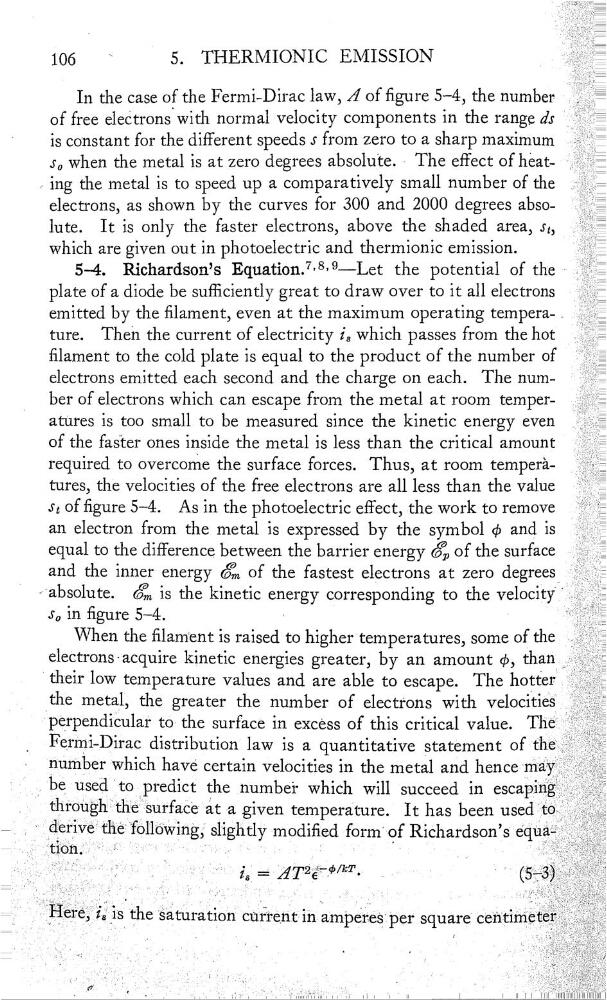
a =
,
'
'
(5—3)
Here, ’813 the saturation Cü1:i‘ent in ampére‘s'per square“ cent1m€ter
"
f
w
…
l
\
il \ lHLLHMMWlή\
5.
THERMIONIC EMISSION
In the case of the Fermi-Dirac law, Â of gure 5—4, the number
of free
normal velocity components
in the range ds
'
is constant for the different speeds : from zero to a sharp maximum
sa when the metal is at zero degrees absolute. » The effect of heat—
ing the metal is to speed up a comparatively small number of the
electrons, as shown by the curves for 300 and 2000 degrees absolute.
It is only the faster electrons, above the shaded area, st,
which are given out in photoelectric and thermionic emission.
5—4.
Richardson’s Equation.7'sv9—Let the potential of the ,
plate of a diode be suiciently great to draw over to it all electrons
emitted by the lament, even at the maximum operating tempera- .
ture.
Then the current of electricity is which passes
from the hot
:
lament to the cold plate is equal to the product of the number of
electrons emitted each second and the charge on each. The num— ’
_
ber of electrons which can escape from the metal at room temperatüres is too small to be measured since the kinetic energy even
:
of the faster ones inside the metal is less than the critical amount
required to over-come the surface forces. Thus, at room temperà—
—
tures, the velocities of the free electrons are all less than the value
st of gure 5—4. As in the photoelectric effect, the work to remove
an electron from the metal is expressed by the symbol çb and is
equal to the difference between the barrier energy éî, of the surface
and the inner energy ômm of the fastest electrons at zero degrees
éÎn is the kinetic energy corresponding to the velocity
sa in gure 5—4.
«
When the lam“ent is raised to higher‘temperatures, some of the
electrons—acquire kinetic energies greater, by an amount @, than
.
'
their low temperature values and are able to escape.
The hottef
metal, the greater the number of electrons with velocities
‘perpendicular to the surface in excess of this critical value. The
_
Fermi—Dirac distribution law is a quantitative statement
of the
number
which have certain velocities in the metal and hence may
'
be used 'topredict the number which will succeed in escap1ng
,
through—fthé—“surface at »a given temperature. It has been used to
—} ,
slightly modied form“ of Richardson’s‘ equa
=
a =
,
'
'
(5—3)
Here, ’813 the saturation Cü1:i‘ent in ampére‘s'per square“ cent1m€ter
"
f
w
…
l
\
il \ lHLLHMMWlή\