

M. T. Dokulil
86
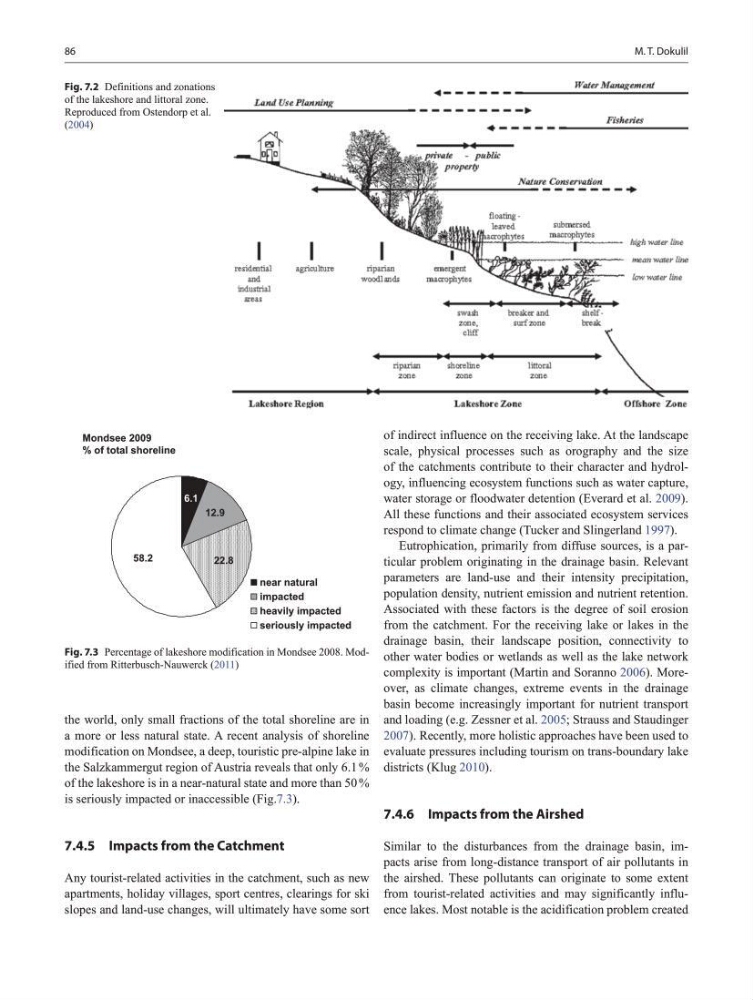
the world, only small fractions of the total shoreline are in
a more or less natural state. A recent analysis of shoreline
modification on Mondsee, a deep, touristic pre-alpine lake in
the Salzkammergut region of Austria reveals that only 6.1 %
of the lakeshore is in a near-natural state and more than 50 %
is seriously impacted or inaccessible (Fig.7.3).
7.4.5 Impacts from the Catchment
Any tourist-related activities in the catchment, such as new
apartments, holiday villages, sport centres, clearings for ski
slopes and land-use changes, will ultimately have some sort
of indirect influence on the receiving lake. At the landscape
scale, physical processes such as orography and the size
of the catchments contribute to their character and hydrology, influencing ecosystem functions such as water capture,
water storage or floodwater detention (Everard et al. 2009).
All these functions and their associated ecosystem services
respond to climate change (Tucker and Slingerland 1997).
Eutrophication, primarily from diffuse sources, is a particular problem originating in the drainage basin. Relevant
parameters are land-use and their intensity precipitation,
population density, nutrient emission and nutrient retention.
Associated with these factors is the degree of soil erosion
from the catchment. For the receiving lake or lakes in the
drainage basin, their landscape position, connectivity to
other water bodies or wetlands as well as the lake network
complexity is important (Martin and Soranno 2006). Moreover, as climate changes, extreme events in the drainage
basin become increasingly important for nutrient transport
and loading (e.g. Zessner et al. 2005; Strauss and Staudinger
2007). Recently, more holistic approaches have been used to
evaluate pressures including tourism on trans-boundary lake
districts (Klug 2010).
7.4.6 Impacts from the Airshed
Similar to the disturbances from the drainage basin, impacts arise from long-distance transport of air pollutants in
the airshed. These pollutants can originate to some extent
from tourist-related activities and may significantly influence lakes. Most notable is the acidification problem created
Fig. 7.2 Definitions and zonations
of the lakeshore and littoral zone.
Reproduced from Ostendorp et al.
(2004)
Fig. 7.3 Percentage of lakeshore modification in Mondsee 2008. Modified from Ritterbusch-Nauwerck (2011)
Mondsee 2009
% of total shoreline
6.1
12.9
22.8
58.2
near natural
impacted
heavily impacted
seriously impacted
86
the world, only small fractions of the total shoreline are in
a more or less natural state. A recent analysis of shoreline
modification on Mondsee, a deep, touristic pre-alpine lake in
the Salzkammergut region of Austria reveals that only 6.1 %
of the lakeshore is in a near-natural state and more than 50 %
is seriously impacted or inaccessible (Fig.7.3).
7.4.5 Impacts from the Catchment
Any tourist-related activities in the catchment, such as new
apartments, holiday villages, sport centres, clearings for ski
slopes and land-use changes, will ultimately have some sort
of indirect influence on the receiving lake. At the landscape
scale, physical processes such as orography and the size
of the catchments contribute to their character and hydrology, influencing ecosystem functions such as water capture,
water storage or floodwater detention (Everard et al. 2009).
All these functions and their associated ecosystem services
respond to climate change (Tucker and Slingerland 1997).
Eutrophication, primarily from diffuse sources, is a particular problem originating in the drainage basin. Relevant
parameters are land-use and their intensity precipitation,
population density, nutrient emission and nutrient retention.
Associated with these factors is the degree of soil erosion
from the catchment. For the receiving lake or lakes in the
drainage basin, their landscape position, connectivity to
other water bodies or wetlands as well as the lake network
complexity is important (Martin and Soranno 2006). Moreover, as climate changes, extreme events in the drainage
basin become increasingly important for nutrient transport
and loading (e.g. Zessner et al. 2005; Strauss and Staudinger
2007). Recently, more holistic approaches have been used to
evaluate pressures including tourism on trans-boundary lake
districts (Klug 2010).
7.4.6 Impacts from the Airshed
Similar to the disturbances from the drainage basin, impacts arise from long-distance transport of air pollutants in
the airshed. These pollutants can originate to some extent
from tourist-related activities and may significantly influence lakes. Most notable is the acidification problem created
Fig. 7.2 Definitions and zonations
of the lakeshore and littoral zone.
Reproduced from Ostendorp et al.
(2004)
Fig. 7.3 Percentage of lakeshore modification in Mondsee 2008. Modified from Ritterbusch-Nauwerck (2011)
Mondsee 2009
% of total shoreline
6.1
12.9
22.8
58.2
near natural
impacted
heavily impacted
seriously impacted