

7 Environmental Impacts of Tourism on Lakes
87
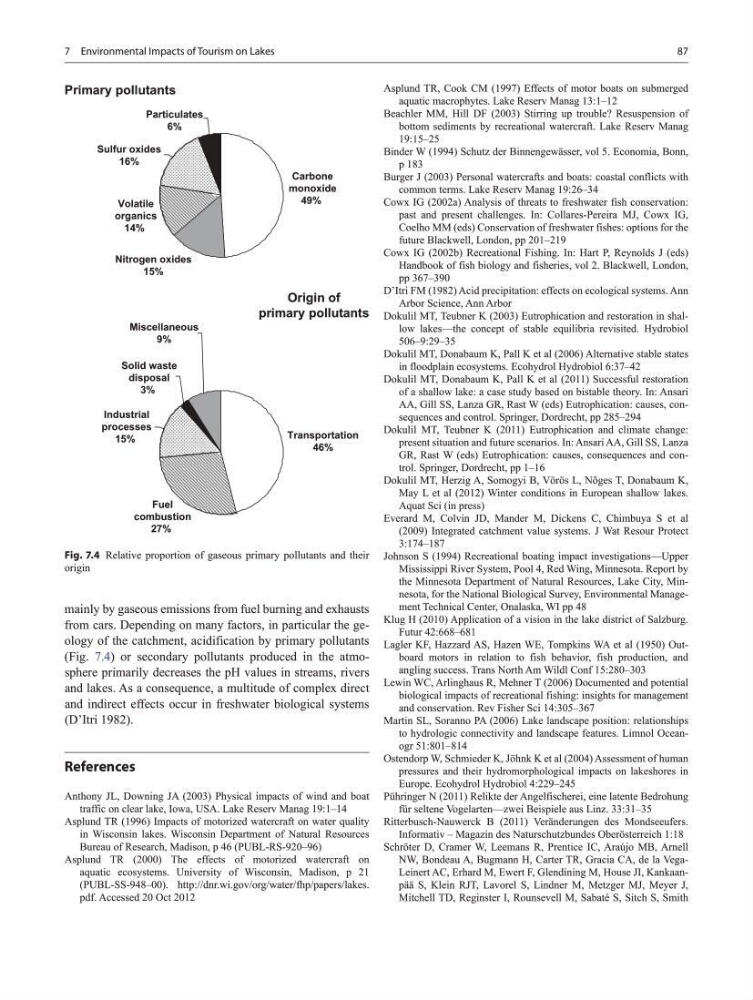
mainly by gaseous emissions from fuel burning and exhausts
from cars. Depending on many factors, in particular the geology of the catchment, acidification by primary pollutants
(Fig. 7.4) or secondary pollutants produced in the atmosphere primarily decreases the pH values in streams, rivers
and lakes. As a consequence, a multitude of complex direct
and indirect effects occur in freshwater biological systems
(D’Itri 1982).
References
Anthony JL, Downing JA (2003) Physical impacts of wind and boat
traffic on clear lake, Iowa, USA. Lake Reserv Manag 19:1–14
Asplund TR (1996) Impacts of motorized watercraft on water quality
in Wisconsin lakes. Wisconsin Department of Natural Resources
Bureau of Research, Madison, p 46 (PUBL-RS-920–96)
Asplund TR (2000) The effects of motorized watercraft on
aquatic ecosystems. University of Wisconsin, Madison, p 21
(PUBL-SS-948–00). http://dnr.wi.gov/org/water/fhp/papers/lakes.
pdf. Accessed 20 Oct 2012
Asplund TR, Cook CM (1997) Effects of motor boats on submerged
aquatic macrophytes. Lake Reserv Manag 13:1–12
Beachler MM, Hill DF (2003) Stirring up trouble? Resuspension of
bottom sediments by recreational watercraft. Lake Reserv Manag
19:15–25
Binder W (1994) Schutz der Binnengewässer, vol 5. Economia, Bonn,
p 183
Burger J (2003) Personal watercrafts and boats: coastal conflicts with
common terms. Lake Reserv Manag 19:26–34
Cowx IG (2002a) Analysis of threats to freshwater fish conservation:
past and present challenges. In: Collares-Pereira MJ, Cowx IG,
Coelho MM (eds) Conservation of freshwater fishes: options for the
future Blackwell, London, pp 201–219
Cowx IG (2002b) Recreational Fishing. In: Hart P, Reynolds J (eds)
Handbook of fish biology and fisheries, vol 2. Blackwell, London,
pp 367–390
D’Itri FM (1982) Acid precipitation: effects on ecological systems. Ann
Arbor Science, Ann Arbor
Dokulil MT, Teubner K (2003) Eutrophication and restoration in shallow lakes—the concept of stable equilibria revisited. Hydrobiol
506–9:29–35
Dokulil MT, Donabaum K, Pall K et al (2006) Alternative stable states
in floodplain ecosystems. Ecohydrol Hydrobiol 6:37–42
Dokulil MT, Donabaum K, Pall K et al (2011) Successful restoration
of a shallow lake: a case study based on bistable theory. In: Ansari
AA, Gill SS, Lanza GR, Rast W (eds) Eutrophication: causes, consequences and control. Springer, Dordrecht, pp 285–294
Dokulil MT, Teubner K (2011) Eutrophication and climate change:
present situation and future scenarios. In: Ansari AA, Gill SS, Lanza
GR, Rast W (eds) Eutrophication: causes, consequences and control. Springer, Dordrecht, pp 1–16
Dokulil MT, Herzig A, Somogyi B, Vörös L, Nõges T, Donabaum K,
May L et al (2012) Winter conditions in European shallow lakes.
Aquat Sci (in press)
Everard M, Colvin JD, Mander M, Dickens C, Chimbuya S et al
(2009) Integrated catchment value systems. J Wat Resour Protect
3:174–187
Johnson S (1994) Recreational boating impact investigations—Upper
Mississippi River System, Pool 4, Red Wing, Minnesota. Report by
the Minnesota Department of Natural Resources, Lake City, Minnesota, for the National Biological Survey, Environmental Management Technical Center, Onalaska, WI pp 48
Klug H (2010) Application of a vision in the lake district of Salzburg.
Futur 42:668–681
Lagler KF, Hazzard AS, Hazen WE, Tompkins WA et al (1950) Outboard motors in relation to fish behavior, fish production, and
angling success. Trans North Am Wildl Conf 15:280–303
Lewin WC, Arlinghaus R, Mehner T (2006) Documented and potential
biological impacts of recreational fishing: insights for management
and conservation. Rev Fisher Sci 14:305–367
Martin SL, Soranno PA (2006) Lake landscape position: relationships
to hydrologic connectivity and landscape features. Limnol Oceanogr 51:801–814
Ostendorp W, Schmieder K, Jöhnk K et al (2004) Assessment of human
pressures and their hydromorphological impacts on lakeshores in
Europe. Ecohydrol Hydrobiol 4:229–245
Pühringer N (2011) Relikte der Angelfischerei, eine latente Bedrohung
für seltene Vogelarten—zwei Beispiele aus Linz. 33:31–35
Ritterbusch-Nauwerck B (2011) Veränderungen des Mondseeufers.
Informativ – Magazin des Naturschutzbundes Oberösterreich 1:18
Schröter D, Cramer W, Leemans R, Prentice IC, Araújo MB, Arnell
NW, Bondeau A, Bugmann H, Carter TR, Gracia CA, de la VegaLeinert AC, Erhard M, Ewert F, Glendining M, House JI, Kankaanpää S, Klein RJT, Lavorel S, Lindner M, Metzger MJ, Meyer J,
Mitchell TD, Reginster I, Rounsevell M, Sabaté S, Sitch S, Smith
Fig. 7.4 Relative proportion of gaseous primary pollutants and their
origin
Nitrogen oxides
15%
Volatile
organics
14%
Sulfur oxides
16%
Particulates
6%
Carbone
monoxide
49%
Transportation
46%
Fuel
combustion
27%
Industrial
processes
15%
Solid waste
disposal
3%
Miscellaneous
9%
Primary pollutants
Origin of
primary pollutants
87
mainly by gaseous emissions from fuel burning and exhausts
from cars. Depending on many factors, in particular the geology of the catchment, acidification by primary pollutants
(Fig. 7.4) or secondary pollutants produced in the atmosphere primarily decreases the pH values in streams, rivers
and lakes. As a consequence, a multitude of complex direct
and indirect effects occur in freshwater biological systems
(D’Itri 1982).
References
Anthony JL, Downing JA (2003) Physical impacts of wind and boat
traffic on clear lake, Iowa, USA. Lake Reserv Manag 19:1–14
Asplund TR (1996) Impacts of motorized watercraft on water quality
in Wisconsin lakes. Wisconsin Department of Natural Resources
Bureau of Research, Madison, p 46 (PUBL-RS-920–96)
Asplund TR (2000) The effects of motorized watercraft on
aquatic ecosystems. University of Wisconsin, Madison, p 21
(PUBL-SS-948–00). http://dnr.wi.gov/org/water/fhp/papers/lakes.
pdf. Accessed 20 Oct 2012
Asplund TR, Cook CM (1997) Effects of motor boats on submerged
aquatic macrophytes. Lake Reserv Manag 13:1–12
Beachler MM, Hill DF (2003) Stirring up trouble? Resuspension of
bottom sediments by recreational watercraft. Lake Reserv Manag
19:15–25
Binder W (1994) Schutz der Binnengewässer, vol 5. Economia, Bonn,
p 183
Burger J (2003) Personal watercrafts and boats: coastal conflicts with
common terms. Lake Reserv Manag 19:26–34
Cowx IG (2002a) Analysis of threats to freshwater fish conservation:
past and present challenges. In: Collares-Pereira MJ, Cowx IG,
Coelho MM (eds) Conservation of freshwater fishes: options for the
future Blackwell, London, pp 201–219
Cowx IG (2002b) Recreational Fishing. In: Hart P, Reynolds J (eds)
Handbook of fish biology and fisheries, vol 2. Blackwell, London,
pp 367–390
D’Itri FM (1982) Acid precipitation: effects on ecological systems. Ann
Arbor Science, Ann Arbor
Dokulil MT, Teubner K (2003) Eutrophication and restoration in shallow lakes—the concept of stable equilibria revisited. Hydrobiol
506–9:29–35
Dokulil MT, Donabaum K, Pall K et al (2006) Alternative stable states
in floodplain ecosystems. Ecohydrol Hydrobiol 6:37–42
Dokulil MT, Donabaum K, Pall K et al (2011) Successful restoration
of a shallow lake: a case study based on bistable theory. In: Ansari
AA, Gill SS, Lanza GR, Rast W (eds) Eutrophication: causes, consequences and control. Springer, Dordrecht, pp 285–294
Dokulil MT, Teubner K (2011) Eutrophication and climate change:
present situation and future scenarios. In: Ansari AA, Gill SS, Lanza
GR, Rast W (eds) Eutrophication: causes, consequences and control. Springer, Dordrecht, pp 1–16
Dokulil MT, Herzig A, Somogyi B, Vörös L, Nõges T, Donabaum K,
May L et al (2012) Winter conditions in European shallow lakes.
Aquat Sci (in press)
Everard M, Colvin JD, Mander M, Dickens C, Chimbuya S et al
(2009) Integrated catchment value systems. J Wat Resour Protect
3:174–187
Johnson S (1994) Recreational boating impact investigations—Upper
Mississippi River System, Pool 4, Red Wing, Minnesota. Report by
the Minnesota Department of Natural Resources, Lake City, Minnesota, for the National Biological Survey, Environmental Management Technical Center, Onalaska, WI pp 48
Klug H (2010) Application of a vision in the lake district of Salzburg.
Futur 42:668–681
Lagler KF, Hazzard AS, Hazen WE, Tompkins WA et al (1950) Outboard motors in relation to fish behavior, fish production, and
angling success. Trans North Am Wildl Conf 15:280–303
Lewin WC, Arlinghaus R, Mehner T (2006) Documented and potential
biological impacts of recreational fishing: insights for management
and conservation. Rev Fisher Sci 14:305–367
Martin SL, Soranno PA (2006) Lake landscape position: relationships
to hydrologic connectivity and landscape features. Limnol Oceanogr 51:801–814
Ostendorp W, Schmieder K, Jöhnk K et al (2004) Assessment of human
pressures and their hydromorphological impacts on lakeshores in
Europe. Ecohydrol Hydrobiol 4:229–245
Pühringer N (2011) Relikte der Angelfischerei, eine latente Bedrohung
für seltene Vogelarten—zwei Beispiele aus Linz. 33:31–35
Ritterbusch-Nauwerck B (2011) Veränderungen des Mondseeufers.
Informativ – Magazin des Naturschutzbundes Oberösterreich 1:18
Schröter D, Cramer W, Leemans R, Prentice IC, Araújo MB, Arnell
NW, Bondeau A, Bugmann H, Carter TR, Gracia CA, de la VegaLeinert AC, Erhard M, Ewert F, Glendining M, House JI, Kankaanpää S, Klein RJT, Lavorel S, Lindner M, Metzger MJ, Meyer J,
Mitchell TD, Reginster I, Rounsevell M, Sabaté S, Sitch S, Smith
Fig. 7.4 Relative proportion of gaseous primary pollutants and their
origin
Nitrogen oxides
15%
Volatile
organics
14%
Sulfur oxides
16%
Particulates
6%
Carbone
monoxide
49%
Transportation
46%
Fuel
combustion
27%
Industrial
processes
15%
Solid waste
disposal
3%
Miscellaneous
9%
Primary pollutants
Origin of
primary pollutants