

M. T. Dokulil
84
nobacterial species can produce toxins, which are released
into the water. Skin irritation or even allergic reactions in
sensitive individuals are then possible. Algal blooms washed
on shore create aesthetic problems not only by looking ugly
but also because of the smell produced during decay.
7.4.2 Angling
Exploitation and impacts from angling have received much
less attention compared with commercial fishing. Over the
last decades, inland commercial fisheries strongly declined
in economic importance in the industrialized countries while
angling became increasingly more important particularly for
tourism development. This is even true for the developing
countries, where fishing is still important for subsistence
(Cowx 2002a, b).
Although the management of recreational fishing has regionally received considerable attention, the dimension of
angling and the potential impacts of fishing on fish populations and aquatic ecosystems are largely underestimated. A
single angler may have a low or moderate impact on fish
stock. It is, however, the cumulative impacts large numbers
of anglers can induce which matter. Since angling is usually practiced during leisure time, it becomes increasingly
important for tourism. Recently, Lewin et al. (2006) have extensively documented and discussed the potential impacts of
non-commercial recreational fishing, angling and associated
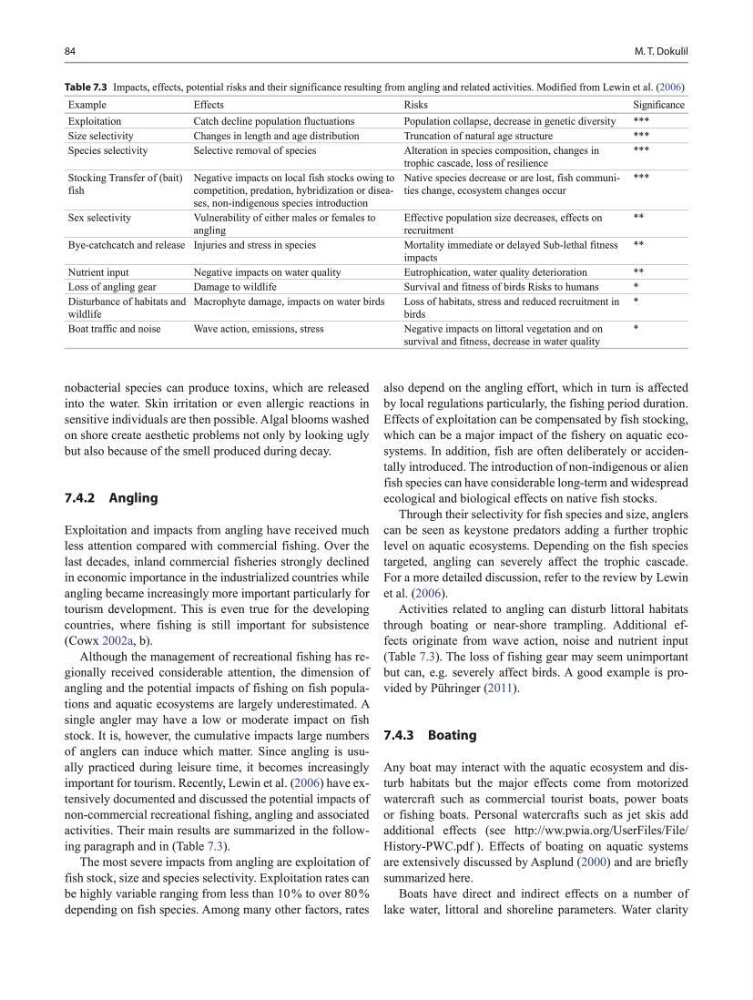
activities. Their main results are summarized in the following paragraph and in (Table 7.3).
The most severe impacts from angling are exploitation of
fish stock, size and species selectivity. Exploitation rates can
be highly variable ranging from less than 10 % to over 80 %
depending on fish species. Among many other factors, rates
also depend on the angling effort, which in turn is affected
by local regulations particularly, the fishing period duration.
Effects of exploitation can be compensated by fish stocking,
which can be a major impact of the fishery on aquatic ecosystems. In addition, fish are often deliberately or accidentally introduced. The introduction of non-indigenous or alien
fish species can have considerable long-term and widespread
ecological and biological effects on native fish stocks.
Through their selectivity for fish species and size, anglers
can be seen as keystone predators adding a further trophic
level on aquatic ecosystems. Depending on the fish species
targeted, angling can severely affect the trophic cascade.
For a more detailed discussion, refer to the review by Lewin
et al. (2006).
Activities related to angling can disturb littoral habitats
through boating or near-shore trampling. Additional effects originate from wave action, noise and nutrient input
(Table 7.3). The loss of fishing gear may seem unimportant
but can, e.g. severely affect birds. A good example is provided by Pühringer (2011).
7.4.3 Boating
Any boat may interact with the aquatic ecosystem and disturb habitats but the major effects come from motorized
watercraft such as commercial tourist boats, power boats
or fishing boats. Personal watercrafts such as jet skis add
additional effects (see http://ww.pwia.org/UserFiles/File/
History-PWC.pdf ). Effects of boating on aquatic systems
are extensively discussed by Asplund (2000) and are briefly
summarized here.
Boats have direct and indirect effects on a number of
lake water, littoral and shoreline parameters. Water clarity
Table 7.3 Impacts, effects, potential risks and their significance resulting from angling and related activities. Modified from Lewin et al. (2006)
Example
Effects
Risks
Significance
Exploitation
Catch decline population fluctuations
Population collapse, decrease in genetic diversity
***
Size selectivity
Changes in length and age distribution
Truncation of natural age structure
***
Species selectivity
Selective removal of species
Alteration in species composition, changes in
trophic cascade, loss of resilience
***
Stocking Transfer of (bait)
fish
Negative impacts on local fish stocks owing to
competition, predation, hybridization or diseases, non-indigenous species introduction
Native species decrease or are lost, fish communities change, ecosystem changes occur
***
Sex selectivity
Vulnerability of either males or females to
angling
Effective population size decreases, effects on
recruitment
**
Bye-catchcatch and release Injuries and stress in species
Mortality immediate or delayed Sub-lethal fitness
impacts
**
Nutrient input
Negative impacts on water quality
Eutrophication, water quality deterioration
**
Loss of angling gear
Damage to wildlife
Survival and fitness of birds Risks to humans
*
Disturbance of habitats and
wildlife
Macrophyte damage, impacts on water birds
Loss of habitats, stress and reduced recruitment in
birds
*
Boat traffic and noise
Wave action, emissions, stress
Negative impacts on littoral vegetation and on
survival and fitness, decrease in water quality
*
84
nobacterial species can produce toxins, which are released
into the water. Skin irritation or even allergic reactions in
sensitive individuals are then possible. Algal blooms washed
on shore create aesthetic problems not only by looking ugly
but also because of the smell produced during decay.
7.4.2 Angling
Exploitation and impacts from angling have received much
less attention compared with commercial fishing. Over the
last decades, inland commercial fisheries strongly declined
in economic importance in the industrialized countries while
angling became increasingly more important particularly for
tourism development. This is even true for the developing
countries, where fishing is still important for subsistence
(Cowx 2002a, b).
Although the management of recreational fishing has regionally received considerable attention, the dimension of
angling and the potential impacts of fishing on fish populations and aquatic ecosystems are largely underestimated. A
single angler may have a low or moderate impact on fish
stock. It is, however, the cumulative impacts large numbers
of anglers can induce which matter. Since angling is usually practiced during leisure time, it becomes increasingly
important for tourism. Recently, Lewin et al. (2006) have extensively documented and discussed the potential impacts of
non-commercial recreational fishing, angling and associated
activities. Their main results are summarized in the following paragraph and in (Table 7.3).
The most severe impacts from angling are exploitation of
fish stock, size and species selectivity. Exploitation rates can
be highly variable ranging from less than 10 % to over 80 %
depending on fish species. Among many other factors, rates
also depend on the angling effort, which in turn is affected
by local regulations particularly, the fishing period duration.
Effects of exploitation can be compensated by fish stocking,
which can be a major impact of the fishery on aquatic ecosystems. In addition, fish are often deliberately or accidentally introduced. The introduction of non-indigenous or alien
fish species can have considerable long-term and widespread
ecological and biological effects on native fish stocks.
Through their selectivity for fish species and size, anglers
can be seen as keystone predators adding a further trophic
level on aquatic ecosystems. Depending on the fish species
targeted, angling can severely affect the trophic cascade.
For a more detailed discussion, refer to the review by Lewin
et al. (2006).
Activities related to angling can disturb littoral habitats
through boating or near-shore trampling. Additional effects originate from wave action, noise and nutrient input
(Table 7.3). The loss of fishing gear may seem unimportant
but can, e.g. severely affect birds. A good example is provided by Pühringer (2011).
7.4.3 Boating
Any boat may interact with the aquatic ecosystem and disturb habitats but the major effects come from motorized
watercraft such as commercial tourist boats, power boats
or fishing boats. Personal watercrafts such as jet skis add
additional effects (see http://ww.pwia.org/UserFiles/File/
History-PWC.pdf ). Effects of boating on aquatic systems
are extensively discussed by Asplund (2000) and are briefly
summarized here.
Boats have direct and indirect effects on a number of
lake water, littoral and shoreline parameters. Water clarity
Table 7.3 Impacts, effects, potential risks and their significance resulting from angling and related activities. Modified from Lewin et al. (2006)
Example
Effects
Risks
Significance
Exploitation
Catch decline population fluctuations
Population collapse, decrease in genetic diversity
***
Size selectivity
Changes in length and age distribution
Truncation of natural age structure
***
Species selectivity
Selective removal of species
Alteration in species composition, changes in
trophic cascade, loss of resilience
***
Stocking Transfer of (bait)
fish
Negative impacts on local fish stocks owing to
competition, predation, hybridization or diseases, non-indigenous species introduction
Native species decrease or are lost, fish communities change, ecosystem changes occur
***
Sex selectivity
Vulnerability of either males or females to
angling
Effective population size decreases, effects on
recruitment
**
Bye-catchcatch and release Injuries and stress in species
Mortality immediate or delayed Sub-lethal fitness
impacts
**
Nutrient input
Negative impacts on water quality
Eutrophication, water quality deterioration
**
Loss of angling gear
Damage to wildlife
Survival and fitness of birds Risks to humans
*
Disturbance of habitats and
wildlife
Macrophyte damage, impacts on water birds
Loss of habitats, stress and reduced recruitment in
birds
*
Boat traffic and noise
Wave action, emissions, stress
Negative impacts on littoral vegetation and on
survival and fitness, decrease in water quality
*