

7 Environmental Impacts of Tourism on Lakes
83
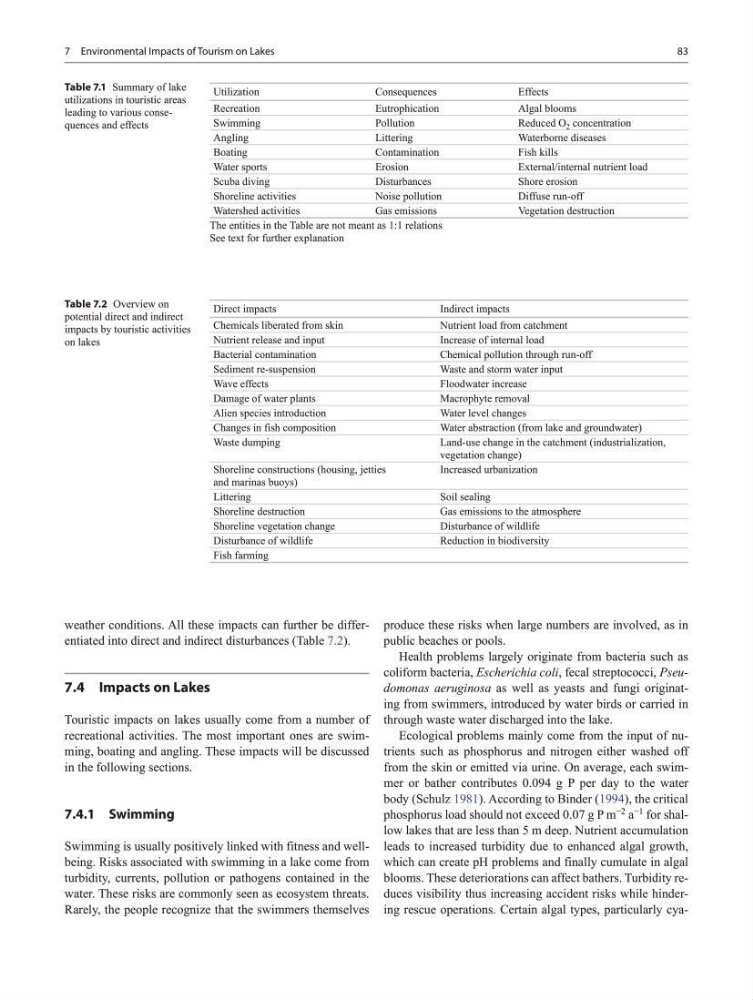
weather conditions. All these impacts can further be differentiated into direct and indirect disturbances (Table 7.2).
7.4 Impacts on Lakes
Touristic impacts on lakes usually come from a number of
recreational activities. The most important ones are swimming, boating and angling. These impacts will be discussed
in the following sections.
7.4.1 Swimming
Swimming is usually positively linked with fitness and wellbeing. Risks associated with swimming in a lake come from
turbidity, currents, pollution or pathogens contained in the
water. These risks are commonly seen as ecosystem threats.
Rarely, the people recognize that the swimmers themselves
produce these risks when large numbers are involved, as in
public beaches or pools.
Health problems largely originate from bacteria such as
coliform bacteria, Escherichia coli, fecal streptococci, Pseudomonas aeruginosa as well as yeasts and fungi originating from swimmers, introduced by water birds or carried in
through waste water discharged into the lake.
Ecological problems mainly come from the input of nutrients such as phosphorus and nitrogen either washed off
from the skin or emitted via urine. On average, each swimmer or bather contributes 0.094 g P per day to the water
body (Schulz 1981). According to Binder (1994), the critical
phosphorus load should not exceed 0.07 g P m
−2
a
−1
for shallow lakes that are less than 5 m deep. Nutrient accumulation
leads to increased turbidity due to enhanced algal growth,
which can create pH problems and finally cumulate in algal
blooms. These deteriorations can affect bathers. Turbidity reduces visibility thus increasing accident risks while hindering rescue operations. Certain algal types, particularly cyaUtilization
Consequences
Effects
Recreation
Eutrophication
Algal blooms
Swimming
Pollution
Reduced O 2 concentration
Angling
Littering
Waterborne diseases
Boating
Contamination
Fish kills
Water sports
Erosion
External/internal nutrient load
Scuba diving
Disturbances
Shore erosion
Shoreline activities
Noise pollution
Diffuse run-off
Watershed activities
Gas emissions
Vegetation destruction
The entities in the Table are not meant as 1:1 relations
See text for further explanation
Table 7.1 Summary of lake
utilizations in touristic areas
leading to various consequences and effects
Direct impacts
Indirect impacts
Chemicals liberated from skin
Nutrient load from catchment
Nutrient release and input
Increase of internal load
Bacterial contamination
Chemical pollution through run-off
Sediment re-suspension
Waste and storm water input
Wave effects
Floodwater increase
Damage of water plants
Macrophyte removal
Alien species introduction
Water level changes
Changes in fish composition
Water abstraction (from lake and groundwater)
Waste dumping
Land-use change in the catchment (industrialization,
vegetation change)
Shoreline constructions (housing, jetties
and marinas buoys)
Increased urbanization
Littering
Soil sealing
Shoreline destruction
Gas emissions to the atmosphere
Shoreline vegetation change
Disturbance of wildlife
Disturbance of wildlife
Reduction in biodiversity
Fish farming
Table 7.2 Overview on
potential direct and indirect
impacts by touristic activities
on lakes
83
weather conditions. All these impacts can further be differentiated into direct and indirect disturbances (Table 7.2).
7.4 Impacts on Lakes
Touristic impacts on lakes usually come from a number of
recreational activities. The most important ones are swimming, boating and angling. These impacts will be discussed
in the following sections.
7.4.1 Swimming
Swimming is usually positively linked with fitness and wellbeing. Risks associated with swimming in a lake come from
turbidity, currents, pollution or pathogens contained in the
water. These risks are commonly seen as ecosystem threats.
Rarely, the people recognize that the swimmers themselves
produce these risks when large numbers are involved, as in
public beaches or pools.
Health problems largely originate from bacteria such as
coliform bacteria, Escherichia coli, fecal streptococci, Pseudomonas aeruginosa as well as yeasts and fungi originating from swimmers, introduced by water birds or carried in
through waste water discharged into the lake.
Ecological problems mainly come from the input of nutrients such as phosphorus and nitrogen either washed off
from the skin or emitted via urine. On average, each swimmer or bather contributes 0.094 g P per day to the water
body (Schulz 1981). According to Binder (1994), the critical
phosphorus load should not exceed 0.07 g P m
−2
a
−1
for shallow lakes that are less than 5 m deep. Nutrient accumulation
leads to increased turbidity due to enhanced algal growth,
which can create pH problems and finally cumulate in algal
blooms. These deteriorations can affect bathers. Turbidity reduces visibility thus increasing accident risks while hindering rescue operations. Certain algal types, particularly cyaUtilization
Consequences
Effects
Recreation
Eutrophication
Algal blooms
Swimming
Pollution
Reduced O 2 concentration
Angling
Littering
Waterborne diseases
Boating
Contamination
Fish kills
Water sports
Erosion
External/internal nutrient load
Scuba diving
Disturbances
Shore erosion
Shoreline activities
Noise pollution
Diffuse run-off
Watershed activities
Gas emissions
Vegetation destruction
The entities in the Table are not meant as 1:1 relations
See text for further explanation
Table 7.1 Summary of lake
utilizations in touristic areas
leading to various consequences and effects
Direct impacts
Indirect impacts
Chemicals liberated from skin
Nutrient load from catchment
Nutrient release and input
Increase of internal load
Bacterial contamination
Chemical pollution through run-off
Sediment re-suspension
Waste and storm water input
Wave effects
Floodwater increase
Damage of water plants
Macrophyte removal
Alien species introduction
Water level changes
Changes in fish composition
Water abstraction (from lake and groundwater)
Waste dumping
Land-use change in the catchment (industrialization,
vegetation change)
Shoreline constructions (housing, jetties
and marinas buoys)
Increased urbanization
Littering
Soil sealing
Shoreline destruction
Gas emissions to the atmosphere
Shoreline vegetation change
Disturbance of wildlife
Disturbance of wildlife
Reduction in biodiversity
Fish farming
Table 7.2 Overview on
potential direct and indirect
impacts by touristic activities
on lakes