

213
15 Biogeochemical Indicators of Nutrient Enrichments in Wetlands …
concentration (Hill et al. 2006) and even no effect related to
carbon availability (Shackle et al. 2000) have been reported.
When readily metabolized soluble carbon is freely available,
it has been suggested that there is no need for microorganisms to acquire it enzymically (Chróst and Rai 1993). Further
work is needed to assess the role of carbon quality controlling not only glucosidase activity but also both peptidase and
esterase enzyme activities under different nutrient limitation
scenarios in wetlands. Other variables such as soil porewater
P according to pH and aerobic/anaerobic conditions determine the phosphatase activities (e.g., the acid phosphatase
activity becomes higher in aerobic soils whereas the alkaline
phosphatase activity appears to be higher in anaerobic soils;
McLatchey and Reddy 1998). Since extracellular enzyme
activities did not depend on a single environmental variable
(e.g., Kang et al. 2005), other multivariate approaches need
to be considered in order to refine the potential of phosphatase activity as a sensitive indicator of nutrient dynamics in
wetlands.
The relationships between organic N and extracellular
enzyme activities appear to be more diffuse than those of
P because N is associated with nucleic acids, polysaccharides, proteins, and humic complexes. Unlike extracellular
phosphatases which typically have wide substrate preferences, each of these N pools is accessed by discrete enzyme
systems. In aquatic systems, the relationship of protease and
aminopeptidase activities to protein degradation has received
the most attention (e.g., Mayer 1989; Billen 1991). Aminopeptidase activity has been shown to be induced by low N
conditions and noncompetitively inhibited by inorganic N
(Chróst 1991; Boschker and Cappenberg 1998; Montuelle
and Volat 1998; Ainsworth and Goulder 2000; Nausch and
Nausch 2000). Protease activities have also been studied
in soils (e.g., Ladd 1972) but rarely in the context of their
relationship to N acquisition by microorganisms in relation
with N supply. Protease enzymes are considered as the main
responsible for the supply of bioavailable N in the substrate
(Paul and Clark 1996) and, therefore, as the exoenzyme
addressing and controlling the nitrogen cycle in wetlands
(Wright and Reddy 2001; Schimel and Bennett 2004). Protease activity demonstrated a significant positive relationship
with gross organic nitrogen mineralization, with greater protease activity under aerobic conditions than under anaerobic
conditions (McLatchey and Reddy 1998). Protease activity
appears to be inversely correlated with soil NH 4
+ concentration: at high substrate concentrations for microbial growth,
some hydrolysis products such as NH 4
+ cannot be assimilated by microorganims and are released into the soil solution;
thus an excess of NH 4
+ may repress some enzyme activities
(Wright and Reddy 2001).
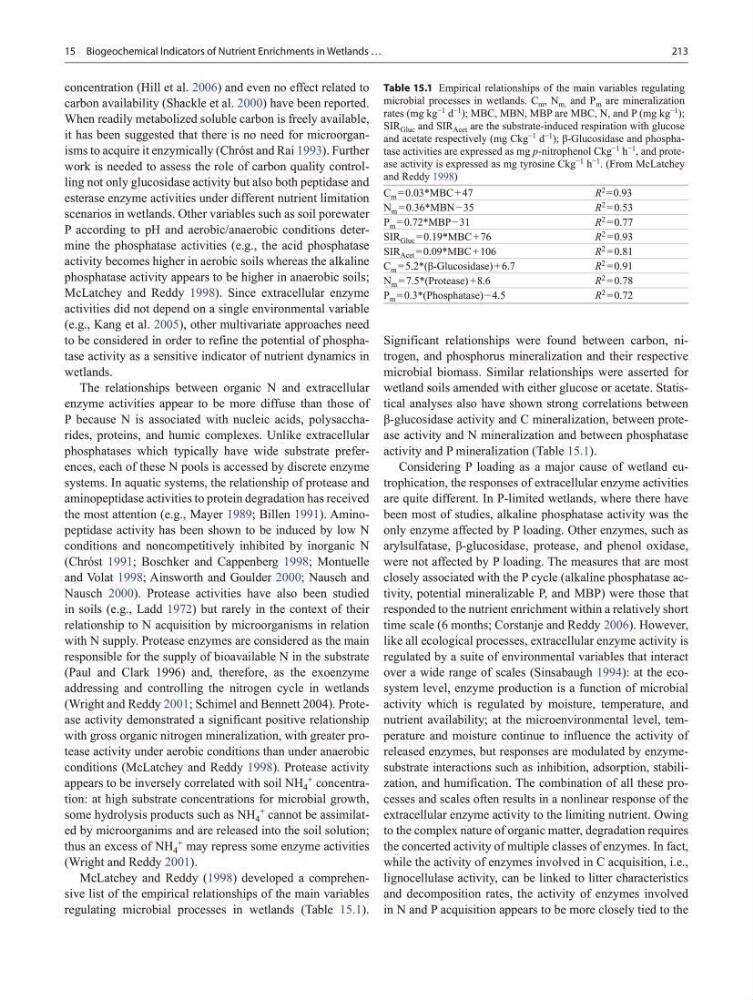
McLatchey and Reddy (1998) developed a comprehensive list of the empirical relationships of the main variables
regulating microbial processes in wetlands (Table 15.1).
Significant relationships were found between carbon, nitrogen, and phosphorus mineralization and their respective
microbial biomass. Similar relationships were asserted for
wetland soils amended with either glucose or acetate. Statistical analyses also have shown strong correlations between
β-glucosidase activity and C mineralization, between protease activity and N mineralization and between phosphatase
activity and P mineralization (Table 15.1).
Considering P loading as a major cause of wetland eutrophication, the responses of extracellular enzyme activities
are quite different. In P-limited wetlands, where there have
been most of studies, alkaline phosphatase activity was the
only enzyme affected by P loading. Other enzymes, such as
arylsulfatase, β-glucosidase, protease, and phenol oxidase,
were not affected by P loading. The measures that are most
closely associated with the P cycle (alkaline phosphatase activity, potential mineralizable P, and MBP) were those that
responded to the nutrient enrichment within a relatively short
time scale (6 months; Corstanje and Reddy 2006). However,
like all ecological processes, extracellular enzyme activity is
regulated by a suite of environmental variables that interact
over a wide range of scales (Sinsabaugh 1994): at the ecosystem level, enzyme production is a function of microbial
activity which is regulated by moisture, temperature, and
nutrient availability; at the microenvironmental level, temperature and moisture continue to influence the activity of
released enzymes, but responses are modulated by enzymesubstrate interactions such as inhibition, adsorption, stabilization, and humification. The combination of all these processes and scales often results in a nonlinear response of the
extracellular enzyme activity to the limiting nutrient. Owing
to the complex nature of organic matter, degradation requires
the concerted activity of multiple classes of enzymes. In fact,
while the activity of enzymes involved in C acquisition, i.e.,
lignocellulase activity, can be linked to litter characteristics
and decomposition rates, the activity of enzymes involved
in N and P acquisition appears to be more closely tied to the
Table 15.1 Empirical relationships of the main variables regulating
microbial processes in wetlands. C m , N m, and P m are mineralization
rates (mg kg −1 d
−1
); MBC, MBN, MBP are MBC, N, and P (mg kg
−1
);
SIR Gluc and SIR Acet are the substrate-induced respiration with glucose
and acetate respectively (mg Ckg −1 d
−1
); β-Glucosidase and phosphatase activities are expressed as mg p-nitrophenol Ckg −1 h
−1
, and protease activity is expressed as mg tyrosine Ckg −1 h
−1
. (From McLatchey
and Reddy 1998)
C m = 0.03*MBC + 47
R
2 = 0.93
N m = 0.36*MBN − 35
R
2 = 0.53
P m = 0.72*MBP − 31
R
2
= 0.77
SIR Gluc = 0.19*MBC + 76
R
2
= 0.93
SIR Acet = 0.09*MBC + 106
R
2 = 0.81
C m = 5.2*(β-Glucosidase) + 6.7
R
2 = 0.91
N m = 7.5*(Protease) + 8.6
R
2
= 0.78
P m = 0.3*(Phosphatase) − 4.5
R
2 = 0.72
15 Biogeochemical Indicators of Nutrient Enrichments in Wetlands …
concentration (Hill et al. 2006) and even no effect related to
carbon availability (Shackle et al. 2000) have been reported.
When readily metabolized soluble carbon is freely available,
it has been suggested that there is no need for microorganisms to acquire it enzymically (Chróst and Rai 1993). Further
work is needed to assess the role of carbon quality controlling not only glucosidase activity but also both peptidase and
esterase enzyme activities under different nutrient limitation
scenarios in wetlands. Other variables such as soil porewater
P according to pH and aerobic/anaerobic conditions determine the phosphatase activities (e.g., the acid phosphatase
activity becomes higher in aerobic soils whereas the alkaline
phosphatase activity appears to be higher in anaerobic soils;
McLatchey and Reddy 1998). Since extracellular enzyme
activities did not depend on a single environmental variable
(e.g., Kang et al. 2005), other multivariate approaches need
to be considered in order to refine the potential of phosphatase activity as a sensitive indicator of nutrient dynamics in
wetlands.
The relationships between organic N and extracellular
enzyme activities appear to be more diffuse than those of
P because N is associated with nucleic acids, polysaccharides, proteins, and humic complexes. Unlike extracellular
phosphatases which typically have wide substrate preferences, each of these N pools is accessed by discrete enzyme
systems. In aquatic systems, the relationship of protease and
aminopeptidase activities to protein degradation has received
the most attention (e.g., Mayer 1989; Billen 1991). Aminopeptidase activity has been shown to be induced by low N
conditions and noncompetitively inhibited by inorganic N
(Chróst 1991; Boschker and Cappenberg 1998; Montuelle
and Volat 1998; Ainsworth and Goulder 2000; Nausch and
Nausch 2000). Protease activities have also been studied
in soils (e.g., Ladd 1972) but rarely in the context of their
relationship to N acquisition by microorganisms in relation
with N supply. Protease enzymes are considered as the main
responsible for the supply of bioavailable N in the substrate
(Paul and Clark 1996) and, therefore, as the exoenzyme
addressing and controlling the nitrogen cycle in wetlands
(Wright and Reddy 2001; Schimel and Bennett 2004). Protease activity demonstrated a significant positive relationship
with gross organic nitrogen mineralization, with greater protease activity under aerobic conditions than under anaerobic
conditions (McLatchey and Reddy 1998). Protease activity
appears to be inversely correlated with soil NH 4
+ concentration: at high substrate concentrations for microbial growth,
some hydrolysis products such as NH 4
+ cannot be assimilated by microorganims and are released into the soil solution;
thus an excess of NH 4
+ may repress some enzyme activities
(Wright and Reddy 2001).
McLatchey and Reddy (1998) developed a comprehensive list of the empirical relationships of the main variables
regulating microbial processes in wetlands (Table 15.1).
Significant relationships were found between carbon, nitrogen, and phosphorus mineralization and their respective
microbial biomass. Similar relationships were asserted for
wetland soils amended with either glucose or acetate. Statistical analyses also have shown strong correlations between
β-glucosidase activity and C mineralization, between protease activity and N mineralization and between phosphatase
activity and P mineralization (Table 15.1).
Considering P loading as a major cause of wetland eutrophication, the responses of extracellular enzyme activities
are quite different. In P-limited wetlands, where there have
been most of studies, alkaline phosphatase activity was the
only enzyme affected by P loading. Other enzymes, such as
arylsulfatase, β-glucosidase, protease, and phenol oxidase,
were not affected by P loading. The measures that are most
closely associated with the P cycle (alkaline phosphatase activity, potential mineralizable P, and MBP) were those that
responded to the nutrient enrichment within a relatively short
time scale (6 months; Corstanje and Reddy 2006). However,
like all ecological processes, extracellular enzyme activity is
regulated by a suite of environmental variables that interact
over a wide range of scales (Sinsabaugh 1994): at the ecosystem level, enzyme production is a function of microbial
activity which is regulated by moisture, temperature, and
nutrient availability; at the microenvironmental level, temperature and moisture continue to influence the activity of
released enzymes, but responses are modulated by enzymesubstrate interactions such as inhibition, adsorption, stabilization, and humification. The combination of all these processes and scales often results in a nonlinear response of the
extracellular enzyme activity to the limiting nutrient. Owing
to the complex nature of organic matter, degradation requires
the concerted activity of multiple classes of enzymes. In fact,
while the activity of enzymes involved in C acquisition, i.e.,
lignocellulase activity, can be linked to litter characteristics
and decomposition rates, the activity of enzymes involved
in N and P acquisition appears to be more closely tied to the
Table 15.1 Empirical relationships of the main variables regulating
microbial processes in wetlands. C m , N m, and P m are mineralization
rates (mg kg −1 d
−1
); MBC, MBN, MBP are MBC, N, and P (mg kg
−1
);
SIR Gluc and SIR Acet are the substrate-induced respiration with glucose
and acetate respectively (mg Ckg −1 d
−1
); β-Glucosidase and phosphatase activities are expressed as mg p-nitrophenol Ckg −1 h
−1
, and protease activity is expressed as mg tyrosine Ckg −1 h
−1
. (From McLatchey
and Reddy 1998)
C m = 0.03*MBC + 47
R
2 = 0.93
N m = 0.36*MBN − 35
R
2 = 0.53
P m = 0.72*MBP − 31
R
2
= 0.77
SIR Gluc = 0.19*MBC + 76
R
2
= 0.93
SIR Acet = 0.09*MBC + 106
R
2 = 0.81
C m = 5.2*(β-Glucosidase) + 6.7
R
2 = 0.91
N m = 7.5*(Protease) + 8.6
R
2
= 0.78
P m = 0.3*(Phosphatase) − 4.5
R
2 = 0.72