

214
S. Sánchez-Carrillo et al.
environmental availability of these nutrients. The combined
relative activity of the enzymes has been proposed by Sinsabaugh et al. (1997) as a model for microbial response to
environmental conditions. Enzyme activities are normalized
through a simple index model which incorporates all the enzyme data into one pool without the bias associated with the
different ranges of activity. The enzyme data are standardized
to a 0–1 scale by dividing the activity recorded for a specific
enzyme by the maximum value obtained for that enzyme
during the study. Average enzyme activity for each sampling
date is calculated by summing the relative activities of each
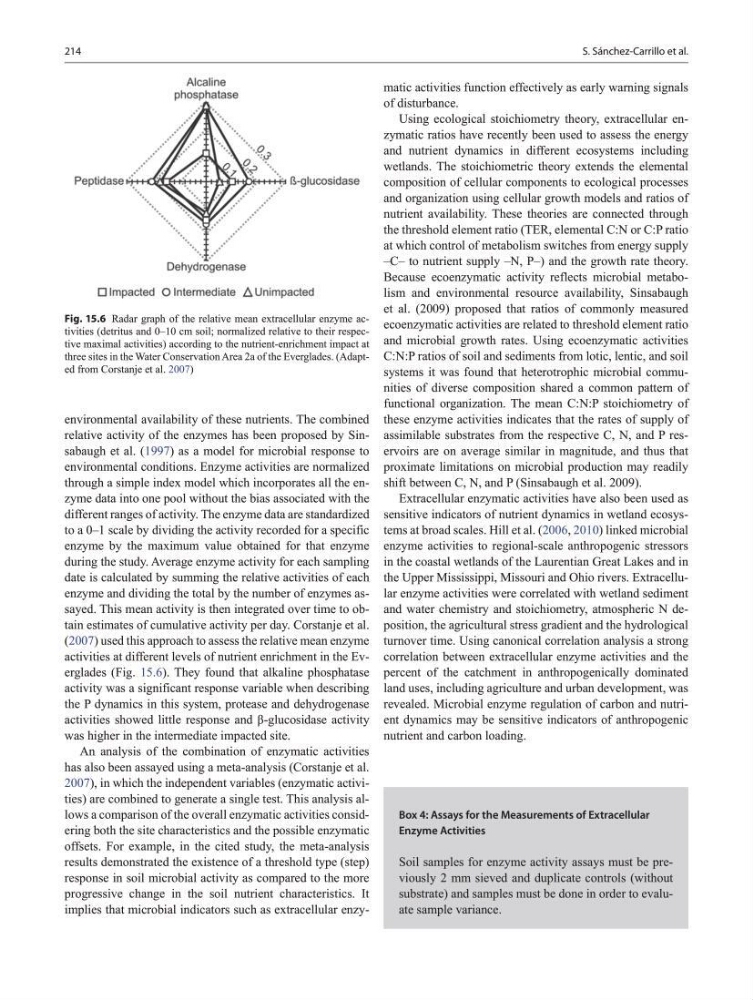
enzyme and dividing the total by the number of enzymes assayed. This mean activity is then integrated over time to obtain estimates of cumulative activity per day. Corstanje et al.
(2007) used this approach to assess the relative mean enzyme
activities at different levels of nutrient enrichment in the Everglades (Fig. 15.6). They found that alkaline phosphatase
activity was a significant response variable when describing
the P dynamics in this system, protease and dehydrogenase
activities showed little response and β-glucosidase activity
was higher in the intermediate impacted site.
An analysis of the combination of enzymatic activities
has also been assayed using a meta-analysis (Corstanje et al.
2007), in which the independent variables (enzymatic activities) are combined to generate a single test. This analysis allows a comparison of the overall enzymatic activities considering both the site characteristics and the possible enzymatic
offsets. For example, in the cited study, the meta-analysis
results demonstrated the existence of a threshold type (step)
response in soil microbial activity as compared to the more
progressive change in the soil nutrient characteristics. It
implies that microbial indicators such as extracellular enzymatic activities function effectively as early warning signals
of disturbance.
Using ecological stoichiometry theory, extracellular enzymatic ratios have recently been used to assess the energy
and nutrient dynamics in different ecosystems including
wetlands. The stoichiometric theory extends the elemental
composition of cellular components to ecological processes
and organization using cellular growth models and ratios of
nutrient availability. These theories are connected through
the threshold element ratio (TER, elemental C:N or C:P ratio
at which control of metabolism switches from energy supply
–C– to nutrient supply –N, P–) and the growth rate theory.
Because ecoenzymatic activity reflects microbial metabolism and environmental resource availability, Sinsabaugh
et al. (2009) proposed that ratios of commonly measured
ecoenzymatic activities are related to threshold element ratio
and microbial growth rates. Using ecoenzymatic activities
C:N:P ratios of soil and sediments from lotic, lentic, and soil
systems it was found that heterotrophic microbial communities of diverse composition shared a common pattern of
functional organization. The mean C:N:P stoichiometry of
these enzyme activities indicates that the rates of supply of
assimilable substrates from the respective C, N, and P reservoirs are on average similar in magnitude, and thus that
proximate limitations on microbial production may readily
shift between C, N, and P (Sinsabaugh et al. 2009).
Extracellular enzymatic activities have also been used as
sensitive indicators of nutrient dynamics in wetland ecosystems at broad scales. Hill et al. (2006, 2010) linked microbial
enzyme activities to regional-scale anthropogenic stressors
in the coastal wetlands of the Laurentian Great Lakes and in
the Upper Mississippi, Missouri and Ohio rivers. Extracellular enzyme activities were correlated with wetland sediment
and water chemistry and stoichiometry, atmospheric N deposition, the agricultural stress gradient and the hydrological
turnover time. Using canonical correlation analysis a strong
correlation between extracellular enzyme activities and the
percent of the catchment in anthropogenically dominated
land uses, including agriculture and urban development, was
revealed. Microbial enzyme regulation of carbon and nutrient dynamics may be sensitive indicators of anthropogenic
nutrient and carbon loading.
Fig. 15.6 Radar graph of the relative mean extracellular enzyme activities (detritus and 0–10 cm soil; normalized relative to their respective maximal activities) according to the nutrient-enrichment impact at
three sites in the Water Conservation Area 2a of the Everglades. (Adapted from Corstanje et al. 2007)
Box 4: Assays for the Measurements of Extracellular
Enzyme Activities
Soil samples for enzyme activity assays must be previously 2 mm sieved and duplicate controls (without
substrate) and samples must be done in order to evaluate sample variance.
S. Sánchez-Carrillo et al.
environmental availability of these nutrients. The combined
relative activity of the enzymes has been proposed by Sinsabaugh et al. (1997) as a model for microbial response to
environmental conditions. Enzyme activities are normalized
through a simple index model which incorporates all the enzyme data into one pool without the bias associated with the
different ranges of activity. The enzyme data are standardized
to a 0–1 scale by dividing the activity recorded for a specific
enzyme by the maximum value obtained for that enzyme
during the study. Average enzyme activity for each sampling
date is calculated by summing the relative activities of each
enzyme and dividing the total by the number of enzymes assayed. This mean activity is then integrated over time to obtain estimates of cumulative activity per day. Corstanje et al.
(2007) used this approach to assess the relative mean enzyme
activities at different levels of nutrient enrichment in the Everglades (Fig. 15.6). They found that alkaline phosphatase
activity was a significant response variable when describing
the P dynamics in this system, protease and dehydrogenase
activities showed little response and β-glucosidase activity
was higher in the intermediate impacted site.
An analysis of the combination of enzymatic activities
has also been assayed using a meta-analysis (Corstanje et al.
2007), in which the independent variables (enzymatic activities) are combined to generate a single test. This analysis allows a comparison of the overall enzymatic activities considering both the site characteristics and the possible enzymatic
offsets. For example, in the cited study, the meta-analysis
results demonstrated the existence of a threshold type (step)
response in soil microbial activity as compared to the more
progressive change in the soil nutrient characteristics. It
implies that microbial indicators such as extracellular enzymatic activities function effectively as early warning signals
of disturbance.
Using ecological stoichiometry theory, extracellular enzymatic ratios have recently been used to assess the energy
and nutrient dynamics in different ecosystems including
wetlands. The stoichiometric theory extends the elemental
composition of cellular components to ecological processes
and organization using cellular growth models and ratios of
nutrient availability. These theories are connected through
the threshold element ratio (TER, elemental C:N or C:P ratio
at which control of metabolism switches from energy supply
–C– to nutrient supply –N, P–) and the growth rate theory.
Because ecoenzymatic activity reflects microbial metabolism and environmental resource availability, Sinsabaugh
et al. (2009) proposed that ratios of commonly measured
ecoenzymatic activities are related to threshold element ratio
and microbial growth rates. Using ecoenzymatic activities
C:N:P ratios of soil and sediments from lotic, lentic, and soil
systems it was found that heterotrophic microbial communities of diverse composition shared a common pattern of
functional organization. The mean C:N:P stoichiometry of
these enzyme activities indicates that the rates of supply of
assimilable substrates from the respective C, N, and P reservoirs are on average similar in magnitude, and thus that
proximate limitations on microbial production may readily
shift between C, N, and P (Sinsabaugh et al. 2009).
Extracellular enzymatic activities have also been used as
sensitive indicators of nutrient dynamics in wetland ecosystems at broad scales. Hill et al. (2006, 2010) linked microbial
enzyme activities to regional-scale anthropogenic stressors
in the coastal wetlands of the Laurentian Great Lakes and in
the Upper Mississippi, Missouri and Ohio rivers. Extracellular enzyme activities were correlated with wetland sediment
and water chemistry and stoichiometry, atmospheric N deposition, the agricultural stress gradient and the hydrological
turnover time. Using canonical correlation analysis a strong
correlation between extracellular enzyme activities and the
percent of the catchment in anthropogenically dominated
land uses, including agriculture and urban development, was
revealed. Microbial enzyme regulation of carbon and nutrient dynamics may be sensitive indicators of anthropogenic
nutrient and carbon loading.
Fig. 15.6 Radar graph of the relative mean extracellular enzyme activities (detritus and 0–10 cm soil; normalized relative to their respective maximal activities) according to the nutrient-enrichment impact at
three sites in the Water Conservation Area 2a of the Everglades. (Adapted from Corstanje et al. 2007)
Box 4: Assays for the Measurements of Extracellular
Enzyme Activities
Soil samples for enzyme activity assays must be previously 2 mm sieved and duplicate controls (without
substrate) and samples must be done in order to evaluate sample variance.