

212
S. Sánchez-Carrillo et al.
diffusion to the sites where enzymes are present (Reddy and
DeLaune 2008). The synthesis of enzymes is regulated by
the presence or absence of the readily available substrates.
Presumably, the production of enzymes is relatively expensive at the cellular level, resulting in a hydrolytic activity that
reflects the relative need of the microbial communities (Sinsabaugh et al. 1997). If production of extracellular enzymes
is maximized in terms of resource allocation by the microbial communities, the relative activity of N and P-acquiring
enzymes relative to the permanent C requirement is an indication of the levels of N or P limitation that these microbial
communities experience in that particular environment (Sinsabaugh and Moorhead 1994).
Several enzymes are known to be involved in the cycling
of nutrients and can be used as potential indicators of nutrient cycling processes in wetlands. Glucosidase catalyzes
the hydrolysis of glycosides, resulting in the release of a
β-linked monosaccharide (Eivazi and Tabatabai 1990). Phenol oxidase mediates the breakdown of lignin-containing
compounds and depends on oxygen availability (McLatchey
and Reddy 1998). Cellulose and lignin-degrading enzyme
activities have been correlated with degradation rates of
detritus (Sinsabaugh 1994; McLatchey and Reddy 1998).
Phosphatase activity plays an important role in the regeneration of inorganic P through its catalysis of the breakdown of
organic P esters to inorganic P (Chróst 1991). Phosphatase is
often repressed by high dissolved reactive P concentrations
in a process referred to as feedback inhibition (Chróst 1991;
Wright and Reddy 2001). Protease enzymes are important
in the wetland N cycle and function in the breakdown of
proteins, resulting in the release of NH 4 -N (Ladd and Butler
1972). Arylsulfatase enzymes catalyze the hydrolysis of sulfate esters resulting in the release of SO 4
2− , being important
to S cycling processes in wetland soils (Tabatabai and Bremner 1970). Finally, dehydrogenase enzyme activity is used
as a measurement of the overall biological activity in soils
(Trevors et al. 1982).
While decomposition rates have been strongly correlated
with the activity of lignocellulose degrading enzymes (Sinsabaugh et al. 1992), the enzymes involved in the other macronutrient (N, P, S) cycles are now receiving increasing attention. The activity of these extracellular enzymes is affected
to some degree by the nutrient loading because bioavailable
nutrients can potentially decrease their activity (Newman
and Reddy 1993). Therefore, measurements of extracellular
enzyme activities can be useful as an early warning indicator
of the impacts of nutrient enrichment in wetlands (Newman
et al. 2003). Phosphatase enzymes are known to be release
by microorganisms in response to a decrease in the internal
P pool; therefore it is possible to expect their inhibition in
response to P enrichment (Jansson et al. 1988). Inverse relationships between soil total P and alkaline phosphatase activity have been found in wetlands (Cotner and Wetzel 1991;
Newman and Reddy 1993; McLatchey and Reddy 1998;
Wright and Reddy 2001; Newman et al. 2003; Corstanje and
Reddy 2006; Hill et al. 2006; Corstanje et al. 2007) as well in
other aquatic systems (Cotner and Wetzel 1991; Nausch and
Nausch 2000; Shackle et al. 2000). The nutrient enrichment
mesocosm-scale study performed by Corstanje and Reddy
(2006) during 18 months using organic peat soil planted with
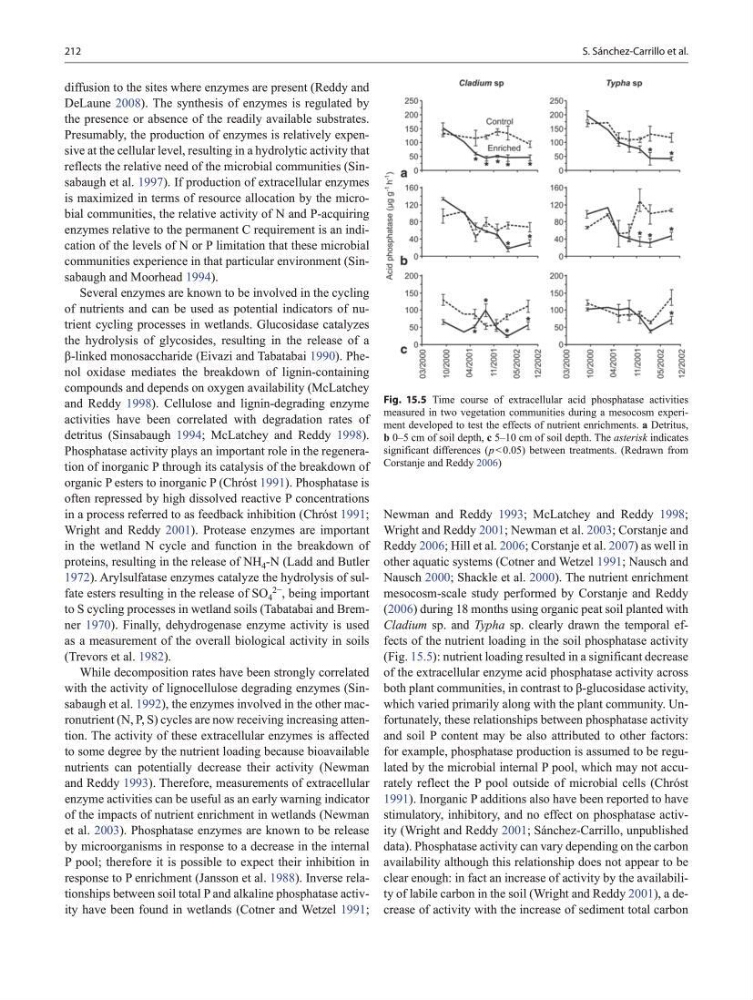
Cladium sp. and Typha sp. clearly drawn the temporal effects of the nutrient loading in the soil phosphatase activity
(Fig. 15.5): nutrient loading resulted in a significant decrease
of the extracellular enzyme acid phosphatase activity across
both plant communities, in contrast to β-glucosidase activity,
which varied primarily along with the plant community. Unfortunately, these relationships between phosphatase activity
and soil P content may be also attributed to other factors:
for example, phosphatase production is assumed to be regulated by the microbial internal P pool, which may not accurately reflect the P pool outside of microbial cells (Chróst
1991). Inorganic P additions also have been reported to have
stimulatory, inhibitory, and no effect on phosphatase activity (Wright and Reddy 2001; Sánchez-Carrillo, unpublished
data). Phosphatase activity can vary depending on the carbon
availability although this relationship does not appear to be
clear enough: in fact an increase of activity by the availability of labile carbon in the soil (Wright and Reddy 2001), a decrease of activity with the increase of sediment total carbon
Fig. 15.5 Time course of extracellular acid phosphatase activities
measured in two vegetation communities during a mesocosm experiment developed to test the effects of nutrient enrichments. a Detritus,
b 0–5 cm of soil depth, c 5–10 cm of soil depth. The asterisk indicates
significant differences ( p < 0.05) between treatments. (Redrawn from
Corstanje and Reddy 2006)
S. Sánchez-Carrillo et al.
diffusion to the sites where enzymes are present (Reddy and
DeLaune 2008). The synthesis of enzymes is regulated by
the presence or absence of the readily available substrates.
Presumably, the production of enzymes is relatively expensive at the cellular level, resulting in a hydrolytic activity that
reflects the relative need of the microbial communities (Sinsabaugh et al. 1997). If production of extracellular enzymes
is maximized in terms of resource allocation by the microbial communities, the relative activity of N and P-acquiring
enzymes relative to the permanent C requirement is an indication of the levels of N or P limitation that these microbial
communities experience in that particular environment (Sinsabaugh and Moorhead 1994).
Several enzymes are known to be involved in the cycling
of nutrients and can be used as potential indicators of nutrient cycling processes in wetlands. Glucosidase catalyzes
the hydrolysis of glycosides, resulting in the release of a
β-linked monosaccharide (Eivazi and Tabatabai 1990). Phenol oxidase mediates the breakdown of lignin-containing
compounds and depends on oxygen availability (McLatchey
and Reddy 1998). Cellulose and lignin-degrading enzyme
activities have been correlated with degradation rates of
detritus (Sinsabaugh 1994; McLatchey and Reddy 1998).
Phosphatase activity plays an important role in the regeneration of inorganic P through its catalysis of the breakdown of
organic P esters to inorganic P (Chróst 1991). Phosphatase is
often repressed by high dissolved reactive P concentrations
in a process referred to as feedback inhibition (Chróst 1991;
Wright and Reddy 2001). Protease enzymes are important
in the wetland N cycle and function in the breakdown of
proteins, resulting in the release of NH 4 -N (Ladd and Butler
1972). Arylsulfatase enzymes catalyze the hydrolysis of sulfate esters resulting in the release of SO 4
2− , being important
to S cycling processes in wetland soils (Tabatabai and Bremner 1970). Finally, dehydrogenase enzyme activity is used
as a measurement of the overall biological activity in soils
(Trevors et al. 1982).
While decomposition rates have been strongly correlated
with the activity of lignocellulose degrading enzymes (Sinsabaugh et al. 1992), the enzymes involved in the other macronutrient (N, P, S) cycles are now receiving increasing attention. The activity of these extracellular enzymes is affected
to some degree by the nutrient loading because bioavailable
nutrients can potentially decrease their activity (Newman
and Reddy 1993). Therefore, measurements of extracellular
enzyme activities can be useful as an early warning indicator
of the impacts of nutrient enrichment in wetlands (Newman
et al. 2003). Phosphatase enzymes are known to be release
by microorganisms in response to a decrease in the internal
P pool; therefore it is possible to expect their inhibition in
response to P enrichment (Jansson et al. 1988). Inverse relationships between soil total P and alkaline phosphatase activity have been found in wetlands (Cotner and Wetzel 1991;
Newman and Reddy 1993; McLatchey and Reddy 1998;
Wright and Reddy 2001; Newman et al. 2003; Corstanje and
Reddy 2006; Hill et al. 2006; Corstanje et al. 2007) as well in
other aquatic systems (Cotner and Wetzel 1991; Nausch and
Nausch 2000; Shackle et al. 2000). The nutrient enrichment
mesocosm-scale study performed by Corstanje and Reddy
(2006) during 18 months using organic peat soil planted with
Cladium sp. and Typha sp. clearly drawn the temporal effects of the nutrient loading in the soil phosphatase activity
(Fig. 15.5): nutrient loading resulted in a significant decrease
of the extracellular enzyme acid phosphatase activity across
both plant communities, in contrast to β-glucosidase activity,
which varied primarily along with the plant community. Unfortunately, these relationships between phosphatase activity
and soil P content may be also attributed to other factors:
for example, phosphatase production is assumed to be regulated by the microbial internal P pool, which may not accurately reflect the P pool outside of microbial cells (Chróst
1991). Inorganic P additions also have been reported to have
stimulatory, inhibitory, and no effect on phosphatase activity (Wright and Reddy 2001; Sánchez-Carrillo, unpublished
data). Phosphatase activity can vary depending on the carbon
availability although this relationship does not appear to be
clear enough: in fact an increase of activity by the availability of labile carbon in the soil (Wright and Reddy 2001), a decrease of activity with the increase of sediment total carbon
Fig. 15.5 Time course of extracellular acid phosphatase activities
measured in two vegetation communities during a mesocosm experiment developed to test the effects of nutrient enrichments. a Detritus,
b 0–5 cm of soil depth, c 5–10 cm of soil depth. The asterisk indicates
significant differences ( p < 0.05) between treatments. (Redrawn from
Corstanje and Reddy 2006)