

211
15 Biogeochemical Indicators of Nutrient Enrichments in Wetlands …
Box 3: Incubations for Assays of Potential
Mineralization
Potential mineralizable nitrogen and phosphorus
(PMN and PMP) are measured using 10-day anaerobic
incubations respectively. Equivalent of 10 g (PMN)
or 0.5 g (PMP) dry weight soil samples are placed in
50 mL serum bottles and mixed with 5 mL of distilled
deionized water. Bottles are capped with butyl rubber
stoppers and sealed with aluminum crimps. The headspace is evacuated and replaced with 99.99 % O 2 -free
N 2 gas. The samples are subsequently incubated in
the dark at 40 °C for 10 days, after which, 30 mL of
0.5 M K 2 SO 4 (PMN) or 20 mL of 1.0 M HCl (PMP)
are injected into the serum bottle and after shaken for
1–3 h on a longitudinal shaker and centrifuged for
10 min at 4,000 g. The supernatant is extracted and
filtered (0.45 µm) and the filtrate stored at 4 °C until
analysis. A second set of samples of equivalent weights
(controls of PMN and PMP reported as starting total N
and P) is directly extracted with 35 mL of 0.5 M K 2 SO 4
(PMN) and 25 mL of 1.0 M HCl (PMP) as described
previously. PMN extractions are finally analyzed for
NH 4 -N through total Kjeldahl nitrogen procedure.
HCl extract for PMP is analyzed by the ascorbic acid.
The difference in K 2 SO 4 and HCl–extractable N and
P over the 10-day incubation period constitutes PMN
(mg N kg
−1
d
−1
) and PMP (mg N kg
−1
d
−1
).
Substrate-induced N mineralization can be assessed
over short time periods (h) by adding simple substrates
as amino acids. The basic setup for this assay is similar
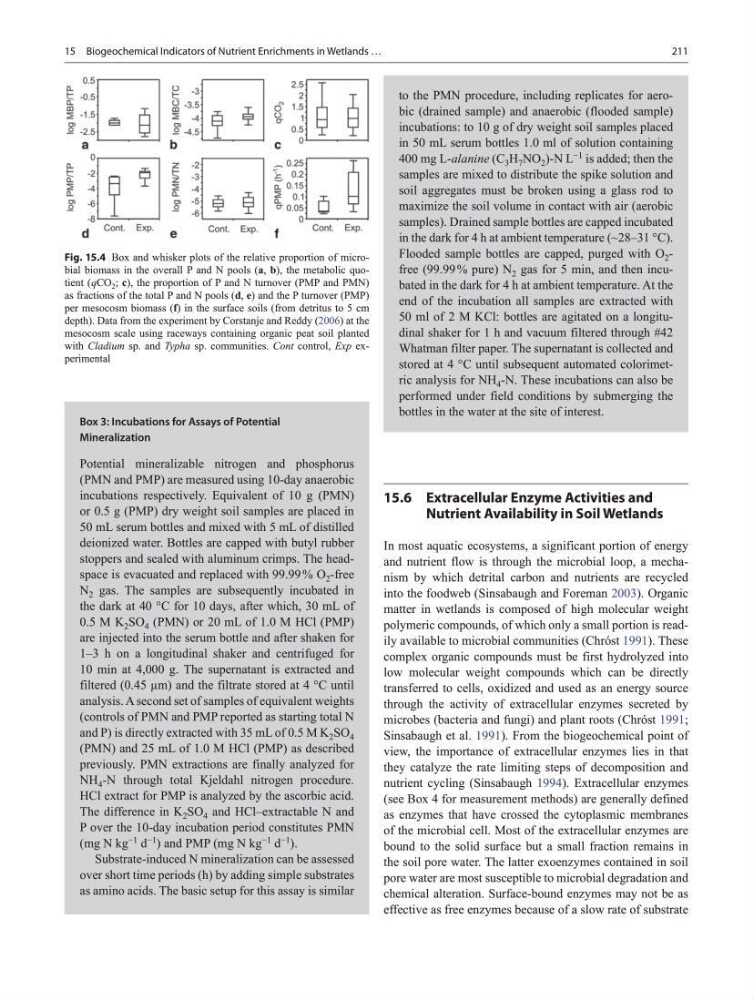
Fig. 15.4 Box and whisker plots of the relative proportion of microbial biomass in the overall P and N pools (a, b), the metabolic quotient ( qCO 2 ; c), the proportion of P and N turnover (PMP and PMN)
as fractions of the total P and N pools (d, e) and the P turnover (PMP)
per mesocosm biomass (f) in the surface soils (from detritus to 5 cm
depth). Data from the experiment by Corstanje and Reddy (2006) at the
mesocosm scale using raceways containing organic peat soil planted
with Cladium sp. and Typha sp. communities. Cont control, Exp experimental
to the PMN procedure, including replicates for aerobic (drained sample) and anaerobic (flooded sample)
incubations: to 10 g of dry weight soil samples placed
in 50 mL serum bottles 1.0 ml of solution containing
400 mg L-alanine (C 3 H 7 NO 2 )-N L
−1
is added; then the
samples are mixed to distribute the spike solution and
soil aggregates must be broken using a glass rod to
maximize the soil volume in contact with air (aerobic
samples). Drained sample bottles are capped incubated
in the dark for 4 h at ambient temperature (~28–31 °C).
Flooded sample bottles are capped, purged with O 2 -
free (99.99 % pure) N 2 gas for 5 min, and then incubated in the dark for 4 h at ambient temperature. At the
end of the incubation all samples are extracted with
50 ml of 2 M KCl: bottles are agitated on a longitudinal shaker for 1 h and vacuum filtered through #42
Whatman filter paper. The supernatant is collected and
stored at 4 °C until subsequent automated colorimetric analysis for NH 4 -N. These incubations can also be
performed under field conditions by submerging the
bottles in the water at the site of interest.
15.6 Extracellular Enzyme Activities and
Nutrient Availability in Soil Wetlands
In most aquatic ecosystems, a significant portion of energy
and nutrient flow is through the microbial loop, a mechanism by which detrital carbon and nutrients are recycled
into the foodweb (Sinsabaugh and Foreman 2003). Organic
matter in wetlands is composed of high molecular weight
polymeric compounds, of which only a small portion is readily available to microbial communities (Chróst 1991). These
complex organic compounds must be first hydrolyzed into
low molecular weight compounds which can be directly
transferred to cells, oxidized and used as an energy source
through the activity of extracellular enzymes secreted by
microbes (bacteria and fungi) and plant roots (Chróst 1991;
Sinsabaugh et al. 1991). From the biogeochemical point of
view, the importance of extracellular enzymes lies in that
they catalyze the rate limiting steps of decomposition and
nutrient cycling (Sinsabaugh 1994). Extracellular enzymes
(see Box 4 for measurement methods) are generally defined
as enzymes that have crossed the cytoplasmic membranes
of the microbial cell. Most of the extracellular enzymes are
bound to the solid surface but a small fraction remains in
the soil pore water. The latter exoenzymes contained in soil
pore water are most susceptible to microbial degradation and
chemical alteration. Surface-bound enzymes may not be as
effective as free enzymes because of a slow rate of substrate
15 Biogeochemical Indicators of Nutrient Enrichments in Wetlands …
Box 3: Incubations for Assays of Potential
Mineralization
Potential mineralizable nitrogen and phosphorus
(PMN and PMP) are measured using 10-day anaerobic
incubations respectively. Equivalent of 10 g (PMN)
or 0.5 g (PMP) dry weight soil samples are placed in
50 mL serum bottles and mixed with 5 mL of distilled
deionized water. Bottles are capped with butyl rubber
stoppers and sealed with aluminum crimps. The headspace is evacuated and replaced with 99.99 % O 2 -free
N 2 gas. The samples are subsequently incubated in
the dark at 40 °C for 10 days, after which, 30 mL of
0.5 M K 2 SO 4 (PMN) or 20 mL of 1.0 M HCl (PMP)
are injected into the serum bottle and after shaken for
1–3 h on a longitudinal shaker and centrifuged for
10 min at 4,000 g. The supernatant is extracted and
filtered (0.45 µm) and the filtrate stored at 4 °C until
analysis. A second set of samples of equivalent weights
(controls of PMN and PMP reported as starting total N
and P) is directly extracted with 35 mL of 0.5 M K 2 SO 4
(PMN) and 25 mL of 1.0 M HCl (PMP) as described
previously. PMN extractions are finally analyzed for
NH 4 -N through total Kjeldahl nitrogen procedure.
HCl extract for PMP is analyzed by the ascorbic acid.
The difference in K 2 SO 4 and HCl–extractable N and
P over the 10-day incubation period constitutes PMN
(mg N kg
−1
d
−1
) and PMP (mg N kg
−1
d
−1
).
Substrate-induced N mineralization can be assessed
over short time periods (h) by adding simple substrates
as amino acids. The basic setup for this assay is similar
Fig. 15.4 Box and whisker plots of the relative proportion of microbial biomass in the overall P and N pools (a, b), the metabolic quotient ( qCO 2 ; c), the proportion of P and N turnover (PMP and PMN)
as fractions of the total P and N pools (d, e) and the P turnover (PMP)
per mesocosm biomass (f) in the surface soils (from detritus to 5 cm
depth). Data from the experiment by Corstanje and Reddy (2006) at the
mesocosm scale using raceways containing organic peat soil planted
with Cladium sp. and Typha sp. communities. Cont control, Exp experimental
to the PMN procedure, including replicates for aerobic (drained sample) and anaerobic (flooded sample)
incubations: to 10 g of dry weight soil samples placed
in 50 mL serum bottles 1.0 ml of solution containing
400 mg L-alanine (C 3 H 7 NO 2 )-N L
−1
is added; then the
samples are mixed to distribute the spike solution and
soil aggregates must be broken using a glass rod to
maximize the soil volume in contact with air (aerobic
samples). Drained sample bottles are capped incubated
in the dark for 4 h at ambient temperature (~28–31 °C).
Flooded sample bottles are capped, purged with O 2 -
free (99.99 % pure) N 2 gas for 5 min, and then incubated in the dark for 4 h at ambient temperature. At the
end of the incubation all samples are extracted with
50 ml of 2 M KCl: bottles are agitated on a longitudinal shaker for 1 h and vacuum filtered through #42
Whatman filter paper. The supernatant is collected and
stored at 4 °C until subsequent automated colorimetric analysis for NH 4 -N. These incubations can also be
performed under field conditions by submerging the
bottles in the water at the site of interest.
15.6 Extracellular Enzyme Activities and
Nutrient Availability in Soil Wetlands
In most aquatic ecosystems, a significant portion of energy
and nutrient flow is through the microbial loop, a mechanism by which detrital carbon and nutrients are recycled
into the foodweb (Sinsabaugh and Foreman 2003). Organic
matter in wetlands is composed of high molecular weight
polymeric compounds, of which only a small portion is readily available to microbial communities (Chróst 1991). These
complex organic compounds must be first hydrolyzed into
low molecular weight compounds which can be directly
transferred to cells, oxidized and used as an energy source
through the activity of extracellular enzymes secreted by
microbes (bacteria and fungi) and plant roots (Chróst 1991;
Sinsabaugh et al. 1991). From the biogeochemical point of
view, the importance of extracellular enzymes lies in that
they catalyze the rate limiting steps of decomposition and
nutrient cycling (Sinsabaugh 1994). Extracellular enzymes
(see Box 4 for measurement methods) are generally defined
as enzymes that have crossed the cytoplasmic membranes
of the microbial cell. Most of the extracellular enzymes are
bound to the solid surface but a small fraction remains in
the soil pore water. The latter exoenzymes contained in soil
pore water are most susceptible to microbial degradation and
chemical alteration. Surface-bound enzymes may not be as
effective as free enzymes because of a slow rate of substrate